NASA detects huge carbon monoxide plume from Amazon rainforests

Carbon monoxide is a pollutant that can persist in the atmosphere for about a month and has implications for both air pollution and climate change

nasaImage: NASA/JPL-Caltech

NASA has detected a giant plume of carbon monoxide from fires in the Amazon rainforest.

New data from its Atmospheric Infrared Sounder (AIRS) technology, aboard the Aqua satellite, shows movement in the atmosphere of carbon monoxide associated with fires in the Amazon region of Brazil from 8th August to 22nd August 2019.

Fires have been raging across the world’s largest tropical rainforest, one of the most important carbon sinks.

Carbon monoxide is a pollutant that can be transported large distances and persist in the atmosphere for about a month and has implications both for air pollution and climate change.

NASA’s time series maps carbon monoxide at an altitude of 18,000 feet and shows the plume growing in the northwest Amazon region, before drifting in a “more concentrated plume” towards the southeastern part of the country.

It says while the gas has little effect on the air people breathe at the high altitude mapped in the images, strong winds can carry it downward to where it can significantly impact air quality.

Green in the image indicates concentrations of carbon monoxide at approximately 100 parts per billion by volume (ppbv), yellow at around 120ppbv and dark red at 160ppbv but NASA notes the local values can be significantly higher.

Prime Minister Boris Johnson has pledged to provide £10 million towards helping the Amazon rainforest following the recent surge in fires.

via NASA detects huge carbon monoxide plume from Amazon rainforests – Energy Live News

Posted in Air Quality, Latin America, World News | Tagged , , , , , | Leave a comment

Pollutionwatch: how LA beat the ‘blight on the land of sunshine’

Decades before a Greenpeace warning on smog in Asia, LA found a novel way to tackle the problem

Many Asian cities are facing new air pollution challenges and are struggling to stem smog emergencies. According to a recent study by Greenpeace, 22 of the world’s 30 most polluted cities are in India.

In 1954, Los Angeles became one of the first cities to address smog, described by one local newspaper as a “blight on the land of sunshine”. Fearing an event similar to the Great Smog of London in 1952, which killed more than 4,000 people, authorities in the Californian city devised an emergency plan.

While modern-day air pollution warnings in the UK advise vulnerable people to protect themselves, decades earlier LA installed a system to quickly shut local pollution sources if one of its frequent eye-stinging smogs spiralled out of control.

Monitoring stations were constructed and, in an age before the internet, scientists telephoned their results to a control centre every hour. Alerts were then sent through teleprinters in the sheriff’s office, as well as press wires and dedicated radios in the city’s factories.

The new Sigalert system was employed too, which left a recorded message in each radio and television station and, just like the Batphone, activated a light and buzzer to notify broadcasters to interrupt programming. Meanwhile, industries would lower boilers and activate carpooling schemes, while residents were asked to drive less and stop burning rubbish. Nightly weather forecasts used a red/green smog warning system, leading to the myth that LA had multicoloured smog.

via Pollutionwatch: how LA beat the ‘blight on the land of sunshine’ | Environment | The Guardian

Posted in Air Quality, USA, USA & Canada | Tagged , , , | Leave a comment

Amazon fires generate smoke cloud almost as big as devastating Siberia blaze

While fires in Siberia have created a cloud of smoke larger than the European Union, on the other side of the world, forest blazes in the Amazon are causing a phenomenon of almost the same magnitude.

Santiago Gassó, a researcher at NASA’s Goddard center, warned on his Twitter account on Tuesday that the surface of Latin America covered by the smoke layer was about 3.2 million square kilometers.

That compares to the area of ​​smoke caused by fires in Siberia (7 million square kilometers) and the area of the EU (4,476 million square kilometers).

Scientists point out that these extensive layers of smoke affect the local weather.

Gassó explained that smoke “not only prevents solar energy from reaching the earth”, but also inhibits the formation of clouds.

A study published in Science in 2004 demonstrated the effect between urban air pollution and smoke from fires in reducing cloud formation, which results in warming of the atmosphere and cooling of the surface.

“Smoke over clouds can be particularly important when you think about the weather,” Finnish Meteorological Institute researcher Antti Lipponen explained to Euronews. “The smoke absorbs solar radiation that would otherwise be reflected back into space by clouds, but now some of the radiation is not reflected due to smoke.”

The Brazilian state of Amazonas declared a state of emergency last week due to the increasing number of fires in the region.

Fires in the Rondonia nature reserve, bordering the Amazon, have been active for more than 15 days.

“The fire has exceeded the limits of the unit and reaches the neighboring pastures, endangering the survival of the animals and compromising the health of the farmers,” says Brazil news portal EBC.

via Amazon fires generate smoke cloud almost as big as devastating Siberia blaze | Euronews

Posted in Air Quality, Latin America | Tagged , , , | Leave a comment

Smoke from blazes led to major air pollution in Athens

The high concentrations of airborne microparticles in the atmosphere of the Greek capital due to the large wildfire that raged across the island of Evia had dropped Wednesday from the levels observed on Tuesday, according to the director of the Institute for Environmental and Sustainable Development Research, Nikos Michalopoulos.

Speaking to the Athens-Macedonian News Agency (ANA-MPA) on Wednesday, Michalopoulos said that Tuesday was “a difficult day” with high concentrations of airborne particles almost everywhere in the Attica basin.

“Today, the situation is much better. There is a clear improvement. Levels are down by about 50 percent,” he said.

Michalopoulos added however that levels of airborne microparticles remain relatively high. Before the Evia fire started, concentrations were at 15-20 micrograms per cubic meters, but that figure had jumped to 80-90 mg/m3 by Tuesday noon.

“Today levels are clearly lower, at 30-40 mg/m3. Levels on Tuesday were four to five times higher than usual for August and they they are now twice as high.”

via Smoke from blazes led to major air pollution in Athens | News | ekathimerini.com

Posted in Air Quality, Europe | Tagged , , , , | Leave a comment

Microplastics ‘significantly contaminating the air’, scientists warn

Abundant levels of microplastic pollution have been found in snow from the Arctic to the Alps, according to a study that has prompted scientists to warn of significant contamination of the atmosphere and demand urgent research into the potential health impacts on people.

Snow captures particles from the air as it falls and samples from ice floes on the ocean between Greenland and Svalbard contained an average of 1,760 microplastic particles per litre, the research found. Even more – 24,600 per litre on average – were found at European locations. The work shows transport by winds is a key factor in microplastics contamination across the globe.

The scientists called for research on the effect of airborne microplastics on human health, pointing to an earlier study that found the particles in cancerous human lung tissue. In June, another study showed people eat at least 50,000 microplastic particles per year.

Many millions of tonnes of plastic are discarded into the environment every year and are broken down into small particles and fibres that do not biodegrade. These particles, known as microplastics, have now been found everywhere from high mountains to deep oceans and can carry toxic chemicals and harmful microbes.

The latest study was led by Dr Melanie Bergmann of the Alfred Wegener Institute for Polar and Marine Research in Germany. She said: “We really need research on the human health aspect. There are so many studies being published now on microplastics but nothing on human health, and that is really strange in my opinion.” Bergmann added that microplastics should be included in air pollutant monitoring schemes.

Bergmann had previously found 12,000 microplastic particles per litre in samples of Arctic sea ice: “So we asked where does it all come from?” Some is carried from populated regions by ocean currents, but analysis of snow samples shows much is blown by the wind.

“Microplastic concentrations in snow were very high, indicating significant contamination of the atmosphere,” concluded the study published in the journal Science Advances.

“It basically gets everywhere with the wind,” said Bergmann. Pollen and dust from the Sahara are already known to be blown over long distances. As well as the Arctic ice floes, the team’s 22 samples included snow from Svalbard, an island well north of the Arctic circle, the German and Swiss Alps and the city of Bremen.

The team found that the smallest particles were the most abundant, but their equipment could not detect particles smaller than 11 microns.

“I am convinced there are many more particles in the smaller size range beyond our detection limit,” said Bergmann. “The worry with smaller particles is they can be taken up by a greater range of organisms and, if they reach nano-scale, they could penetrate cell membranes and translocate into organs much more easily than the larger fraction.”

Microplastics from polymer-based protective coatings on vehicles, buildings and ships were the most common of those frequently found by the researchers, followed by rubber, polyethylene and polyamides including nylon.

The researchers cite a 1998 study as the only assessment of microplastic in human lungs. It found inhaled fibres were present in cancerous lung specimens and concluded: “These bioresistant and biopersistent plastic fibres are candidate agents contributing to the risk of lung cancer.”

The European commission’s chief scientific advisers said in a report in April: “The evidence [on the environmental and health risks of microplastics] provides grounds for genuine concern and for precaution to be exercised.”

Scientists not involved in the latest study expressed concern that supposedly pristine ecosystems such as the Arctic were contaminated.

“The work is very important because it strengthens the argument for much more stringent regulations on the plastics industry and forcing the governments of the world to address the issue of plastic pollution,” said Steve Allen, at the EcoLab research institute in France. “With [microplastics] pouring into our environment, it is highly likely we will only find out the safe levels after we have exceeded them.”

An earlier study published by Allen in April found significant microplastic quantities falling from the air in the Pyrenees, also implicating wind as a transport mechanism. The Bergmann-led research, however, is the first to look the contamination of snow.

Just two previous studies have looked at the presence of microplastics in the air, one in Paris, France, and another in Dongguan, China. Both found a steady fall of particles. Other recent research has found microplastics raining down on the Rockies in North America and in farmland soils near Shanghaiin China.

via Microplastics ‘significantly contaminating the air’, scientists warn | Environment | The Guardian

Posted in Air Quality, Health Effects of Air Pollution, World News | Tagged , , | 2 Comments

Air quality in Miri remains at hazardous level at on noon today

The air quality in Miri, Sarawak continues to be at hazardous  level as of noon today.

According to Malaysian Air Pollution Index (APIMS) data, an  Air Pollutant Index (API) reading of 361 was recorded at an air surveillance station located at the Miri Industrial Training Institute (ILP) while another station in Miri registered an unhealthy reading of 126.

At Sekolah Kebangsaan (SK) Kuala Baram 2, Miri the API reading dropped to very unhealthy level of 270 as compared to 307 as at 1pm yesterday.

Air quality in Sri Aman rose to very unhealthy level at 245 compared to the average API readings of between 101-200  yesterday.

An update of the haze situation across the country showed one area registered hazardous API reading, two areas registered very unhealthy level, one at unhealthy level while 63 areas recorded moderate API readings.

The Air Pollution Index (API) reading of 0-50 shows good air quality; 51-100 (moderate); 101-200 (unhealthy); 201-300 (very unhealthy) and over 300 (hazardous).

The public can refer to the Department of Environment (DOE) website or download the MyIPU smartphone app on ‘Google Play’ to get hourly API readings.

via Air quality in Miri remains at hazardous level at on noon today | Malaysia | Malay Mail

Posted in Air Quality, Asia, Indonesia, Malaysia | Tagged , , , , , | Leave a comment

Pollutant linked to climate change accelerates lung disease

A new multicenter study at Columbia University links long-term exposure to air pollution, especially ozone, to development of emphysema, a chronic lung disease.

In Brief

Long-term exposure to outdoor air pollutants, especially the pollutant ozone, accelerates the development of emphysema and age-related decline in lung function, even among people who have never smoked, according to a study published in the Journal of the American Medical Association.

The findings may help explain why emphysema is relatively common in nonsmokers.

Background

Chronic lower respiratory disease–a catchall term for emphysema, chronic obstructive pulmonary disease (COPD), chronic bronchitis, and asthma–is the fourth-leading cause of death in the U.S. and third-leading cause of death worldwide. Short-term exposure to air pollutants is a major risk factor for poor lung health. But the long-term effects of air pollutants on the lungs are not well understood.

Study Details

The study, the largest and longest of its kind, looked at whether exposures to four major pollutants–ground-level ozone, fine particulate matter (PM), nitrogen oxide, and black carbon–were associated with the development of emphysema, measured by CT scan, and decline in lung function, measured by spirometry. (Ground-level ozone harms human health, but ozone high in the atmosphere ozone protects against the sun’s harmful ultraviolet rays.)

The study included more than 7,000 adults (ages 45 to 84) living in Chicago, Los Angeles, Baltimore, St. Paul, New York City, and Winston-Salem, who were taking part in the Multi-Ethnic Study of Atherosclerosis Air Pollution (MESA Air) and MESA Lung studies. Participants were followed for a median of 10 years. Air pollutant levels were estimated at each participant’s home address.

What the Study Found

The researchers found that exposure to each of the pollutants at the beginning of the study was independently linked to the development of emphysema during the study period. The strongest association was seen with ozone. Only ozone, at baseline and during follow-up, was associated with a decline in lung function.

Ambient concentrations of fine particulates and nitrous oxide, but not ozone, decreased significantly over the study period.

“The increase in emphysema we observed was relatively large, similar to the lung damage caused by 29 pack-years of smoking and 3 years of aging,”said R. Graham Barr, MD, DrPH, the Hamilton Southworth Professor of Medicine and Epidemiology at Columbia University Irving Medical Center and a senior author of the paper. (One pack-year is equal to smoking a pack a day for a year.)

What the Study Means

“These findings matter since ground-level ozone levels are rising, and the amount of emphysema on CT scans predicts hospitalization from and deaths due to chronic lower respiratory disease,” says Barr.

“Ground-level ozone is produced when UV light reacts with pollutants from fossil fuels,” adds Barr. “This process is accelerated by heatwaves, so ground-level ozone will likely continue to increase unless additional steps are taken to reduce fossil fuel emissions and curb climate change. But it’s not clear what level of ozone, if any, is safe for human health.”

via Pollutant linked to climate change accelerates lung disease | EurekAlert! Science News

Posted in Health Effects of Air Pollution, Medical Studies | Tagged , , , , , | Leave a comment

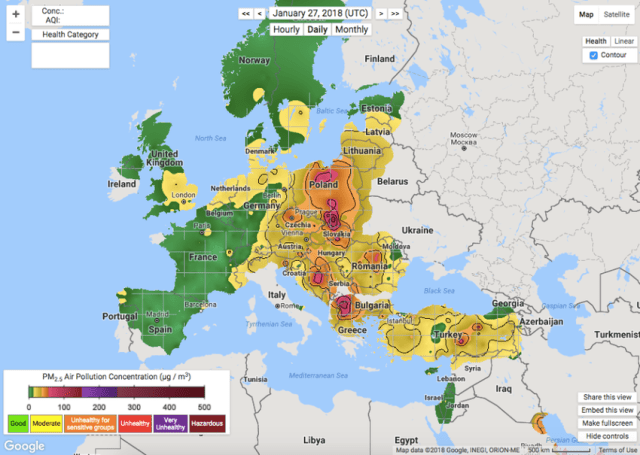
The average person in Europe loses two years of their life due to air pollution

The average person living in Europe loses two years of their life to the health effects of breathing polluted air, according to a report published in the European Heart Journal on March 12.

The report also estimates about 800,000 people die prematurely in Europe per year due to air pollution, or roughly 17% of the 5 million deaths in Europe annually. Many of those deaths, between 40 and 80% of the total, are due to air pollution effects that have nothing to do with the respiratory system but rather are attributable to heart disease and strokes caused by air pollutants in the bloodstream, the researchers write.

“Chronic exposure to enhanced levels of fine particle matter impairs vascular function, which can lead to myocardial infarction, arterial hypertension, stroke, and heart failure,” the researchers write.

Their estimate more than doubles the World Health Organization’s previous estimate of early deaths due to air pollution.

large_QK308mbVilKidP7NpGXaetE8Ty4s0f86G2B9sIRDszQ.png

“To put this into perspective, this means that air pollution causes more extra deaths a year than tobacco smoking,” Thomas Münzel, a cardiologist in Mainz, Germany, and one of the authors of the study, told the Guardian. “Smoking is avoidable but air pollution is not.”

The researchers note that the air pollution, which is caused by burning fossil fuels, could be quickly alleviated by switching to clean and renewable energy sources. That switch would “substantially reduce the loss of life expectancy from air pollution,” they write.

Previous reports estimated that air pollution takes one year off the average global lifespan, and that lowering it just enough to match levels recommended by the World Health Organization would be the equivalent of globally eradicating breast and lung cancer in terms of life spans. Air pollution has been spiking globally, rising 8% in just the last five years alone.

India has the highest levels of small particulate-matter pollution (PM2.5) globally, according to the WHO, and is home to 16 of the 30 most-polluted cities in the world. A Lancet report from 2018 found that air pollution in India causes about 1.2 million early deaths a year.

While India is the most-polluted nation, Europeans are exposed to more air pollution than the global average. But exposure isn’t distributed evenly across the continent. Previous research has demonstrated that Eastern European countries produce far more air pollution than those in Western Europe, due to more reliance on coal-fired power plants to generate electricity, higher use of wood and coal stoves for heating, and fewer pollution-mitigation policies overall. An iron curtain of dangerous air effectively divides Europe.

A report published in October found that air pollution could save Europe up to $775 billion by 2025, by saving on health costs and the economic damage of premature deaths, but also by increasing tourism and real estate values in places currently devalued due to dirty air.

via The average person in Europe loses two years of their life due to air pollution | World Economic Forum

Posted in Air Quality, Europe, Health Effects of Air Pollution, Medical Studies, World News | Tagged , , , , , , , , | Leave a comment