Air pollution particles found on foetal side of placentas – study

Research finds black carbon breathed by mothers can cross into unborn children

Air pollution particles have been found on the foetal side of placentas, indicating that unborn babies are directly exposed to the black carbon produced by motor traffic and fuel burning.

The research is the first study to show the placental barrier can be penetrated by particles breathed in by the mother. It found thousands of the tiny particles per cubic millimetre of tissue in every placenta analysed.

The link between exposure to dirty air and increased miscarriages, premature births and low birth weights is well established. The research suggests the particles themselves may be the cause, not solely the inflammatory response the pollution produces in mothers.

Damage to foetuses has lifelong consequences and Prof Tim Nawrot at Hasselt University in Belgium, who led the study, said: “This is the most vulnerable period of life. All the organ systems are in development. For the protection of future generations, we have to reduce exposure.” He said governments had the responsibility of cutting air pollution but that people should avoid busy roads when possible.

A comprehensive global review concluded that air pollution may be damaging every organ and virtually every cell in the human body. Nanoparticles have also been found to cross the blood-brain barrier and billions have been found in the hearts of young city dwellers.

While air pollution is reducing in some nations, the evidence of harm caused by even low levels is rapidly increasing and 90% of the world’s population live in places where air pollution is above World Health Organization (WHO) guidelines.

The research, published in the journal Nature Communications, examined 25 placentas from non-smoking women in the town of Hasselt. It has particle pollution levels well below the EU limit, although above the WHO limit. Researchers used a laser technique to detect the black carbon particles, which have a unique light fingerprint.

In each case, they found nanoparticles on the foetal side of the placenta and the number correlated with air pollution levels experienced by the mothers. There was an average of 20,000 nanoparticles per cubic millimetre in the placentas of mothers who lived near main roads. For those further away, the average was 10,000 per cubic millimetre.

They also examined placentas from miscarriages and found the particles were present even in 12-week-old foetuses. The first report of possible pollution particles in placentas was presented at a conference in September 2018, though the composition of the particles had not been confirmed.

The detection of the particles on the foetal side of the placental barrier means it was very likely the foetuses were exposed, Nawrot said. Work to analyse foetal blood for particles is now under way, as is research to see if the particles cause DNA damage.

The team also found black carbon particles in the urine of primary school children. The study, published in 2017, found an average of 10 million particles per millilitre in hundreds of nine-to-12-year-olds tested. “It shows there is translocation of particles from the lungs to all organ systems,” said Nawrot.

“It is really difficult to give people practical advice, because everyone has to breathe,” he said. “But what people can do is avoid busy roads as much as possible. There can be very high levels next to busy roads, but just a few metres away can be lower.”

Prof Jonathan Grigg, whose group presented the first report of particles in five placentas in September, welcomed the research and said the group’s work had since been expanded and would be published soon.

“We see evidence of particles in all women – it is not like it is a one-off,” said Grigg at Queen Mary University of London in the UK. “It implies that every day we have these very small particles moving around our bodies.”

“We should be protecting foetuses and this is another reminder that we need to get [air pollution] levels down,” he said. “But people shouldn’t be totally scared.” He said the total weight of the tiny particles was small and more research was needed to determine their impact, but he advised people to use lower pollution transport optionsor public transport, rather than cars.

Grigg said: “This new field of research certainly focuses our attention on the direct role of particles getting to the tissues, rather than particles getting into the lungs and releasing other [inflammatory] substances.”

Air pollution research now shows full scale bodily harm, from heart and lung disease to diabetes and reduced intelligence to brittle bones and damaged skin. The WHO calls air pollution a “public health emergency” and recent analysis indicates 8.8 million early deaths each year, though scientists suspect even this may be “the tip of the iceberg”.

via Air pollution particles found on foetal side of placentas – study | Environment | The Guardian
Posted in Air Quality, Health Effects of Air Pollution, Medical Studies | Tagged , , , , , | Leave a comment

These areas have the worst air pollution in South Africa

While the main culprits may not surprise you, the bronze prize for pollution goes to a newcomer.

The two regions in South Africa with the worst air pollution are repeat offenders and will not cause much surprise, but the area in third spot in this dirty race to the bottom was unspoilt wilderness not too long ago

Figures contained in a detailed air quality report, presented in Parliament by the Department of Environmental Affairs, show the Vaal Triangle’s air to be the most polluted in the country, followed by the coal fields of the Mpumalanga highveld. The third worst air quality can be found in and to the north of (“behind” in local parlance) the Waterberg in Limpopo.

The worst air pollution in South Africa: Cities and suburbs
The worst air pollution in the country is to be found specifically in the suburb of Three Rivers in Vereeniging, and the nearby townships of Sharpeville (at Vanderbijlpark) and Zamdela (at Sasolburg).

On the Mpumalanga highveld, the towns with the most heavily polluted air are Standerton, Delmas, eMalahleni (formerly Witbank), Middelburg, Hendrina and Ermelo.

In the Waterberg region the towns of Lephalale (formerly Ellisras), Thabazimbi and Mokopane (formerly Potgietersrus) were singled out for their dirty air.

Generally, air pollution levels in South Africa have remained largely stable over the last few years. Air quality is measured daily at 136 monitoring stations operated by the state and about 25 operated privately.

On top of the three worst areas already referred to above, there were a number of towns and neighbourhoods where air pollution reached unacceptable levels at least once (and in some cases more often) in the last year

Places where pollution has reached ‘unacceptable levels’
The affected areas were Phalaborwa, George, Bellville South, Cape Town City Bowl, Cape Town Atlantic Seaboard, Goodwood, Khayelitsha, Table View, Bedfordview, Springs-Etwatwa, Springs Central, Vanderbijlpark, Olifantsfontein, Thokoza, Alexandra, Buccleuch, Soweto-Jabavu, Olievenhoutbosch, Rosslyn, Bloemfontein Central, Port Elizabeth-Walmer, Durban Central, Chatsworth, Durban-Wentworth, Marikana and Mahikeng.

Cape Town
In Cape Town, air pollution levels are very low, but the highest levels of air pollution were measured at the Wallacedene informal settlement near Kraaifontein, in Khayelitsha and in the Cape Town city centre.

Johannesburg
The level of air pollution in Johannesburg is generally about six times higher than in Cape Town, with the townships of Alexandra, Diepsloot and Ivory Park the worst affected areas.

Pretoria’s air pollution is about three times worse than in Cape Town. In Pretoria, the situation is worst in Olivenhoutbosch (near Centurion), followed by Pretoria West in second place and the suburb of Booysens coming in third worst.

On the East Rand, pollution levels are lower than in Johannesburg but higher than in Pretoria. Etwatwa township near Springs has the worst air quality on the East Rand, followed by the Wattville area close to Benoni. Germiston has the third worst air quality on the East Rand.

Durban
The three worst affected neighbourhoods in Durban are the city centre, Chatsworth and Wentworth.

Surprisingly the town of Standerton, which is some distance away from the province’s mining and heavy industrial hubs, measured the most polluted air on the Mpumalanga highveld, followed by Delmas second worst, Balfour third and Middelburg fourth.

In addition to the established reasons for and causes of South African air pollution, the air quality report listed power outages as a new contributing factor to a periodical worsening of air quality.

via These areas have the worst air pollution in South Africa

Posted in Africa, Air Quality | Tagged , , , , , , , , , , , | Leave a comment

Kuching declared ‘world’s most air-polluted city’ – and KL is not far behind

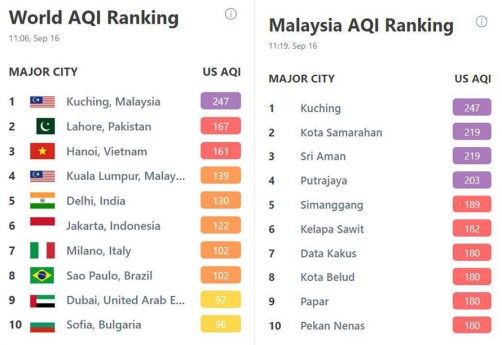
Due to the worsening haze in southwestern Sarawak, Kuching has earned the title of the most air-polluted city in the world. This is the second time in a week that a Malaysian city has topped the list of the world’s most polluted cities, according to US-based website World’s Air Pollution: Real-time Air Quality Index.

According to the New Straits Times, Kuala Lumpur took first place on Wednesday (Sept 11) with a 165 reading on the Air Quality Index (AQI), which is the index used by the World’s Air Pollution website.

On Monday (Sept 16), Kuala Lumpur was at fourth place in a global air quality ranking by IQAir AirVisual.

20191609-HazeKuching-ranking

Kuala Lumpur was ranked fourth in a global air quality ranking. IQAir AirVisual

Five areas in Malaysia were in the “very unhealthy” air quality category as of 11am on Monday. They are: Johan Setia, Putrajaya, Kuching, Samarahan and Sri Aman.

According to the Department of Environment’s (DoE) monitoring of the Air Pollutant Index (API), Kuching recorded the highest API reading of 245, followed by Sri Aman (220) and Samarahan (216).

In Peninsular Malaysia, Johan Setia and Putrajaya both had a very unhealthy API reading of 202. A further 29 places recorded “unhealthy” readings.

API readings of 0 to 50 represent “good” air quality, while 51 to 100 is considered “moderate”, 101-200 is classified as “unhealthy”, 201-300 is “very unhealthy”, and above 300 is deemed “hazardous”.

20191609-HazeKuching-Info

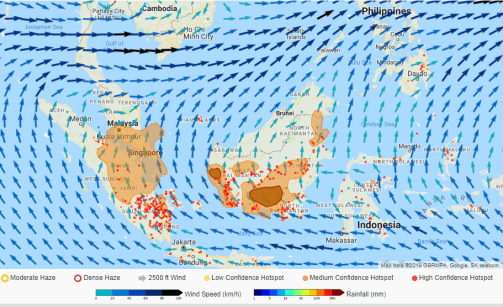
A map showing hotspot activities, wind direction and rainfall across Indonesia and Malaysia as of September 15. ASMC

According to the Asean Specialised Meteorological Centre (ASMC), dry conditions prevailed over the southern ASEAN region on Sunday. Moderate to dense smoke haze continued to emanate from persistent hotspots in the provinces of Riau, Jambi, South Sumatra, Lampung and many areas of Kalimantan, it said. The prevailing winds have blown some of the smoke haze to affect parts of peninsular Malaysia and Singapore.

However, the haze situation in Singapore gradually improved over the weekend, with a 24hr-Pollutant Standards Index (PSI) of 77 to 86 as of 11am on Monday (Sept 16).

The ASMC has forecasted that hazy conditions in the region can be expected to continue with the hotspot activities in Sumatra and Kalimantan persisting under the prevailing dry weather.

via Kuching declared ‘world’s most air-polluted city’ – and KL is not far behind, Business Insider – Business Insider Malaysia

Posted in Air Quality, Asia, Malaysia | Tagged , , , , , , | Leave a comment

Air pollution a growing threat for North Macedonia

The World Health Organisation (WHO) recently ranked Skopje, the capital of North Macedonia, as the third most polluted city in Europe. The organisation’s data shows that Skopje’s annual air pollution stood at 40 µg/m3 in 2018, 60 per cent higher than EU guidelines and four times higher than WHO guidelines.

North Macedonia has an especially poor record when it comes to particulate matter (PM) air pollution, one of the most damaging causes. In 2018, it was the country’s eighth largest mortality risk factor and was linked to 7.3 per cent of deaths, decreasing the average life expectancy in North Macedonia by 0.81 years.

What’s more, the effects of air pollution go beyond health and have a considerable impact on economic growth: it increases medical expenditure, decreases work productivity and contributes to a rise in premature deaths.

Health expenditure in North Macedonia has increased to around 397 million US dollars, which is almost 3.5 per cent of GDP. The country’s job performance has also been affected: the World Bank estimates that the productivity impact of air pollution is around 0.13 per cent of GDP (4.7 million US dollars). Furthermore, the increased death tolls, which result in reduced labour hours and total profits, lead to a decrease in gross domestic product.

Such a major health crisis requires immediate solutions by both public and private actors in the Macedonian economy, with a green economic transformation being vital to resolve the issue.

Air pollution will therefore be one of the key topics of the Macedonia2025 Summit between November 13 and 15 in Skopje, a platform for sharing knowledge, connecting business and inspiring innovation not just in North Macedonia, but all of Southeastern Europe, serving as an opportunity to address the issue by sharing expertise and encouraging a joint dialogue by all stakeholders.

via Air pollution a growing threat for North Macedonia – Emerging Europe | News, Intelligence, Community

Posted in Air Quality, Europe | Tagged , , , , | Leave a comment

The Amazon Has Seen More Than 100,000 Fires This Year, Causing Spike in Air Pollution

enxi8e9gkbhmlf0nohhm-620x349The fires burning throughout the Amazon rainforest and the rest of Brazil are billowing all types of air pollutants into the atmosphere, new satellite images from the European Space Agency (ESA) show.

The agency released the images Monday, reminding the world that the Amazon fires aren’t just an environmental issue — but a public health issue, as well. The images come as the number of Brazil’s forest fires soar past 100,000, a 45 per cent increase from this same time last year, according to Brazil’s National Institute for Space Research.

With the spike in fires, ESA found that the rates of dangerous pollutants like carbon monoxide, formaldehyde, and aerosols have gone up dramatically this year compared to last. The particulate matter from the organic matter going up in flames can cause respiratory or cardiac issues for individuals exposed. Carbon monoxide can make it harder for individuals to breathe by reducing oxygen levels. The World Health Organization issued a warning to vulnerable communities just last week because of all this air pollution.

Aerosols = bad (Illustration: European Space Agency)

There are also environmental impacts as well. The black carbon emissions from the fire are absorbing sunlight and blocking outgoing energy, a process that can worsening warming. The forest is also releasing carbon dioxide from its burning trees, another factor that could speed up global warming.

Many suspect that President Jair Bolsonaro’s new reign in the country has everything to do with this rise in Brazil’s forest fires. He’s been outspoken about handing the Amazon over to private interests, which burn the forest to clear land for crops, cattle, mining, and timber. The indigenous communities that live under the forest canopy have the most to lose as the Amazon continues to burn.

These maps show how much carbon monoxide has increased. (Image: European Space Agency)

Unfortunately, the Amazon forest fires are part of a greater global trend: The number of global fires increased by nearly fourfold last month compared to last year. August 2018 saw 16,632 fires. August 2019? 79,000. The world is on fire.

Featured image: European Space Agency

via The Amazon Has Seen More Than 100,000 Fires This Year, Causing Spike in Air Pollution | Gizmodo UK

Posted in Air Quality, Latin America | Tagged , , , , | Leave a comment

Indonesian forests are burning, and Malaysia and Singapore are choking on the fumes

Malaysian authorities distributed half a million face masks to residents on Tuesday after large-scale forest fires in Indonesia spread smoke and thick smog to neighboring countries.

Intense forest fires have raged across the Indonesian regions of Sumatra and Kalimantan in recent weeks. More than 930,000 hectares (about 2.3 million acres) of land have been burned, hundreds of residents evacuated, and more than 9,000 personnel have been deployed to battle the flames, according to CNN Indonesia.

Nearby, Singapore and Malaysia have both choked in a dense haze all week, with air quality reaching unhealthy levels.

The fires were allegedly caused by farmers using slash and burn techniques to clear the ecologically rich land — the same practice that led to uncontrollable fires in the Brazilian Amazon this summer.

On Tuesday Malaysia’s National Disaster Management Agency distributed half a million face masks to Sarawak state, which saw a spike in the air pollution index (API), according to state media agency Bernama. 409 schools in the state closed Tuesday before reopening today, Bernama reported.

API measures a variety of pollutants to gauge air quality, which is typically defined by the concentration of fine particulate matter, or PM2.5, per cubic meter. The microscopic particles are considered particularly harmful because they are small enough to lodge deep into the lungs and can pass into other organs or the bloodstream.

In the last 24 hours, 11 of Malaysia’s 16 states and territories have recorded API levels in the “unhealthy” range of 101-200. Rompin district in Pahang recorded the highest level, tipping into “very unhealthy” at a peak of 232.
In Singapore, the API hit a peak of 151 on Tuesday, with levels largely in the “unhealthy” range all day.
To put that in perspective, on Wednesday the API was a healthy 7 in New York City and 24 in London. Even Beijing, a city notorious for its pollution, measured a “good” level of 50.
Images on Tuesday show the iconic Petronas Twin Towers in Malaysia’s Kuala Lumpur shrouded in gray smog. Local media reported many residents wore face masks and stayed indoors.
The unusually high API levels has been linked to smoke drifting from fires in Indonesia, according to the Asean Specialised Meteorological Centre (ASMC). The ASMC site described “persistent hotspots with extensive moderate to dense smoke haze” in Indonesia’s Sumatra and Kalimantan regions, which have been detected for several weeks now by satellite data.
Winds are then carrying this dense, unhealthy smog to neighboring countries like Malaysia, Brunei, and Singapore, which are also experiencing high levels of air pollution, said the ASMC.
Singapore’s National Environment Agency (NEA) issued a health advisory on Tuesday, also pointing to the Indonesian fires as the cause of the pollution and warning residents to stay indoors. According to the NEA, there were 1,286 hotspots detected in Sumatra and Kalimantan on Tuesday.
Malaysian authorities have also urged their Indonesian counterparts to take action and prevent the haze from spreading further, according to Bernama.
The issue is not new, but it’s persistent. For years, fires in Sumatra have caused the rest of Indonesia, Singapore, and Malaysia to choke under the smog. At times, the API in Indonesia has reached as high as 1,000, with visibility falling below 100 meters.
It stems from the annual burning of land for the production of pup, paper, and palm oil — industries that have devastated the Indonesian forests for years.
The particles in the pollution caused by the burning can increase the risk of cardiovascular and respiratory diseases and cancer, according to the World Health Organization (WHO).
Authorities in Indonesia have tried to put a stop to the burning. It’s an illegal practice, and those found guilty can be fined up to 10 billion rupiah (US$700,000), and management faces up to 10 years in jail — but burning has continued anyway. Last month, Indonesian President Joko Widodo said he felt “embarrassed” by the fires, acknowledging the smoke’s effects on Singapore and Malaysia, according to Bernama.
The fires also raise Indonesia’s contribution to climate change, as the land burned is extremely carbon rich. Environmental organizations like Greenpeace and the World Wildlife Fund have spoken out against the fires, calling for action to preserve the land.

via Indonesian forests are burning, and Malaysia and Singapore are choking on the fumes – CNN

Posted in Air Quality, Asia, Indonesia, Malaysia, Singapore | Tagged , , , , , , , , , , , , | Leave a comment

Haze blankets Kuala Lumpur, Singapore as fires rage in Indonesia

A regional agency monitoring land and forest fires in Southeast Asia has raised the alert on the danger of haze from Indonesia, as neighbouring Malaysia and Singapore woke up to smoke-filled skies on Tuesday.

The ASEAN Specialised Meteorological Centre (ASMC) warned that the “transboundary haze situation could worsen” in the coming days, with winds expected to continue blowing from the south towards the direction of the Malaysian Peninsula.

“Over the past few days, there has been a further escalation of hotspot activities and deterioration in haze situation in Sumatra,” the ASMC said in a statement posted on its website on Monday evening, as it issued its highest alert level, 3, for the Indonesian province.

WATCH25:30
Indonesia: Where There’s Smoke
“The smoke haze has been blown across the Strait of Malacca to western parts of Peninsular Malaysia by the prevailing winds.”

The Alert Level 3 is raised when dense smoke plumes are recorded on two consecutive days, and the number of hotspots exceeds 250. A total of 52 and 206 hotspots were detected in Sumatra on Saturday and Sunday, according to ASMC.

According to reports, this year’s El Nino warm-ocean pattern has contributed to the increase in forest fire hotspots to its highest level in four years.

The forest fires raging on the Indonesian island of Sumatra and the province of Kalimantan on Borneo island in recent weeks have prompted the Indonesian government to deploy 9,000 personnel to help stop them.

On Tuesday, Malaysia’s environment department reported a continuing rise in the air pollutant index (API) in Kuala Lumpur.

As of Tuesday morning, API levels in five areas in and around the capital rose to between 119 and 140, which are considered as “unhealthy”.

The country’s Ministry of Education has ordered schools in areas affected by the haze to cancel all outdoor activities. The order is compulsory when the pollutant index hits 100.

In September 2015, Indonesia declared a state of emergency in Sumatra after forest fires created a thick haze that spread across the region, including Singapore and Malaysia. The fire raged for days affecting Indonesia’s neighbouring countries across the Strait of Malacca.

Azrul Mohd Khalib, CEO of Galen Centre for Health and Social Policy, told Al Jazeera that compared with this year, the transboundary haze in 2015 was worse, because of the combination of smoke from peat fires and burning forests in the Sumatra and Kalimantan regions.

“However, the stakes and risks are increasing [this year] as this dry season may be more serious compared to what was experienced in the last few years,” he said.

Syed Hasnain Raza, an environmental researcher and wildlife filmmaker from Kuala Lumpur, told Al Jazeera that the recent thick haze has gotten him “really worried” about his health and that of his family.

“Something has definitely gone wrong. The last time that it was this bad was in 2015,” he told Al Jazeera. “The haze is just adding to the greenhouse gases, so it is really bad.”

Meanwhile, the city-state of Singapore reported a “moderate” API as a result of the smoke from the fires, according to the country’s National Environment Agency (NEA).

But it said districts in southern and eastern parts of the city were inching towards the “unhealthy” level, which is between 101 and 200.

“Singapore could experience slightly hazy conditions if the hotspot situation in Sumatra persists,” NEA said, referring to the Indonesian island’s ongoing fires.

Further escalation of hotspots

The issue of haze in Malaysia and Singapore has been a continuing source of friction with neighbouring Indonesia. On Friday, Kuala Lumpur hinted it would send a diplomatic note to Jakarta to address the cross-border haze.

But in a social media post on Sunday, Indonesia’s environment and forestry minister, Siti Nurbaya Bakar, denied that the haze had spread to other parts of the Southeast Asia region.

“It has been determined that until now, there has been no transboundary haze from Indonesia to neighbouring countries,” she wrote.

Siti said most forest fire incidents were caused by human factors.

ASMC, the regional monitoring agency, warned that dry weather in the region will continue in the coming weeks “and further escalation of hotspots activities in Sumatra is possible”.

Elsewhere in Indonesia, ASMC reported that “persistent hotspots continued to be detected” in many parts of Kalimantan, also affecting Sarawak, the Malaysian part of the island of Borneo.

According to reports, there have been over 6,000 hotspots in Kalimantan.

In Sarawak, Malaysia’s state education agency ordered hundreds of schools in eight districts, including in the state capital of Kuching, to close because of the poor air quality.

“Some smoke haze was also observed to extend over the adjacent South China Sea area.”

ASMC raised the alert to the highest level in Sarawak last Thursday.

Among those who are relatively healthy, with previous serious health conditions, exposure will likely cause irritation in the eyes, nose and throat, according to Azrul, of the Galen Centre.

But those who already have chronic lung or heart disease, as well as children and elderly, are vulnerable to complications such as breathing difficulties and asthma, he added.

“Fortunately, Malaysia’s exposure to haze is short-term and does not occur throughout the year.”

Pressure on Jakarta

Forest fires are a familiar scene during the dry season in Indonesia.

But the pressure against Jakarta to end to slash-and-burn practises in tropical forests has been more intense this year, amid international outrage over the enormous forest fires in the Amazon.

In the past, the Indonesian government has promised to prosecute those who were responsible. But so far, there has been no reported progress on those cases. In 2016, police in Sumatra’s Riau province dropped charges against 15 companies, suspected of their roles in the fires in 2015.

Indonesia’s Walhi Environmental Group had blamed corporations who clear vast tracts of land under concession for being directly responsible for the fires, whether they were deliberately started or not.

The group has also criticised the state governments for failing to prosecute those major concessionaires and companies.

On Sunday, Siti, Indonesia’s environment and forestry minister, promised to prosecute those who were involved, saying: “We will continue to pursue and act decisively.”

“The Indonesian government continues to work hard for the interest of the nation, and we will not lose or let down on the pressures.”

According to Indonesia’s weather agency, BMKG, the dry season will last until October this year.

via Haze blankets Kuala Lumpur, Singapore as fires rage in Indonesia | Indonesia News | Al Jazeera

Posted in Air Quality, Asia, Indonesia, Malaysia, Singapore | Tagged , , , , , , , , , , , , , , | Leave a comment

Egypt to Stop Burning Rice Straw for Better Air Quality

In a bid against air pollution, Egypt’s Ministry of Environment is now gathering rice straws to be used for “furniture manufacturing and animal fodder,” according to Egypt Today, instead of burning them.

The ministry revealed that this year alone, Egypt collected 1,900 tons of rice straws from 156 areas to be reused as artificial organic fertilizer, food for livestock, bricks, and furniture. The national campaign aims is aimed towards Sharkia, Gharbia, Dakahlia, Qalyobia, Beheria and Kafr El Sheikh.

During an inspection tour at Dakahlia governorate last August 2019, representatives of the Egyptian Environmental Affairs Agency at the Ministry (EEAA) discovered violations that ranged EGP 5,000 and EGP 100,000.

Egypt Today noted that ‘the Black Cloud,” a dark smog that hovers across Cairo’s capital as a result of igniting fire on rice straws.

Last year, a study, in the journal Environmental Science & TechnologyLetters, air pollution is responsible for shortening the lives of Egyptians by 1.85 years.

Cairo’s air pollution, however, is at the most critical level, with an estimated 43,000 Egyptians dying from diseases related to air pollution in 2012.
For this, Egypt has been taking initiative in to become more environmentally friendly to achieve its 2030 agenda for sustainable development.

In June of this year, the Ministry of Environment installed the first two stations to monitor the surrounding air in Sohag governorate. A monitoring station was installed at the top of the central administration building of Sohag University to the east of the Nile, bringing the number of air monitoring stations at the national level to 100 stations.

Egypt is one of the few countries in the Middle East region, Africa and Asia that owns such a large number of air quality monitoring stations, according to the ministry.

via Egypt to Stop Burning Rice Straw for Better Air Quality | Egyptian Streets

Posted in Africa, Air Quality | Tagged , , , , | Leave a comment


