UC Riverside Researchers Show Thirdhand Smoke Exposure Damages Human Cells

Researchers at University of California, Riverside, found cellular damage in healthy non-smoking adults after just three hours of exposure to thirdhand smoke. This is the first study to show a direct effect of thirdhand smoke on cells in humans. 

Thirdhand smoke can damage epithelial cells in the respiratory system by stressing cells and causing them to fight for survival, a research team led by scientists at the University of California, Riverside, has found. The finding could assist physicians treating patients exposed to thirdhand smoke.

“Our data show that cells in humans are affected by thirdhand smoke,” said Prue Talbot, who led the research. “The health effects of thirdhand smoke, have been studied in cultured cells and animal models, but this is the first study to show a direct effect of thirdhand smoke on gene expression in humans.”

Thirdhand smoke results when exhaled smoke and smoke emanating from the tip of burning cigarettes settles on surfaces such as clothing, hair, furniture, and cars. Not strictly smoke, thirdhand smoke refers to the residues left behind by smoking.

“Thirdhand smoke can resurface into the atmosphere and can be inhaled unwillingly by nonsmokers,” said Giovanna Pozuelos, the first author of the research paper and a graduate student in Talbot’s lab. “It has not been widely studied, which may explain why no regulations are in place to protect nonsmokers from it.”

The researchers obtained nasal scrapes from four healthy nonsmokers who had been exposed to thirdhand smoke for three hours in a laboratory setting at UC San Francisco. The UC Riverside researchers then worked to get good quality RNA from the scrapes — necessary to examine gene expression changes. RNA sequencing identified genes that were over- or under-expressed. They found 382 genes were significantly over-expressed; seven other genes were under-expressed. They then identified pathways affected by these genes.

“Thirdhand smoke inhalation for only three hours significantly altered gene expression in the nasal epithelium of healthy nonsmokers,” Pozuelos said. “The inhalation altered pathways associated with oxidative stress, which can damage DNA, with cancer being a potential long-term outcome. It’s extremely unlikely a three-hour exposure to thirdhand smoke would cause cancer, but if someone lived in an apartment or home with thirdhand smoke or drove a car regularly where thirdhand smoke was present, there could be health consequences.”

Because gene expression in the nasal epithelium is similar to the bronchial epithelium, the researchers note that their data is relevant to cells deeper in the respiratory system. In the samples they studied, the researchers also found that brief thirdhand smoke exposure affected mitochondrial activity. Mitochondria are organelles that serve as the cell’s powerhouses. If left unchecked, the observed effects would lead to cell death.

Pozuelos explained that the team focused on the nasal epithelium because the nasal passage is one way thirdhand smoke can enter people’s lungs. The other common exposure route is through the skin, which the researchers did not study, but plan to in the future.

Already, the researchers are working with groups in San Diego, California, and Cincinnati to study long-term exposure to thirdhand smoke, made possible with access to homes where people are being exposed to thirdhand smoke.

“Many people do not know what thirdhand smoke is,” said Talbot, the director of the UC Riverside Stem Cell Center “We hope our study raises awareness of this potential health hazard. Many smoking adults think, ‘I smoke outside, so my family inside the house will not get exposed.’ But smokers carry chemicals like nicotine indoors with their clothes. It’s important that people understand that thirdhand smoke is real and potentially harmful.”

Talbot and Pozuelos were joined in the research by Meenakshi Kagda, currently of Stanford University; Suzaynn Schick of UC San Francisco; and Thomas Girke and David Volz of UC Riverside. Kagda is a former postdoctoral researcher in Talbot’s lab.

The study was supported by a grant to Talbot from the UC Tobacco-Related Disease Research Program.

Source: https://bit.ly/2G4BHwQ
Note: Content may be edited for style and length.

via UC Riverside Researchers Show Thirdhand Smoke Exposure Damages Human Cells – Thirdhand Smoke Resource Center

Posted in Air Quality, Health Effects of Air Pollution, Medical Studies | Tagged , , , | Leave a comment

More than half a million Americans exposed to toxic air pollution face cancer risks above EPA guidelines

Neighbors used to barely notice the drab, low-slung industrial building across the river from downtown.

The corporate name on the sign out front had changed a few times over the years. Truck traffic in and out of the loading docks ebbed and flowed. As far as anybody knew, the only concern was word that spread around town years ago about a gas they used inside being explosive enough to level the entire building.

Even after the U.S. Environmental Protection Agency concluded last summer that the same gas is responsible for some of the nation’s biggest cancer risks from , it took months before residents of Michigan’s second-largest city discovered they had an ethylene oxide problem.

EPA scientists had determined the lifetime cancer risk in one Grand Rapids census tract is nearly four times greater than the national average. But the Trump administration buried the finding in a report quietly released in August 2018.

Nobody at the EPA told people in the middle- and working-class neighborhood known as Kielbasa Valley that they were potentially at risk. Nor did the agency investigate the facility that had reported emitting the cancer-causing gas: a medical device manufacturer sandwiched between a cluster of two-story homes and a branch campus of Grand Valley State University.

“It’s like we’ve been forgotten. Or maybe they just don’t care,” said Lorna Conkle, who grew up in the neighborhood and today lives a block away from the facility.

This pattern of inaction by the Trump EPA has been repeated in dozens of communities across the nation during the past year, a Chicago Tribune investigation found.

More than a half million Americans exposed to toxic air pollution face cancer risks exceeding agency guidelines, according to EPA data. Ethylene oxide is the chief chemical of concern.

Yet industrial facilities emitting the toxic gas continue to legally operate under federal regulations that haven’t been updated to reflect the risk it poses. As a result, neighbors for the most part don’t know they are breathing pollution that can potentially trigger breast cancer, leukemia and lymphomas.

Some of the communities the EPA found to be at risk are near sprawling petrochemical complexes in Louisiana and Texas where ethylene oxide is produced by industry giants, including Dow Chemical, Shell, Huntsman and Union Carbide (now a subsidiary of Dow).

Others facing elevated cancer risks live close to nondescript buildings owned by lesser-known companies that use the toxic gas to sterilize medical products in the suburbs of Atlanta and Denver; Charleston, S.C.; Laredo, Texas; and rural Missouri.

So far the only source of ethylene oxide scrutinized by the EPA is Sterigenics, a sterilization facility behind a Target store and next to the village hall in Willowbrook, a Chicago suburb where residents and elected officials mobilized to demand action after learning they were living in a pollution hot spot.

Faced with a  and bipartisan political pressure, the EPA deployed air monitoring equipment last winter at parks, schools and homes near Sterigenics. Three months of testing confirmed that pollution from the facility could trigger more than 10 cases of cancer for every 10,000 people exposed during their lifetimes—a rate 10 times higher than what the EPA considers acceptable.

“We have been very proactive,” Cathy Stepp, the Trump administration’s top EPA official in the Midwest, told a public forum in May.

The testing in Willowbrook produced real-world measurements of ethylene oxide that led to the shutdown of Sterigenics. But Trump administration officials have refused to monitor air quality in other communities that stand out in the latest National Air Toxics Assessment, an occasional report compiled by EPA scientists intended to highlight areas of the United States where more investigation is needed.

EPA officials also haven’t done anything to draw the public’s attention to alarming cancer risks in those communities.

There are 73,057 census tracts in the U.S., with between 2,500 and 8,000 people living in each one. In 106 tracts, the EPA data shows, the risk of developing cancer from breathing toxic air pollution over a lifetime exceeds agency guidelines.

Three entire counties in Louisiana, known locally as parishes, face risks considered unacceptable by the EPA.

The population of a Louisiana tract with the nation’s highest cancer risks is largely African American and poor—one of the definitions of an environmental justice community. However, in about two-thirds of the areas facing risks exceeding EPA guidelines, most of the residents are white and live in either middle-class or well-to-do neighborhoods, according to census data.

In the absence of action by the Trump administration, decisions about ethylene oxide pollution have been left to state environmental agencies. Only Colorado and Michigan reacted to the EPA findings by launching investigations.

“We took it very seriously, and we are very concerned,” said Heidi Hollenbach, a district supervisor at the Michigan Department of Environment, Great Lakes and Energy. “Our No. 1 concern here is protecting public health.”

State officials already were involved in the Grand Rapids neighborhood when the EPA identified it as a pollution hot spot. In 2017, residents had raised concerns about a possible cancer cluster they feared might be linked to a city dump where the federal agency had overseen a cleanup during the late 1990s.

While health officials began studying actual cases of cancer in the area, Hollenbach’s agency adopted more stringent limits on ethylene oxide, based on a 2016 scientific evaluation by the EPA that concluded the chemical is far more dangerous than previously thought.

Citing its new regulations, the state agency accused Viant Medical, the current owner of the medical device manufacturing facility, of violating Michigan air quality standards. Then state officials installed the same type of monitoring equipment the EPA used in Willowbrook to measure day-to-day concentrations of ethylene oxide in the surrounding neighborhood.

“They found it’s hitting the people downtown, too, the people with money,” said Margo Johnson, an employment benefits consultant and president of a local neighborhood group. “That’s when things really started to change.”

Sometimes environmental agencies fail to enforce clean air and water laws until confronted by residents affected by pollution. But in many of the communities with elevated cancer risks from toxic air, people don’t know they are at risk.

For instance, there has been no federal or state scrutiny of B. Braun, a German manufacturer of medical and pharmaceutical products, despite EPA records showing the company’s Allentown, Pa., assembly plant emitted more ethylene oxide than Sterigenics did in Willowbrook between 2014 and 2016.

What makes the EPA’s decision to not conduct air quality testing even more remarkable: The agency’s own scientists determined that 56,000 people near the Allentown facility face elevated cancer risks—more than twice the affected population in suburban Chicago neighborhoods surrounding Sterigenics.

B. Braun legally emits ethylene oxide, just as Sterigenics did for years in Willowbrook. But permits for both companies were based on regulations adopted before the EPA had concluded that the toxic gas can be harmful at extremely low levels.

“B. Braun Medical Inc. has a longstanding history of responsible operation of our facilities in a manner designed to fully protect our employees and the communities in which we operate,” the company said in an email response to questions from the Tribune. “B. Braun continues to investigate the availability of alternative methods that are consistent with our commitment to ensuring the safety of patients, clinicians, our employees and the environment.”

The EPA didn’t require the sterilization industry to install pollution-control equipment until the late 1990s. Agency officials relaxed the regulations a few years later in response to explosions at plants in Indiana, Massachusetts, Virginia and Wisconsin.

Industry representatives persuaded regulators that the government-mandated pollution controls were responsible for the blasts, though investigators found operator errors were to blame in each case and could have been prevented with more rigorous training and safer handling of the highly flammable chemical.

For most of 2019, it appeared the EPA’s conclusions about ethylene oxide might prompt the Trump administration to briefly detour from its aggressive campaign to scrap environmental regulations.

William Wehrum, the administration official in charge of the EPA’s air quality office, promised the agency would adopt more stringent federal restrictions on pollution from the sterilization industry. As recently as late May, Wehrum told the Tribune the rules would be based on a stringent safety limit derived from the agency’s 2016 evaluation of the chemical.

“We are now in a position to make very good decisions about what needs to happen next,” he told a May 29 public forum in Burr Ridge, a Chicago suburb next door to Willowbrook. “We’re going to get results.”

But after Wehrum resigned in June, the EPA indefinitely delayed releasing the ethylene oxide rules for public comment.

Members of President Donald Trump’s Cabinet, including EPA Administrator Andrew Wheeler, are under pressure from the White House to eliminate regulations, not to adopt new ones. The chemical and sterilization industries also are lobbying the administration to back off, in part by raising doubts about the cancer risks posed by ethylene oxide.

Trade groups have petitioned the administration to throw out the EPA’s scientific evaluation, sought to weaken the agency’s safety limit through unrelated rule-making and hired industry-friendly scientists whose research was rejected by two panels of independent scientists convened by the EPA.

If administration officials end up agreeing with industry lobbyists, the federal government would not require companies that make and use ethylene oxide to do anything to reduce their pollution. The cancer risks calculated by the EPA would suddenly disappear in Allentown, Willowbrook and other hot spots.

“People are going to continue to suffer, though,” said Jennifer Sass, a senior scientist at the nonprofit Natural Resources Defense Council who helped draft a recent letter to the EPA that rebutted claims made by the chemical industry.

The chemical industry has fought tougher ethylene oxide regulations for decades, Sass noted. “Now a bunch of corporations are having a temper tantrum,” she said, “because they don’t like what the science is telling us about this extremely dangerous chemical.”

In Illinois, it doesn’t matter what the federal government decides about ethylene oxide.

Gov. J.B. Pritzker’s administration shut down the company’s Willowbrook facility in February. Before the company can be permitted to resume operations, a new state law and a recently negotiated legal settlement require an overhaul that would limit emissions to 85 pounds a year, down from 2,890 pounds released into the community during 2017.

Sterigenics said it already has taken steps to reduce emissions from its facilities in Smyrna, Ga., and Santa Teresa, N.M., two other communities where the EPA determined that neighbors face elevated cancer risks. The company also said it is planning to upgrade all nine of its U.S. facilities with technology similar to what it is planning for Willowbrook.

“We will ensure that our additional controls will comply with any changing regulations,” the company said in an email response to questions from the Tribune, “and we will seek to continue to perform far better than those requirements at all of our facilities.”

The Illinois law requires similar improvements at Medline Industries in Waukegan, where local officials scrambled to finance air quality testing after federal and state agencies brushed aside pleas from neighbors.

Back in Grand Rapids, Lorna Conkle and her husband, Larry, said they didn’t think twice when a state official knocked on their door earlier this year and asked if inspectors could measure ethylene oxide concentrations in their backyard.

The stainless steel canisters used to collect samples, outfitted with gauges and tubes that make them look like something out of a 1950s science fiction movie, were posted near the Tiki bar that Larry Conkle built from scratch and the wooden fence the couple painted with images of ocean waves.

During a recent visit, the space where the Conkles usually erect an above-ground pool for their grandchildren was empty. They decided to keep the pool in storage after the state’s testing found that concentrations of ethylene oxide in their yard were 800 times higher than Michigan’s safety limit.

“I feel uncomfortable about the kids coming over,” Lorna Conkle said. “I feel guilty that they’ve been exposed to this for all of these years.”

In March, hours before state officials convened a public meeting about Viant’s emissions, the company dropped a letter in mailboxes throughout the neighborhood. Viant claimed the  could be coming from vehicle exhaust, but the big news was in bold face just below the company logo:

By the end of the year, the letter said, the company will stop using the toxic gas in Grand Rapids for good.

“That’s great, but if this stuff is so bad why didn’t they shut it down immediately?” Larry Conkle said.

“They say exposure is only dangerous over a lifetime,” he said. “But when you live here, when you’ve got grandkids here, you’re not thinking about a lifetime. You want to be safe now.”

via More than half a million Americans exposed to toxic air pollution face cancer risks above EPA guidelines

Posted in Air Quality, Health Effects of Air Pollution, Medical Studies, USA, USA & Canada | Tagged , , , , , , , , , , | Leave a comment

Low level exposure to air pollution is harmful, mouse model shows

Air pollution is made up of both gaseous and particulate matter (PM). Each year almost two million people die as a direct result of air pollution with many more experiencing impaired lung function, developing lung diseases such as asthma and chronic obstructive pulmonary disease (COPD). However research, on the effects of low level air pollution, is often overlooked.

An international research team, led by the University of Technology Sydney (UTS) and the Woolcock Institute of Medical Research (WIMR) investigated whether a low level of exposure to PM10 was harmful. PM10 refers to particles equal or below 10 microns in size, they make up a large proportion of air pollution and can enter the lung.

The results of the study have been published in the American Journal of Physiology — Lung Cellular and Molecular Physiology (AJP-Lung).

Dr Yik Chan from UTS and WIMR, and co-lead author on the paper, said that low level air pollution was often mistakenly treated as “safe” and not harmful to health.

“In Sydney and other Australian capital cities the levels of traffic related air pollution (TRAP) are low by world standards and not often considered a problem in terms of developing chronic lung disease. However almost everyone living in an urban area is exposed to TRAP,” Dr Chan said.

“Sydney has a lot of new construction taking place, as well as a growing population and increased traffic is inevitable,” he said.

Researchers from the Kolling Institute, UNSW, Chinese University of Hong Kong, Chinese Academy of Sciences were also involved in the study that showed that, after three weeks, mice exposed to low levels of traffic related PM10 had an inflammatory response.

Chief Investigator Associate Professor Brian Oliver said that “these results have important implications for new [building] developments.”

“For example, should schools or day care centres be built next to busy roads?

“Our results indicate that PM is a pro-inflammatory molecule, which exerts effects even at low concentrations. In our model we found strong, and statistically significant evidence of, lung inflammation and dysregulated mitochondrial activity. The mitochondria are the powerhouse of the cell, which means that any changes to the mitochondria effects energy production by the cell, and therefore how the cell divides and responds to external stimuli.”

The researchers say that people living alongside major traffic corridors need to be aware of the potential adverse effects on their respiratory health.

via Low level exposure to air pollution is harmful, mouse model shows — ScienceDaily

Posted in Air Quality, Health Effects of Air Pollution | Tagged , , , , , | Leave a comment

Paris region bans cars and cuts Metro ticket prices over pollution spike

Tens of thousands of motorists in the Paris region were unable to take their cars to work on Tuesday after authorities took the step of banning vehicles due to a pollution spike linked to the arrival of the new heatwave.
Around 60 percent of vehicles in the Paris region of Île-de-France were banned from the roads on Tuesday as part of an anti-pollution system brought in by authorities.

The scheme, known as “circulation differenciée” or “alternate circulation” bans the most polluting cars from taking to the roads when there is a likely spike in air pollution in and around the French capital.

It is based on pollution stickers that each car has, known as Crit’Air, which range from the number zero – the least polluting cars to 5, which are the most polluting.

From Tuesday all vehicles with Crit’Air stickers 3,4 or 5 are unable to be driven inside the Paris exterior ring road the A86 – which encompasses Paris and the suburbs.

That equates to some 4.7 million vehicles registered in the greater Paris region that will have to be left at home.

And that figure doesn’t even include all the vehicles with Crit’Air stickers 3,4 or 5 that are registered outside Île-de-France, but will be banned from inside the A86.

The ban runs from 5.30am until midnight but will likely be extended given the heatwave is forecast to last all week.

In another measure that impacts drivers, speed limits in the Paris region have been reduced from 130km/h to 110km/h on the motorway.

On dual carriageways the speed limits are set at 90km/h and at 70km/h on secondary roads.

To make up for the impact on motorists, commuters can buy a one-day travel pass to use on public transport in the Paris region for just €3.80.

via Paris region bans cars and cuts Metro ticket prices over pollution spike – The Local

Posted in Air Quality, Europe, France | Tagged , , | Leave a comment

EU Member States make only mixed progress in reducing emissions under UN convention, latest air pollution data shows

European Union (EU) Member States have made only mixed progress in reducing emissions of the most harmful air pollutants, according to updated data published today by the European Environment Agency (EEA). The data is from the annual EU emission inventory report sent to the UNECE Convention on Long-range Transboundary Air Pollution (LRTAP).

The EEA report  confirms, as highlighted in the recent EEA briefing on the EU’s National Emissions Ceilings Directive earlier this month, that after many years of past declines, for more than half of the 26 pollutants monitored emissions increased slightly in 2017 compared to the previous year. Releases came from key sources such as agriculture, transport, industry and private households.

The report notes that between 2016 and 2017, emissions of nitrogen oxides (NOx) and sulphur oxides (SOx) dropped by 1.8% and 1.3% respectively. However, emissions of non-methane volatile organic compounds (NMVOCs) increased by 1.3%, carbon monoxide (CO) emissions by 0.2% and ammonia (NH3) by 0.4%. Emissions of particulate matter, and several heavy metals and persistent organic pollutants also all increased slightly in 2017 compared to the previous year. In recent years, the rate of emission reductions has stagnated for many pollutants. And as noted, for a number, it has actually slightly increased.  For example, ammonia emissions, which can lead to particulate matter formation in the atmosphere, have fallen less than emissions of the other main pollutants since 1990 and increased in each of the past four years.

The report also highlights the growing importance of the residential stationary combustion sector, which includes the burning of fuels in domestic stoves. This source makes a significant contribution to the total emissions of many pollutants and contributed 51% of fine particulate matter (PM2.5) emitted directly into the air in 2017. Further, 42% of total carbon monoxide, 42% of polycyclic aromatic hydrocarbons, 24% of the dioxin and furan compounds and 16% of the heavy metal cadmium were released by this single source.

The LRTAP report tracks the emissions of key air pollutants over past years. It is submitted by the EU to the UNECE under the requirements of the Gothenburg Protocol to the LRTAP Convention, which aims to limit, and as far as possible, gradually reduce and prevent air pollution. The protocol also sets emission limits for a range of air pollutants that have to be met from 2010 onwards, which for Member States are either equivalent to or less ambitious than those specified under the 2010 EU NEC Directive. Air pollution is the single largest environmental risk to human health in Europe, causing respiratory problems and shortening lifespans. Poor air quality caused by air pollution can also harm vegetation and sensitive ecosystems. Moreover, several air pollutants also contribute to climate change.

via EU Member States make only mixed progress in reducing emissions under UN convention, latest air pollution data shows — European Environment Agency

Posted in Air Quality, Europe | Tagged , , , , , , , , | Leave a comment

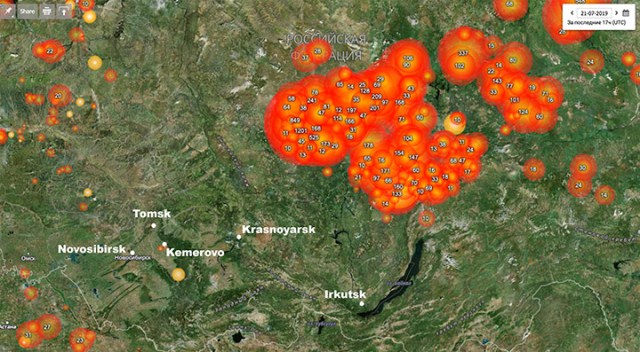
Major Siberian cities choking from strong wildfires

Krasnoyarsk and Novosibirsk suffering smoke pollution and infernos rage in forests after hot, dry weather.

Pictures show the scale of the smoke in major population centres from the raging wildfires with the cause seen mainly as out-of-control forest fires in Krasnoyarsk region, the second largest in Russia.

In Krasnoyarsk city, residents have been told by health officials to go outside only if really necessary.

Here watchdog Rospotrebnadzor confirmed the hygienic standard  in the air of the PM 2.5 particles is exceeded by between 1.2  and 2.3 times.

Sensors installed by activists on Saturday showed a ‘dangerous excess of the maximum permissible concentrations’.

Dust, soot and other small particles are shown as present in the air.

On Saturday morning, the MPC values ranged from 42 to 74, with the safe value of 25 units.

Later the sensors showed readings from 221 to 344.

The limited visibility and smell of burning is observed in all districts of Krasnoyarsk, and in villages and towns in the vast region, for example, Lesosibirsk and Achinsk.

The regional government in Krasnoyarsk blamed lightning for starting most fires.

They reported: ‘An emergency regime is introduced in the region, (and) people have limited access to forests.’

inside_map

The pollution from wildfires in Krasnoyarsk has spread with air flows over a huge geographical area to other regions.

A strong smell of burning and thick haze covered Tomsk city on Saturday.

Experts explain this was caused by high humidity in the city plus air masses blowing from regions where the wildfires are raging.

A representative of the Russian Ministry of Emergencies in the Tomsk region explained: ‘Forest fires in Krasnoyarsk region caused the smell of burning and haze over Tomsk.

‘There are currently no forest fires in (our) region.

According to the observations of the Tomsk Centre for Hydrometeorology and Environmental Monitoring, the excess of maximum permissible concentrations of pollutants has not been observed in the atmospheric air.’

Residents in Kemerovo complained in social networks about the smell of burning and the smoke that stands over the city.

A local weather expert said: ‘We are in the centre of a cyclone.

’It pumps in the air and directs it from the north to us.

‘Tomorrow the north wind is also expected… but rains may clear the area, which will purify the atmosphere.’

Siberia’s largest city Novosibirsk was also hit by a smell of burning and there was light haze.

In the morning of July 21 smog appeared and the smell significantly increased.

The CityAir service estimates air pollution at 8 points out of 10, the situation began to deteriorate at about 2 am.

This was despite the Ministry of Emergency Situations in Novosibirsk region stating their were no fires on its territory

‘Krasnoyarsk firesafe giving us the smoke,’ said a spokesman. ’The wind is northeasterly.’

According to the Federal Service Avialesokhrana on 21 July, some 492,750 hectares of forests are ablaze in Krasnoyarsk region and only 28,366 are being extinguished.

Smoke from wildfires is observed in several districts of the Irkutsk region, further to the east.

Smoke covered Bratsky, Chunsky, Ust-Ilimsky, Nizhneilimsky and Ust-Kut districts.

As of the morning of 21 July, 86 forest fires are registered in Irkutsk region.

The total area of burning forests is 217,418 hectares.

Fire extinguishing is carried out by forest protection troops.

via Major Siberian cities choking from strong wildfires

Posted in Air Quality, Asia | Tagged , , , , , , | Leave a comment

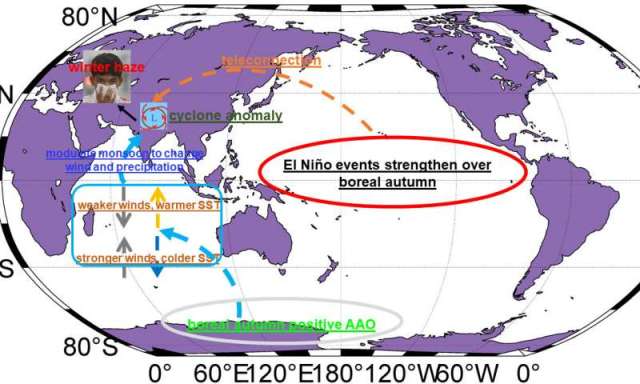
Using El Niño and Antarctic Oscillation data to predict air pollution levels in northern India

5d303ea2aa49e

A team of researchers affiliated with several institutions in China and the U.S. has found that data from El Niño and Antarctic Oscillation events can be used to predict air pollution levels in northern India. In their paper published in the journal Science Advances, the group describes their study of the historical impact of El Niño and Antarctic Oscillation events on weather in northern India and what they found.

In recent years, northern India has experienced poor air quality, particularly in the winter months, to the extent that the country has some of the worst air quality in the world—surpassing even China. Researchers have also noted that in some years, pollution levels seem worse than normal due to weather conditions. In this new effort, the researchers looked at two natural weather events that are known to have a clear impact on winter weather in northern India—El Niño and the Antarctic Oscillation.

El Niño is, of course, an event that involves a large band of warm water forming in the Pacific Ocean—such events have widespread weather impacts across multiple parts of the world. And the Antarctic Oscillation is a wind event caused by a low-pressure belt forming over Antarctica.

To better understand what impact either or both weather events might have on India’s air pollution, the researchers collected data on both, covering the years 2003 to 2018. They then used the data to conduct statistical modeling as a way to assess their impacts on northern India. They report that El Niño events tend to result in reduced wind speeds in the region, which prevented airborne pollutants from moving out of heavily populated areas. They also found that Antarctic Oscillation events create stronger winds in some parts of northern India and weaken them in others, resulting in uneven impacts on pollution levels.

The researchers suggest that it is possible to use weather data collected for El Niño and Antarctic Oscillation events to provide government officials with a means of gauging pollution levels in northern India each year.

via Using El Niño and Antarctic Oscillation data to predict air pollution levels in northern India

Posted in Air Quality, Asia, India | Tagged , , , | 1 Comment

Public health warning for Hong Kong as Air Quality Health Index reaches ‘serious’ category, the highest pollution level in city

  • Avoid or reduce outdoor exercise and spend more time indoors, says environment department
  • Top alert level recorded in parts of the city on Wednesday, with children, elderly and those with certain illnesses in built-up areas most at risk

Air pollution reached its highest alert level in parts of Hong Kong on Wednesday after the government warned of a “serious” risk to public health and advised people to avoid outdoor activity.

The Environmental Protection Department released a statement earlier on Wednesday afternoon saying pollutant levels had been rising since the morning, with the Air Quality Health Index expected to reach the worst category at some monitoring stations.

Later in the afternoon, two official sites in the New Territories recorded the risk to public health as “serious”, which is at the top of the five-tier scale.

“Under the influence of the outer subsiding air of tropical cyclone Danas, the weather in Hong Kong today is hazy with sunny periods and light wind,” the statement said.

“Hong Kong is being affected by an air mass with higher background pollutant concentrations. Higher than normal levels of ozone and particulates have been recorded in the territory since noon.”

It added high levels of ozone promoted the formation of nitrogen dioxide, particularly in urban areas and at the roadside.

At 2pm, 11 out of 16 monitoring stations, including general stations in 13 districts and three roadside sites on Hong Kong Island and Kowloon, reported the health risk from the pollution as “very high”, the second highest on the scale.

The areas affected included Central and Western district, Yuen Long, Kwai Chung, Tun Muen, Tung Chung and Tai Po.

At 4pm, two stations in Yuen Long and Tuen Mun recorded a “serious” health risk from pollution.

The department advised members of the public to reduce or avoid outdoor physical exertion to minimum levels and to cut the time they spent outside, especially in areas with heavy traffic, where the health risk is very high for children, the elderly and people with existing heart or respiratory illnesses.

Hong Kong Observatory forecast a southwesterly air stream to bring a few showers and thunderstorms to the south China coast and ease the pollution later in the week.

via Public health warning for Hong Kong as Air Quality Health Index reaches ‘serious’ category, the highest pollution level in city | South China Morning Post

Posted in Air Quality, Asia, China | Tagged , , | Leave a comment