Northern Thailand’s Air Quality Index Reaches Extremely Hazardous Levels

The worst air quality was in Chiang Rai where the air quality index (AQI) in tambon Wiang Phang Kham in Chiang Rai’s Mae Sai stands at 316.

Provincial Governors in Northern Thailand are being urged to step up measures against open-air burning after PM 2.5 pollutants reached extremely hazardous levels for almost a week.

Pralong Damrongthai, director-general of the Pollution Control Department (PCD), said the Interior Ministry has been roped in to prevent the haze situation in the northern region from worsening. He said forest fires are to blame for poor air quality in nine provinces.

The Ministry of Natural Resources and Environment is asking provincial authorities to strictly control burning of rubbish, farm waste and clearing of scrubland to reduce haze in the region.

“We’re asking people to refrain from burning activities to prevent the dust levels from rising,” he said.
He stressed that villagers need to wear face masks when venturing outside their homes and visiting areas where the hazardous dust levels are high, adding that vulnerable groups are strongly advised to stay inside.

Screen Shot 2019-03-22 at 08.08.38.png

As of today, the PM2.5 readings in the North stood at 76-300+ microgrammes per cubic metre of air. The worst air quality was in Chiang Rai where the air quality index (AQI) in tambon Wiang Phang Kham in Chiang Rai’s Mae Sai stands at 316.

The AQI measures a broad spectrum of air pollutants including PM2.5, PM10 and carbon dioxide.

The Northern Provincial governors have insisted that the ban on burning activity would be enforced strictly.

The haze situation has taken its toll on the tourism in Chiang Rai as the number of visitors to Tham Luang cave complex in Chiang Rai’s Mae Sai district has reportedly decreased by half from around 3,000-4,000 daily to 1,500 following reports about the haze, according to local officials.

Meanwhile, the Meteorological Department on Thursday issued a summer storm warning for provinces in the Northeast, East, North and Central regions from Saturday to March 27, with the Northeast and the East to be hit first.

A high pressure system from China would move in and meet the hot weather over upper Thailand. From March 23-27 summer thunderstorms were likely in the upper half of country, the department said.

via Northern Thailand’s Air Quality Index Reaches Extremely Hazardous Levels – CTN News – Chiang Rai Times

Posted in Air Quality, Asia, Thailand | Tagged , , , | Leave a comment

China’s nationwide pollution readings rose 5 percent in January-February – ministry

China’s average concentrations of lung-damaging small particles known as PM2.5 rose by 5.2 percent in the first two months of the year, the country’s environment ministry said on Thursday, casting doubt over its ability to meet winter targets.

The nation’s average PM2.5 readings came in at 61 micrograms per cubic metre for January and February, according to a Ministry of Ecology and Environment survey of 337 cities, with only 83 registering the national standard of 35 micrograms.

The 28 cities in the key pollution control region of Beijing-Tianjin-Hebei saw PM2.5 levels soar 24 percent to an average of 108 micrograms over the two-month period, more than 10 times higher than the safe level of 10 micrograms as recommended by the World Health Organization.

Meanwhile, the 11 cities of the Fenwei Plain, another major smog control zone, saw their PM2.5 numbers surge by 26.6 percent over the period, hitting an average of 119 micrograms.

China forced smog-prone northern cities to implement special emissions restrictions over the October 2018-March 2019 period in order to offset rising levels of coal combustion from state heating systems during the winter.

But Reuters calculations based on official data showed that PM2.5 readings in the 39 key northern cities still rose 13 percent over the October-February period.

The 39 cities are under pressure to make year-on-year PM2.5 cuts of around 3 percent from October to March, but Reuters calculations show that only three – Changzhi and Luliang in Shanxi province, and Jining in Shandong – were on course to meet their targets at the end of last month.

The government has previously blamed unfavourable weather conditions for the poor air quality over the period, saying that “a weak El Nino effect” and a subsequent increase in temperature and humidity has made it harder to disperse emissions.

via China’s nationwide pollution readings rose 5 percent in January-February – ministry | Reuters

Posted in Air Quality, Asia, China | Tagged , , , , , , , | Leave a comment

Inside Skopje, Europe’s most polluted capital city

Every winter, the pollution in Skopje skyrockets to alarmingly high rates.

In 2018, Skopje became the most polluted capital city in Europe, reaching the highest annual mean of PM 2.5, according to the World Health Organization (WHO).

Tiny particles named for their diameter of 2.5 micrometres – about three percent of the diameter of a human hair – PM 2.5 are considered the most dangerous air pollutants for health.

They are small enough to penetrate the respiratory system, and even the bloodstream, and have been linked to premature deaths and various diseases.

“By breathing this air, we are slowly dying,” Tomislav Maksimovski, a Skopje resident, told Al Jazeera.

“We feel the pollution. You can feel it in your mouth and lungs. Our children are suffering and our parents are coughing. We don’t deserve to live in such a polluted city.”

Skopje, in the centre of the Balkan Peninsula, is nestled in a valley between mountain ranges that hem the city in from the north and the south. This landscape proves deadly in the winter.

As warm air rises up from the mountains, it meets the colder, heavier air travelling downwards. This temperature inversion creates a blanket of smog that settles heavily over the valley, trapping polluted air on city streets and in the lungs of residents.

“Some of the pollution problems specific to the western Balkans may be due to industries, in general, older than in the rest of Europe, as well as domestic heating,” said Alberto Gonzalez Ortiz, an air quality expert from the European Environment Agency (EEA).

“For instance, the use of coal implies that the PM emissions are high. The vehicles may also be older than in other parts of Western Europe.”

Many of the power plants and small factories in North Macedonia have been there since the communist era, before the 1990s, and burn brown coal (lignite) – which is cheap and abundant, but highly polluting.

2016 study by the Health and Environment Alliance found that within areas of former Yugoslav countries, 16 lignite plants emit as much pollution as all of the EU’s 296 power plants combined.

The loosely regulated old vehicles that crowd Skopje is also highly polluting.

Many of those came by way of the European Union when the previous VMRO-DPMNE government in the country allowed the import of old vehicles in 2010.

Many of these ran on diesel and no longer met EU environmental standards.

But the biggest contributors to pollution are the combustion processes, at 77 percent, which include household heating.

“Another reason for the pollution is that too many citizens, because of their financial situation, use firewood for heating,” said Jani Makraduli, North Macedonia’s deputy minister of environment.

Although the country’s electricity tariffs, alongside Serbia, are among the lowest in Europe, energy can cost up to a third, or even a half, of the average monthly salary, especially during winter.

Most residents cannot afford clean energy heating sources, and as many as 42 to 45 percent of the city’s residents turn to firewood to heat their homes.

A lot of that is purchased on the black market – cheaper but more toxic to the environment.

Heart diseases and strokes account for 80 percent of the premature deaths associated with air pollution, with lung diseases and lung cancer in tow, as well as other respiratory cardiovascular diseases and cancers.

“Some of the more serious complications from polluted air are the carcinogenesis,” said Nikola Brznov, a doctor who works in the emergency department at Mother Teresa University Hospital in Skopje.

Younger generation at risk

Air pollution is also linked to negative health impacts on newborns and children, including on neural development and cognitive capacities that can lower performance and quality of life as the child grows older.

“After long-term exposure to polluted air, our organs start to manifest that in some chronic illness, mainly respiratory diseases and heart diseases. In the long run, I think the younger generation will be affected,” added Brznov.

With more studies explaining the link between pollution and health, as well as air-monitoring apps like MojVozduh (MyAir) that draw data from over 40 measuring stations in North Macedonia, citizens are more educated about the scale and effect of pollution.

However, there are still many concerns, including those of parents across the city who are worried about their children’s futures.

“I am afraid of the pollution and I am concerned for my kids,” said Ivana Georgievska, a mother of three. “That’s why we try to use our free time to go out of the city for fresh air, either on Vodno mountain or in the village.”

Maksimovski, who has one child, said in “10 years, our health and that of our children will deteriorate significantly”.

Late last year, the government announced, for the first time, a strategy towards combating pollution, aiming to halve it in Skopje over the next two years.

Some key factors include encouraging and supporting residents to move from fuel-burning heating to more ecological sources like gas or central heating.

However, many residents are doubting the government is making an appropriate investment, having set aside only a small annual budget of 1.6 million euros ($1.8m), which experts say is not enough.

“We are not seeing that the government is fighting pollution,” said Davor Vrgovikj who is part of the Cancerogenous Society which organises weekly protests in Skopje.

“Our main demand is for more funds to be allocated. We don’t care what political party it is. We don’t ask for medals. We just want clean air.”

via Inside Skopje, Europe’s most polluted capital city | Health | Al Jazeera

Posted in Air Quality, Europe | Tagged , , , , , | Leave a comment

7 districts in Taichung, Taiwan exposed to 8 cancerous air pollutants

7 districts of Taichung, Taiwan exposed to high concentrations of 8 carcinogens in air

A study of air pollution in Taichung City has found that seven districts contain unacceptable levels of PM2.5 and eight first-level airborne carcinogens, reported SETN.

On Saturday, a public hearing on the results of the first and second phases of a survey on air pollution was held by the Taichung Environmental Protection Bureau at Chung Shan Medical University. Liaw Yung- po (廖勇柏), a professor at the university, said that although the city of Taichung did not exceed standards for PM2.5 and carcinogens, there are seven districts which were found to have concentrations of eight carcinogens so high, that just inhaling the air would put residents at a higher risk.

The issue of air pollution in Taichung has attracted much attention in recent years. In addition to the dismantling of intermediate load power plants, citizens have been curious about how Taichung Mayor Lu Shiow-yen (盧秀燕) would improve the air quality in the city.

However, the results of the latest survey have caused panic among residents of the seven Taichung districts. The study focuses on the exposure to air pollution by residents around the Taichung Power Plant, Dragon Steel Co., Ltd., and Central Taiwan Science Park.

Although the study found that much of Taichung City did not exceed PM2.5 and carcinogen standards, the following seven districts had high concentrations of carcinogens: Longjing, Situn, Dadu, Daya, Cingshuei, Houli, and Wuci.

At the hearing, Liaw then explained that the eight first-level airborne carcinogens included arsenic, cadmium, nickel, and dioxin. Liaw said that those who inhale these pollutants may face higher health risks, regardless of the dose, particularly pregnant women, children, the elderly, and sensitive groups.

Liaw, who conducted the research, said that air pollution, PM2.5, and carcinogens inflict great harm on the human body. Liaw said this was not only a local problem but also a “national security issue.”

He said that he hoped the government’s many ministries should pay more attention to this matter, regardless of blue or green affiliations.

Liaw also suggested that continuous monitoring be carried out. The third phase of the survey will be conducted from the end of this year into next year.

In response to the results of the report, Lu said that it is conceivable that the seven districts could be seriously affected by air pollution, and the health of the city’s citizens is threatened. Lu said that now that the report has been published, the city government will begin to deal with it.

Lu emphasized that the solution to the problem of air pollution is to thoroughly eradicate its source. Therefore, the Taichung City Government will continue to advocate that some old intermediate load power plants be decommissioned and repurposed much like plans for Fourth Nuclear Power Plant (核四).

via 7 districts in Taichung, Taiwan exposed to 8 … | Taiwan News

Posted in Air Quality, Asia, Taiwan | Tagged , , , , | Leave a comment

Week kicks off with more choking haze and cancelled flights in the north

From Nan to Mae Hong Son, Phrae, Chiang Mai and Chiang Rai, choking smog continues to be a persistent problem and part of daily life in the North, where more than 400 brushfire hotspots have now been identified.

Most of the fires are in Mae Hong Son, on the far north-west border with Myanmar, which counted 100.

Bangkok Airways has already cancelled its morning flights between Chiang Mai and Mae Hong Son until at least next Sunday, extending the deadline from this weekend, saying there had been no improvement in visibility so the situation was too risky for flights.

Yesterday morning visibility at Mae Hong Son was just 1,600 metres, whereas Bangkok Airways requires 6,000 metres. At this stage other flights are continuing their schedule.

Screen-Shot-2019-03-18-at-07.51.40.jpg

The Pollution Control Department reported the level of PM2.5 – particulate matter 2.5 micrometres or less in diameter – in Mae Hong Son more than twice the safe limit of 50 micrograms per cubic metre.

Authorities say that deliberately set brushfires and plantation burn-offs are the main cause of the air pollution. With Mae Hong Son topping the list, Chiang Mai had 83 hotspots on Sunday, Phayao 54, Tak 49, Nan 38, Chiang Rai 37, Lampang 31, Phrae 24 and Lamphum 20.

Authorities in several provinces have declared total bans on outdoor burning, but farmers often risk the threatened fines because they have no other viable way to clear their land.

Several outdoor activities have been cancelled in Nan, such as sports tournaments, as a result of the danger to health.

via Week kicks off with more choking haze and cancelled flights in the north | The Thaiger

Posted in Air Quality, Asia, Thailand | Tagged , , , , , , , , | Leave a comment

Brazilian city’s pollution spreads to untouched Amazon rainforest

  • Pollution from Manaus is affecting pristine areas of the Amazon rainforest
  • Particles interfere with cloud formation causing changes in rainfall patterns in the region
  • The same could be happening in areas of Africa and South-East Asia

The pollution plume produced in the city of Manaus, northwest Brazil, tends to drift towards pristine areas of the Amazon rainforest, elevating up to 50 times the concentration of tiny, harmful particles in parts of the forest with near pre-industrial atmospheric conditions.

This is one of the key findings of a team of researchers from the United States, Brazil and Germany studying how humans have affected the Amazon’s atmosphere.

They analysed how pollution pumped out in Manaus alters the life cycle of aerosols and clouds and how these elements interact in the atmosphere, affecting rainfall in the Amazon forest.
“The main question is how increased human activities will affect Earth’s climate, forest’s atmosphere, clouds, rainfall and human health in the future, especially in developing regions like the Amazon.”
ManishKumar Shrivastava, Pacific Northwest National Laboratory
By doing so, they also found that pollution is increasing the formation of particles that can cause severe cardiopulmonary diseases.

Manaus is the capital of the state of Amazonas, with nearly two million residents and surrounded by jungle on all sides. It also has a strong industrial base and a fleet of 700,000 vehicles on its roads.

Yet, a few hundred kilometres away, large tropical forest areas remain untouched, with conditions close to those seen before human activities started influencing Earth’s atmosphere.

It makes the Amazon one of the few places on Earth where scientists can study atmospheric chemistry in both past and present conditions.

Researchers analysed measurements taken from aircraft and ground-based radar in 2014 and 2015.

Some readings were taken in eastern areas, ahead of prevailing winds over Manaus, where the atmosphere is not yet contaminated by the city’s pollution. Others were taken in Manaus itself and downwind of the city.

The data was processed with an advanced computer model that simulated how chemical reactions form particles in the atmosphere

The findings suggest that pollution from Manaus may increase the concentration of nitrogen oxides from between 10 and 50 times in untouched areas of the Amazon.

Researchers say this would also increase the formation of oxidants such as ozone and hydroxyl radicals, which in turn convert much of the forest’s volatile organic emissions into an air pollutant called secondary organic aerosols, increasing the volume of aerosols in the atmosphere.

“The pollution plume from Manaus increases the formation of secondary organic aerosols by up to 400 per cent in pristine forests,” says ManishKumar Shrivastava, a modelling Earth scientist at the Pacific Northwest National Laboratory, in the United States, and lead author of the study published in Nature Communications.

“The high concentration of these aerosols in the Amazon’s atmosphere could interfere in plants’ photosynthetic processes and cloud formation, affecting rainfall patterns in that region,” says Paulo Artaxo, a physicist at the University of Sao Paulo’s Institute of Physics and co-author of the study.

Artaxo adds that many other big cities in the Amazon region, such as Santarém and Belém, may be pumping out their pollution directly into the rainforest, affecting it in a similar way.

Researchers also point out that the same effect observed in the Amazon region may be happening in other places where there are cities near forests, such as in parts of Africa and South-East Asia.

“Secondary organic aerosols may also penetrate deep into human lungs causing cardiopulmonary diseases,” says Shrivastava, who is one of many scientists worldwide creating complex computer models to explain the atmosphere and climate behaviour.

The study was carried out under the auspices of the Green Ocean Amazon (GOAmazon) program, launched in 2014 with support from the US Department of Energy, FAPESP, the Amazonas Research Foundation (FAPEAM), and the National Science Foundation (NSF).

via Brazilian city’s pollution spreads to untouched Amazon rainforest – SciDev.Net

Posted in Air Quality, Latin America | Tagged , , , | Leave a comment

Air pollution raises diabetes risk in China: study

Long-term exposure to harmful smog particles increases the risk of diabetes, a new study in China has shown, providing evidence for a link between the country’s air pollution and the disease.

China is facing the largest diabetes problem in the world with around 11 percent of its population suffering from the metabolic illness, according to a United States study published in 2017.

Increased prosperity has brought changing diets and lifestyles, along with an air pollution crisis that the World Health Organization estimates causes over a million premature deaths every year.

The risk of diabetes rose by about 16 percent for an increase of 10 microgrammes per cubic metre in long-term PM2.5 particle exposure, researchers from Fuwai Hospital in Beijing and Emory University in the US found in a study published online by Environment International last week.

“Sustained improvement of air quality will help decrease the diabetes epidemic in China,” Lu Xiangfeng, one of the study’s authors, told AFP in an email.

Researchers collected data from over 88,000 subjects across 15 provinces, estimating their exposure to PM2.5 based on satellite data from 2004 to 2015.

PM2.5 includes toxins like sulfate and black carbon, which can penetrate deep into the lungs or cardiovascular system, and have been linked to higher rates of lung cancer, chronic bronchitis and heart disease.

While similar studies in North America, Europe, Hong Kong and Taiwan have linked air pollution with diabetes, researchers say this is the largest study of its kind in mainland China.

“Due to high levels of PM2.5, different exposure pattern and population susceptibility, results from developed countries with low PM2.5 levels were not applicable in China,” Lu said.

His team adjusted for factors such as age, body mass index, smoking status, family history of diabetes and work-related physical activity levels, but did not directly factor in dietary habits and other types of pollutants.

Ho Kin-fai, a professor at the Chinese University in Hong Kong who studies air pollutants and is not involved in the study, told AFP the study shows air pollution is a factor in the diabetes epidemic “that we cannot ignore”.

But scientists still need to find evidence showing how PM2.5 particles work in the human body to increase risk of the disease,” Ho said.

Ho said the study excludes “some other factors in the environment that maybe we haven’t considered … so that’s why we need to have more evidence from the biological mechanism to prove it’s true.”

Diabetes is a growing public health problem throughout the world, killing an estimated 1.6 million people in 2016, according to the WHO, which says the problem is increasing more rapidly in low and middle-income countries.

via Air pollution raises diabetes risk in China: study

Posted in Air Quality, Asia, China, Health Effects of Air Pollution, Medical Studies | Tagged , , , , , | Leave a comment

Air pollution deaths are double previous estimates, finds research

Researchers say dirty air is killing 800,000 people a year in Europe, and urge the phasing out of fossil fuel burning

The number of early deaths caused by air pollution is double previous estimates, according to research, meaning toxic air is killing more people than tobacco smoking.

The scientists used new data to estimate that nearly 800,000 people die prematurely each year in Europe because of dirty air, and that each life is cut short by an average of more than two years. The health damage caused by air pollution in Europe is higher than the global average. Its dense population and poor air results in exposure that is among the highest in the world.

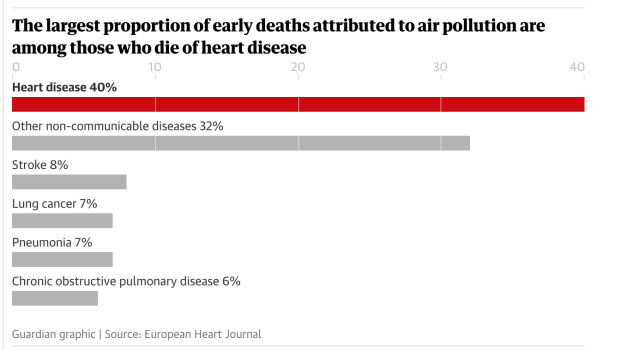
The new research, published in the European Heart Journal, indicates that while air pollution hits the lungs first, its impact via the bloodstream on heart disease and strokes is responsible for twice as many deaths as respiratory diseases.

Screen Shot 2019-03-13 at 08.09.17

The analysis builds on research published in September and confirms that calculation of 8.8m early deaths a year from outdoor air pollution around the world, double previous estimates.

“To put this into perspective, this means that air pollution causes more extra deaths a year than tobacco smoking,” said Prof Thomas Münzel at the University Medical Centre Mainz in Germany and one of the scientists behind the new study. “Smoking is avoidable but air pollution is not.”

Prof Jos Lelieveld of the Max-Plank Institute for Chemistry in Mainz and also part of the team, said: “Since most air pollutants come from the burning of fossil fuels, we need to switch to other sources of energy urgently. When we use clean, renewable energy, we are not just fulfilling the Paris agreement to mitigate the effects of climate change, we could also reduce air pollution-related death rates by up to 55%.”

The new research combined three sets of data: air pollution exposure, population density and age, and the health impacts of toxic air. It calculated a much higher number of premature deaths because better data on the wide impacts of air pollution is now available.

There was previously little data about the effect of high levels of air pollution and results from second-hand smoking studies were used instead, leading to an underestimate of deaths. There are now more than 40 large studies, including important research from China. Research also now covers a wider range of health impacts, including diabetes and high blood pressure, which also increases the estimated number of deaths.

The estimates of early deaths varied significantly between countries. In Germany, there were 154 early deaths per 100,000 people, with an average reduction of 2.4 years in life expectancy. In the UK, there were 98 deaths per 100,000 and a cut in lifespan of 1.5 years. Lelieveld said the UK’s lower number may be because Atlantic winds help to disperse pollution.

Münzel said small particles, less than 2.5 microns in size (PM2.5), are not paid sufficient attention when tackling cardiovascular disease. “The prevention guidelines for CVD must adopt air pollution as an important risk factor,” he said. The EU’s PM2.5 limit is more than double the World HealthOrganization (WHO) guideline used by Canada and Australia.

“The EU is lagging a long way behind,” Münzel said.“We as doctors and patients cannot alter the limits for air pollution, so the politicians have to stand up and give us an environment that keeps us safe.”

Prof Metin Avkiran of the British Heart Foundation said: “Air pollution is clearly a huge problem across Europe. We need to see WHO guidelines in UK law in order to drive decisive action to protect the nation’s health.”

Penny Woods, the chief executive of the British Lung Foundation, said: “Toxic air doesn’t just cut lives short. It also seriously affects the health and quality of life of millions of people.”

The scientists acknowledge there are large uncertainties in their early death estimates for Europe, which range from 645,000 to 934,000. Some deaths could have been misattributed to air pollution, but it is as likely that the true number of deaths could be even higher, they said.

The effects of air pollution on infant deaths was not included, because the evidence is not yet as strong. The new work also only considered PM2.5 and ozone, and not other particles, nitrogen dioxide or other pollutants.

via Air pollution deaths are double previous estimates, finds research | Environment | The Guardian

Posted in Air Quality, Europe, Health Effects of Air Pollution, London, Medical Studies, UK | Tagged , , , , , , | Leave a comment