Oslo, London lead push for greener transport – study

Oslo, London and Amsterdam are leading a shift by major cities to eliminate greenhouse gas emissions from transport, helped by new technologies that will curb climate change and reduce air pollution, a study showed on Tuesday.

European cities filled eight of the top 10 spots, along with Tokyo and Seoul, in the ranking of 35 cities by the independent London-based Centre for Economics and Business Research (CEBR), sponsored by smartphone chip maker Qualcomm (QCOM.O).

“Oslo is set to be the world’s first city with a zero emissions transportation solution,” according to the CEBR report that gauges both existing policies and plans to promote greener transport with everything from electric cars to bicycles.

The Norwegian capital’s metro, trams and buses already run largely on hydro-electricity and Norway has the highest percentage of electric cars of any nation. The Oslo council also plans to sharply restrict cars to its city centre.

The report said second-placed London “may not seem an example of a green city to all residents” but most rely on public transport, rather than cars, and are among the most energy efficient urban dwellers in the world.

“London is somewhat unfairly considered a smoggy, dark city,” CEBR managing economist Nina Skero told Reuters.

London also wants to cut greenhouse gas emissions by 60 percent from 1990 levels by 2025 and has promoted electric cars and bike-sharing, it said.

Amsterdam, in third, has done more than almost any other city to promote cycling and to cut emissions, it said.

CEBR’s index included city air pollution as one of 20 factors along with others such as city carbon emissions, levels of congestion, public investments in infrastructure, green spaces, charging points for electric vehicles, incentives for green travel and city commitments to low emissions.

Cairo was the bottom of the list of 35 cities, just below Nairobi, Mumbai and Istanbul, reflecting population growth and a focus on ending poverty that often means burning more gasoline.

Many cities have set more ambitious goals for restricting emissions than national governments after nearly 200 countries reached a climate agreement in Paris in 2015 to shift the world economy away from fossil fuels.

U.S. President Donald Trump, who doubts that man-made global warming has a human cause, is considering whether to pull out of the Paris Agreement.

San Francisco, in 14th, was the top-ranked city in the United States, where heavy reliance on cars rather than public transport limits options for cities to introduce radical goals to phase out emissions, the study said.

Source: Oslo, London lead push for greener transport – study | Reuters

Posted in Air Quality, Europe, London, UK, World News | Tagged , , , , , , | Leave a comment

Bad Air Contributing to Poor Mental Health and Being Unhappy, Study Finds

Economic progress in many developing countries is often accompanied by increased air pollution and this, in turn, is contributing to higher levels of depression, a new study led by the Yale School of Public Health finds.

The discovery contributes to the growing field of happiness economics, which quantifies the economic impact of personal well-being and life satisfaction, which are increasingly factored into policy-making decisions worldwide.

China’s increase in air pollution accounts for 22.5 percent of the actual decline in happiness in the country from 2007 to 2014, the study finds. In particular, those who are more concerned with environmental problems, work outdoors, earn lower incomes, or have young children are emotionally more sensitive to air pollution.

“Air pollution heavily influences mental and emotional states. It heightens social inequality and is an important factor in a person’s sense of their overall welfare,” said Assistant Professor Xi Chen, Ph.D., lead author of the study in the Journal of Environmental Economics and Management.

The research provides support to the Easterlin paradox, a concept in happiness economics which proposes that happiness does not correlate with economic growth, even though the rich are found to be happier than the poor at any given time. The study warns that GDP-obsessed development strategy in many fast growing economies in the world, such as India and China, may not bring about improved happiness.

This study shows for the first time that worsening air quality can be a key factor for reduced happiness amid rapid economic growth, which still puzzles scholars and policymakers. The study also offers the first population level evidence that air pollution is a major risk factor of depressive symptoms, and that the psychological costs of air pollution are well underestimated.

Chen and his team compared a national longitudinal survey on happiness in China, with air quality and weather information captured at the exact moments respondents were surveyed. The environmental data Chen used looked at levels of air pollutants, including particulate matter (PM), sulfur dioxide and nitrogen dioxide, as well as air temperature and precipitation in the time and geographical location in which interviews took place.

China is an ideal location for examining the Easterlin paradox in this novel way. According to Easterlin, in spite of unprecedented income growth, China’s average happiness did not improve from 1990 to 2010. The World Bank also places 16 of the world’s top 20 most polluted cities in China.

Previous studies attempting to connect air pollution and mental health have stumbled on finding reliable measurements of each; other methods, such as the use of aggregate data or cross-sectional data are prone to biases that compromise results. Using longitudinal data captures the effect of changes in air quality on the same set of people over time, strengthening the link between the two.

Chen’s novel methods were also able, unlike in previous studies, to distinguish between hedonistic happiness, or happiness that varies from moment to moment, and evaluative happiness, which is equated with overall life satisfaction. The results showed that while air pollution had a major impact on hedonistic happiness, it caused little change to measures of life satisfaction.

The study also sheds light on the impact of air pollution on a wide range of economic topics, and indicates that not enough weight is given to the ill effects of air pollution when measuring

factors such as worker productivity. While few studies exist that evaluate the social and economic effects of air pollution in low-income countries, Chen’s work contributes to the literature by adding air pollution to the list of risk factors for depression in the part of the world. Further research is needed into rates of depression in these countries, to understand the extent and impact of mental illness in the developing world.

Chen worked with Xiaobo Zhang, chair and professor of economics, and Ph.D. candidate, Xin Zhang, both of the National School of Development at Peking University in China, on the study.

Source: Bad Air Contributing to Poor Mental Health and Being Unhappy, Study Finds | Yale School of Public Health

Posted in Air Quality, Health Effects of Air Pollution, Medical Studies | Tagged , , , , , , | Leave a comment

Toxic fumes more deadly inside a car than on the pavement, researchers say

Being inside a car can expose you to 10 times the amount of fumes you would experience outside.

It is well known that cars produce dangerous levels of toxic fumes for passing pedestrians and cyclists. That threat increases substantially when vehicles sit idly in heavy traffic.

However, researchers have recently discovered that the fumes inhaled from sitting inside a car can be more deadly than being out of it.

That is because ventilation systems meant to purify the incoming air are still letting in high volumes of toxic particles, researchers have said, meaning car passengers are experiencing them in more confined spaces than pavements.

Scientists at Emissions Analytics have even found that the levels of toxins inside a car can reach 10 million particles in every breath – more than 10 times the comparable amount when outside the car.

Nick Molden of Emissions Analytics told the Times: “Drivers and their passengers can be getting very large doses of particulates if they are in a car with poor ventilation.

“The particles are so tiny – as small as 23 millionths of a millimetre – that they are invisible but long-term exposure is very bad for drivers’ health.”

Emissions Analytics have so far tested six cars and documented how much pollution builds up inside each vehicle. The firm said it would publish its findings when it has tested enough cars to give consumers better choices.

Of the cars it has already tested, the best-performing vehicle recorded an average 75 particles in each cubic centimetre (pcc) and a maximum of 2,400pcc. The worst-performing car recorded nearly 20,000pcc and a high of 435,000pcc.

On average, adults inhale 500cc of air per breath meaning that someone inside the worst-performing car would breathe in 10 million particles.

There are no regulations on air quality inside vehicles. However, the United Nations is in the process of overseeing talks to develop a new global standard.

Source: Toxic fumes more deadly inside a car than on the pavement, researchers say

Posted in Air Quality, Health Effects of Air Pollution | Tagged , , | Leave a comment

How to stop the construction industry choking our cities

Building firms need to start treating diesel emissions in the same way as asbestos, says air pollution expert

Poor air quality, with diesel the biggest culprit, is now thought to be the cause of 40,000 deaths in the UK each year.

But while cars and lorries have attracted most attention, less reported is the contribution of other polluters to the problem, particularly construction sites.

According to the most detailed air-quality study in the UK, the London Atmospheric Emissions Inventory, construction sites are responsible for approximately 7.5% of damaging nitrogen oxide (NOx) emissions, 8% of large particle emissions (PM10) and 14.5% of emissions of the most dangerous fine particles (PM2.5).

While a small amount of this (about 1%) is dust from site activities like demolition, the vast majority comes from the thousands of diesel diggers, generators and other machines operating on sites.

Yet this machinery is not held to the same emissions standards as on-road vehicles. What’s more, its proportionate impact will only get higher as on-road emissions drop, according to Daniel Marsh, King’s College London academic and project manager for the London Low Emission Construction Partnership.

So what are the chances the industry can improve?

Given the construction industry’s questionable history with asbestos, which wasn’t regulated until 1983 or completely banned until 1999 – almost 40 years after the cancer link was proven – some are sceptical. In 2005, the Health and Safety Executive found (pdf) that each year more than 230 construction workers die from cancers caused by exposure to diesel fumes, a figure it hasn’t since updated, even though more is now known about diesel’s noxious effects.

Marsh is particularly concerned about the impact on those working with the most polluting machines. He says: “Now on a construction site if you find asbestos it’s like a scene from ET, people swoop down in protective suits – it has become a huge priority. What the industry has failed to take on board is that diesel emissions should be considered in the same way.”

Despite this general failure to act, there are innovative firms in the industry trying to help clean up. The Greater London Authority is also attempting to clamp down on the problem. In January, Mayor Sadiq Khan said he intends to bring in a fine like the congestion charge to be paid by firms using polluting machines, beefing up groundbreaking emissions rules on central London building sites introduced under his predecessor Boris Johnson.

Leading the charge are firms like Off Grid Energy, which has developed products that turn traditional diesel generators (responsible for an estimated 25% of site emissions) into hybrid machines, reducing fuel consumption by around 60%.

Founder and CEO Danny Jones says the requirement for occasional very high “peak loads” of energy leads builders to use far bigger generators than necessary, which then remain on all day and night. In contrast, Off Grid’s battery system stores excess power, turns off generators when charged, and allows much smaller generators to be used. Just one proposed motorway works installation, Jones says, will be the equivalent of taking 225 cars off the road.

Another firm tackling the problem is Taylor Construction Plant, which is providing the first UK lighting rigs (mobile units that provide bright lighting, generally for working outside after dark but also for security) to be powered by hydrogen fuel cells. This means zero on-site emissions, at a total cost (including fuel) that product manager Simon Meades says is cheaper than the approximately 20,000 conventional generator-powered lighting rigs operating in the UK. After a slow initial uptake, Meades says demand has grown fivefold in the last year.

Even slower to change have been the fleets of diggers and excavators, which until now have relied on powerful diesel engines, but where hybrid technology is finally emerging. Swedish motoring giant Volvo, through its Volvo Construction Equipment subsidiary, has customers currently trialling a prototype hybrid excavator that generates electric power from the down-swing of its boom arm.

Patrick Lundblad, the firm’s senior VP of technology, says these trials have confirmed the vehicle uses around half the fuel of Volvo’s best-performing conventional excavators. Customer demand doesn’t seem to be an issue either.

“Wherever we go our customers want to have a couple of our green machines,” he says. However, producing it is not straightforward; 98% of the vehicle parts are new, and supply chains are immature, meaning the firm doesn’t know when it’ll be ready for sale.

This is not the only problem. Off Grid’s Jones says resistance to its products from the generator hire industry, which also makes money from selling diesel, came close to driving his firm out of business. “We’re a classic disruptive technology, and our challenge is the reluctance of the diesel generator rental industry to engage in a technology that changes what they do now.”

Source: How to stop the construction industry choking our cities | Guardian Sustainable Business | The Guardian

Posted in Air Quality, Europe, London, UK | Tagged , , , , , , , , | Leave a comment

Nearly 40 million people live in UK areas with illegal air pollution 

Exclusive: 59% of the population live in towns and cities where diesel pollution risks damaging health, new data from the Labour party shows
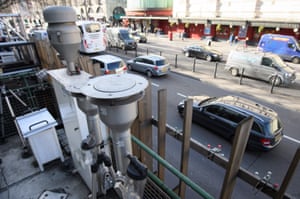
Nearly 40 million people in the UK are living in areas where illegal levels of air pollution from diesel vehicles risk damaging their health, according to analysis commissioned by the Labour party.

The extent of the air pollution crisis nationally is exposed in the data which shows 59% of the population are living in towns and cities where nitrogen dioxide (NO2) pollution breaches the lawful level of 40 micro grammes per cubic metre of air.

Labour says the air pollution crisis is a “national scandal”. Sue Hayman, shadow secretary of state for environment, food and rural affairs, said a Labour government would bring in a new clean air act to tackle what was a public health emergency.

“Labour will not allow the Tories to use the snap general election or Brexit to kick this issue into the long grass or water down standards that would put millions of UK adults and children at risk,” said Hayman.

She said the party was committed to putting in place a network of clean air zones across the UK where there are high emissions, and would act at an international level to close loopholes in emissions testing of vehicles.

The analysis published by Labour shows more than 38 million people, representing 59.3% of the UK population, are living in areas where levels of nitrogen dioxide pollution are above legal limits.

Local authorities including Aberdeen, Birmingham, Bournemouth, Burnley, Derby, Chelmsford, Leeds, Northampton, Richmond and Sheffield – among many others – have NO2 levels above the legal limit.

The new figures were revealed as the government made a last-minute application to the high court to delay publication of a new tougher air quality plan to tackle the pollution crisis.

On Friday at 7pm, ministers lodged the court application – too late for it to be considered.

Judges had ordered them to come up with a tough new draft air quality plan by 4pm this coming Monday – 24 April – after judges said the original measures were so poor as to be unlawful.

James Thornton, CEO of legal NGO ClientEarth, which successfully took the government to court over its air quality plans, said the Labour data showed that air pollution was a national problem which required a national solution.

“Our court case forced the government to come up with new plans to bring down illegal levels of air pollution across the country,” said Thornton.

“Those plans must include a national network of clean air zones to keep the dirtiest diesel vehicles out of pollution hotspots, if we are to stand any chance of dealing with this public health crisis.”

ClientEarth condemned the government’s application to the high court to delay the plans being published.

Thornton said: “This is not a political issue but a public health issue. Whichever party is in power, the British public need to see an air quality plan which relies on good scientific evidence and which ensures that people no longer have to breathe toxic air and suffer the grave consequences to their health as a result.”

ClientEarth will be able to raise objections if the new draft plan – when it is eventually published after the election – does not fulfil the NGO’s five clear lines in the sand.

These are:

  • The need for robust modelling and roadside, not lab-based, emissions testing.
  • Proper funding to make sure cities and towns can delivery the necessary changes.
  • Mandated clean air zones in every town and city with illegal levels of air pollution.
  • A diesel scrappage scheme or other form of compensation for drivers who bought their cars in good faith as successive governments favoured diesel over other fuels.

The Guardian revealed earlier this month that tens of thousands of children in schools and nurseries across England and Wales are being exposed to illegal levels of damaging air pollution from diesel vehicles.

The joint investigation with Greenpeace, which examined the government’s most recent air pollution modelling, showed 2,091 schools, nurseries, further education centres and after-school clubs are within 150 metres of a road emitting illegal levels of nitrogen dioxide.

European data shows modern cars emit 10 times more noxious fumes than trucks and buses – which are subject to a much stricter testing regime.

Research consistently shows exposure to traffic fumes is harmful for children and adults. Children are more vulnerable because their lungs are still developing and exposure to nitrogen dioxide reduces lung growth, produces long term ill-health and can cause premature death.

Nitrogen dioxide emissions from diesel traffic cause 23,500 of the 40,000 premature deaths from air pollution each year, according to figures from the Department for Environment, Food and Rural Affairs (Defra). In April last year, MPs said air pollution was a public health emergency.

In London, Labour mayor Sadiq Khan will force polluting cars to pay up to £24 a day to drive into the city when he creates an ultra-low emission zone in 2019. The price will comprise the existing congestion charge of £11.50 per day, which applies to all cars entering inner London, plus an extra amount.

The government’s original air quality plan involved clean air zones in five cities and an ultra-low emission zone in London – but these were rejected by the high court.

Source: Nearly 40 million people live in UK areas with illegal air pollution | Environment | The Guardian

Posted in Air Quality, Europe, UK | Tagged , , , , , , , , , , , , , , , , , | Leave a comment

NYC air pollution at all-time low, data reveals 

New Yorkers can breathe a little easier — air pollution in the city is at the lowest level ever recorded, new data from the city Health Department shows.

The amount of particulate matter in the air — considered the most dangerous urban pollutant because it can penetrate deep into the lungs and enter the bloodstream, contributing to lung and heart disease — has fallen 18% since 2009, according to the report set to be released Thursday.

Sulfur dioxide saw the biggest drop — 84% over seven years — after the city tightened heating oil rules.

“We’ve seen air pollution improvements happening across the city, due to a lot of federal, state and local programs that have reduced pollution,” said report author Iyad Kheirbek.

“We know that improvements in air quality reduce risks of … asthma emergency department visits, cardiovascular hospitalizations, things like heart attacks and stroke.”

Nitrogen dioxide levels also fell 23% through 2015, the most recent year full data is available. Nitric oxide declined 28%, and black carbon 18%.

The worst pollution levels for particulate matter were in Midtown and neighborhoods with both heavy car traffic and a lot of buildings burning fossil fuels had the dirtiest air, including areas in Manhattan and part of the Bronx.

The cleanest air for particulate matter was in the Rockaways and Broad Channel.

Air pollution levels in the city dropped in part because of federal rules regulating emissions from power plants — which could be axed under President Trump.

Source: EXCLUSIVE: NYC air pollution at all-time low, data reveals – NY Daily News

Posted in Air Quality, USA & Canada | Tagged , , , | Leave a comment

125 million Americans breathe unhealthy levels of air pollution where they live, 2017 ‘State of the Air’ report says

The American Lung Association’s annual “State of the Air” report found that 125 million Americans live in counties with unhealthful levels of either ozone or particle pollution.

While that number has decreased from the previous report, and the report card found continued improvement in air quality, it was found that there is a continued increase in dangerous spikes in particle pollution.

The 2017 report, released April 19, uses air quality data from 2013 to 2015, according to Janice Nolen, report lead author and assistant vice president for national policy for the American Lung Association. The data is collected through air quality monitors managed by states, cities, counties, tribes and federal agencies.

“The results are an amazing testimony to how effective the Clean Air Act has been at reducing pollution across the nation,” Nolen said. “But we still have a lot of challenges ahead and much further to go.”

The spikes in particle pollution were largely due to temperature inversions as well as an increase of drought that led to wildfires. While wildfires created harmful particle pollution, temperature increases work to trap pollutants in the air.

The global temperature has not been a friend to those fighting against pollution over the past few years. The annual global temperature record has been broken over the past three consecutive years (2014, 2015 and 2016), according to the National Oceanic and Atmospheric Administration.

In addition, 2013, 2014 and 2015 yielded some of the worst drought years that Western states, such as California, have endured.

Between the drought and temperature spikes in California, the 2017 report showed that the state continues to experience a severe problem with ozone and particle pollution. Year after year, California cities dominate the report for areas that experienced the most short-term particle pollution, the most year-round particle pollution, as well as the most ozone-polluted cities.

For all but one report, Los Angeles has been the most polluted city for ozone, and this year was no exception, according to Nolen. However, Nolen said there are some small victories for California. On this report, Los Angeles reached its lowest levels of ozone yet.

“That’s a big statement of progress,” Nolen said.

At present, 76.54 percent of California is experiencing no drought whatsoever, according to the United States Drought Monitor. That number one year ago was only 3.55 percent of the state. It is predicted that the state’s unusually wet winter will help the state with air pollution this year, but that data will not be analyzed for another few years.

There were six cities found to have no days when ozone or particle pollution reached unhealthy levels and had the lowest year-round levels of particle pollution. Wilmington, North Carolina, was the lone newcomer to this list.

“Wilmington is a good example of how cleaning up the power plants in the eastern half of the country has helped reduce pollution,” Nolen said.

Breathing either ozone or particle pollution lodges these pollutants into one’s lungs and can shorten one’s life by weeks or even months. The deadly pollutants can cause an array of health problems including asthma attacks, lung cancer and cardiovascular harm such as heart attacks.

“The more that we look beyond the lungs, the more harm we’re finding from breathing air pollution for long periods of time,” Nolen said.

The lungs develop until a person is fully grown, so children and teenagers who live in highly polluted areas are constantly at risk of a variety of health issues. After age 65, the lungs start to weaken, making anyone over that age at greater risk of health issues.

“Even healthy adults who work or exercise outdoors can be affected,” Nolen said.

Those with low income are especially affected as they tend to live in areas or near sources that are more heavily polluted.

Going forward, Nolen said that to see continued progress the Clean Air Act must remain a strong tool at environmentalists disposal. Mitigating climate change must also be a top priority, he said.

“If we aren’t dealing with climate change, we aren’t going to be able to reduce the pollution that we need to reduce in order to protect people,” Nolen said.

To view the report and check the quality of air in your local community, visit stateoftheair.org.

Source: 125 million Americans breathe unhealthy levels of air pollution where they live, 2017 ‘State of the Air’ report says

Posted in Air Quality, USA & Canada | Tagged , , , , , , , | Leave a comment

Belfast air pollution levels ‘among the worst in UK’

Air pollution levels in Belfast have been branded among the worst in the UK, with one monitoring station breaching EU legal limits for three years in a row.

The station at Stockman’s Lane recorded an annual average nitrogen dioxide reading of 50 microgrammes per metre squared for the first three months of 2017 – 25% higher than the EU legal limit of 40 microgrammes per metre squared.

The same average score was also recorded in 2015 and 2016, according to The Times journalist Peter Yeung, who carried out an investigation into the impact of air pollution in the UK which found a rise in the number of communities blighted by toxic air. The Belfast air pollution figure, derived from DEFRA stats, was one of the worst in the UK, he said.

“There has been no decline – despite supposed political attempts to reduce emissions,” he said.

Diesel cars are among the leading producers of nitrogen dioxide, prompting calls for a crackdown by Doctors Against Diesel founding member Jonathan Grigg, who said the cars should be removed from the roads as soon as possible.

“Exposure over a very long time has an insidious effect. It suppresses the lung growth of children, it’s involved in the onset of asthma, a decline in lung function as you age, and there’s emerging evidence of it causing cognitive problems and also reduced growth of foetuses,” he said. “Targeting diesel cars is a very easy way to reduce emissions. At the moment, it’s still relatively advantageous to drive a di esel vehicle – there’s not enough disincentive.”

Belfast Green Party councillor Georgina Milne, who is a research scientist, said she was worried, but not surprised at the news. “Indeed, there are four air quality management areas in Belfast declared for breaches of Nitrogen Dioxide (NO2) and Particulate Matter (PM),” she said.

“One of these areas is on the busy Newtownards Road, in my East Belfast constituency. Indeed, many residents have spoken about the poor air quality.”

Cllr Milne said transport emissions are a huge issue right across Belfast and it is time to move towards more sustainable transport solutions.

“The human and financial cost of doing nothing is huge – over 500 deaths in Northern Ireland per year are attributed to air pollution. This represents more deaths per year than road traffic collisions and passive smoking combined,” she said.

“Deaths from air pollution-related disease cost the NHS over £20bnper year – that’s nearly 1/5th of the overall budget.

“We need the traditional parties to come together, to form an Executive and deliver a budget so that these life and death issues can be tackled.”

Friends of the Earth activist, Declan Allison said: “Air pollution is linked to lung cancer, heart disease, asthma and diabetes, with 40,000 people in the UK dying early each year as a result. It is unacceptable to persistently be in breach of legal air quality limits.”

Source: Belfast air pollution levels ‘among the worst in UK’ – BelfastTelegraph.co.uk

Posted in Air Quality, UK | Tagged , , , | Leave a comment