Singapore’s Air Quality Remains Unhealthy as Haze Worsens

Singapore’s air quality stood at unhealthy levels as haze from Indonesian forest fires intensified Friday, blanketing the city-state in a layer of smoke.

The three-hourly air pollution index peaked at 215 as of 2 p.m. before slipping back to 188 at 3 p.m., according to the National Environment Agency. Readings above 200 are classed as “very unhealthy” and the government advises people to reduce prolonged outdoor activities.

Fire hotspots have appeared over Indonesia’s Sumatra island and West Kalimantan, where the Indonesian government said last week it deployed fire fighters. It has also used cloud seeding and water bombing to try to extinguish the fires.

The number of hotspots is lower than 2015, when dry conditions from the El Nino weather phenomenon drove the pollution reading to a record, forcing the city-state and neighboring Malaysia to shut schools.

Satellite data showed a total of 1,950 hotspots from January through to Aug. 18, compared with 6,595 in the same period a year ago.

The haze caused by plantation land-burning has become an annual occurrence in Southeast Asia and leads to periodic tensions with the Indonesian government. Smoke from illegal burning to clear land for palm oil and paper plantations that blanketed Singapore, parts of Indonesia, Malaysia and Thailand last year briefly turned Indonesia into the world’s biggest climate polluter.

Smoke from Indonesian forest fires shrouded the city-state to such an extent last year that the pollution index went well above 300, forcing Singapore to close schools and cancel a number of public events. A reading exceeding 300 is deemed hazardous.

As Singapore distributed N95 masks to “vulnerable and needy” citizens and permanent residents across the island last year, there were concerns that rising pollution would affect the annual Singapore Grand Prix. The event went ahead and this year’s Grand Prix is scheduled for Sept. 16-18.

Source: Singapore’s Air Quality Remains Unhealthy as Haze Worsens – Bloomberg

Posted in Air Quality, Asia, Singapore | Tagged , , , | Leave a comment

Motorists breathe in 40% more deadly pollutants when sat at red lights 

Car emissions take longer to disperse in built-up areas and end up accumulating in the air at traffic lights and junctions, researchers from the University of Surrey found.

  • Drivers inhale seven times more pollutants at red lights than pedestrians
  • Pollutants can be cut by more than 75% by simply closing the window
  • Motorists should leave more space between cars to allow fumes to escape
  • Safest option for fans is the setting where they re-circulate air in the car

Sitting in a traffic jam is enough to send even a calm person’s blood pressure soaring.

But new research has found it could be even worse for your health than previously thought.

Being stuck at a red light exposes motorists to deadly pollutants which could seriously damage health, scientists warn.

They found pollution levels inside cars are up to 40 per cent higher in queues and at a busy junctions.

And fans which draw in air from outside could be adding to the danger.

The World Health Organisation (WHO) has warned outdoor air pollution is as carcinogenic to humans as smoking.

It is expected to kill more than 6.5 million people a year worldwide by 2050 – twice the current number, a study has found.

Globally, the problem causes around 3.3 million premature deaths annually – mainly in Asia.

The premature deaths are due to two key pollutants – fine particulate matter known as PM2.5s – and the toxic gas nitrogen dioxide, both produced by diesel cars, lorries and buses.

The pollutants affect a person’s lung capacity and growth, and are linked to ailments including lung cancer and heart disease.

And emissions created by traffic queues take more time to disperse, especially in built-up areas.

They end up accumulating in the air at traffic lights, a known pollution hot spot for pedestrians and road users.

But contrary to popular belief, it is drivers who are the most affected.

Researchers from the University of Surrey found those who have their windows open breathe in seven times more PM10 – pollutants up to 10 micrometres in diameter –  than pedestrians at junctions.

Particles of this size can be inhaled deep into the lungs and can also become trapped in the nose, mouth or throat.

From here, they can then be absorbed into the blood and have a negative effect on the body.

The study monitored pollution levels at traffic lights and inside a car under five different ventilation settings over 3.7 miles (6km), passing through 10 different junctions.

However there is a simple solution.

Motorists caught up in queues can slash the levels of pollutants inside their vehicle by more than three-quarters by simply closing the window and switching off the fan.

Drivers should also leave more space between bumpers so exhaust fumes have greater chance to disperse, the researchers say.

They found the safest option is to put fans onto the setting where they re-circulate air within the car, without drawing polluted air in from outside.

Lead researcher Dr Prashant Kumar, said: ‘Travelling time has increased over the years in the UK and elsewhere, indicating a growing need for accurate exposure assessment during daily commuting.

‘Our recent study has shown in some cases as low as 2 per cent of the commuting time spent at traffic intersections could contribute as high as 25 per cent of the total commuting exposure to particle number concentrations (PNCs).

‘If the fan or heater needs to be on, the best setting would be to have the air re-circulating within the car without drawing in air from outdoors.’

Dr Kumar showed last year drivers stuck at traffic lights were exposed up to 29 times more harmful pollution particles than those driving in free flowing traffic.

The latest findings were published in the journal Environmental Science: Processes & Impacts.

Source: Motorists breathe in 40% more deadly pollutants when sat at red lights | Daily Mail Online

Posted in Air Quality, Health Effects of Air Pollution | Tagged , , , , , , | Leave a comment

Smoke from vehicles polluting Lake City

Increasing number of vehicles as well as the ever rising population have been causing environmental pollution in the tourist city of Pokhara.

The lake city has become the most polluted city after Kathmandu due to escalating environmental pollution. Earlier, the government had formed a working team to carry out a study and suggest measures to manage the transport in Pokhara. The team had examined air pollution in five areas of the city.

Dhiraj Pokhrel, general secretary of the Society for Legal and Environment Analysis and Development Research, who was assigned the responsibility of examining air quality in the city, said Pokhara’s air quality was terrible. Since Pokhara is a bowl-shaped Valley, it takes a long time for the air to exit the city.

The research centre had collected air samples from Prithvi Chowk, Mahendrapul, Halnachowk, Harichowk and Nadipur areas.

According to the study, high content of carbon mono oxide has been found in places with high pressure of vehicles. Similarly, dust particles weighing below 10 micro grams were also found in excessive amount.

As the air in Pokhara contains sulfur-dioxide and nitrogen oxide, immediate measures need to be taken to reduce air pollution.

The team has recommended pollution-free vehicles to curb pollution in the Lake City. The team has submitted a 16-point report to the Ministry of Physical Infrastructure and Transport.

They have suggested establishing an Air Quality Monitoring Centre to inspect air quality in the city at the earliest. Other recommendations include implementation of green stickers on vehicles, no permission to new vehicles and promoting electric, gas, and solar vehicles.

A member of the working team, Gandhiraj Giri, said his team had also suggested adding large vehicles with many seats.

Source: Smoke from vehicles polluting Lake City

Posted in Air Quality, Asia | Tagged , , , | Leave a comment

Air pollution threat hidden as research ‘presumes people are at home’: study 

Previous investigations fail to reveal impact of ‘world’s largest human health threat’ because they do not account for people’s movement, researchers say
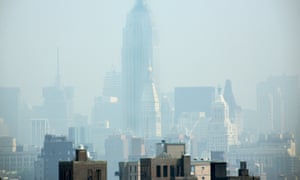
The true impact of air pollution has been obscured by the failure to consider people’s exposure as they move around during the day, according to a new study that has mapped the hotspots of New York’s air pollution based on where people gather for work or recreation.

The research cites air pollution as “the world’s single largest environment and human health threat” but laments that the problem has not previously been “considered spatially and temporally”, with most studies basing a person’s pollution exposure on where they live.

Using information obtained from cellphone towers, the researchers were able to build up a picture of millions of New Yorkers’ movements over the course of 120 days. They used a formula that charts population density as well as pollution levels to look at how people’s exposure to PM2.5, an airborne particle linked to an array of health problems, varies according to where they typically congregate during the day.

The researchers found that areas of midtown and lower Manhattan, which have some of the highest PM2.5 levels, saw large numbers of people exposed during the day, but less so at night. Conversely, areas of southern Brooklyn with high PM2.5 levels peaked in pollution exposure at night as people returned to their neighborhoods after work. Areas of Queens near LaGuardia airport remained elevated throughout the day.

Concentrations of PM2.5 also vary throughout the day and affect the identification of hotspots, depending on factors including power generation and traffic.
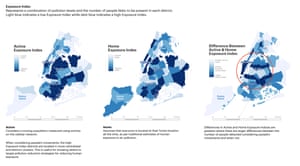
 

“Air pollution is linked to respiratory and cardiovascular illnesses but we have previously presumed that people exposed are at home all the time,” said Dr Marguerite Nyhan, lead author and a researcher in environmental health at Harvard University, although all the research was conducted at MIT’s Senseable City Lab.

“We know that’s not a true assessment of exposure as more people are exposed as they go from home to work and when they are socializing. We found that lots of people are being exposed in central Brooklyn and Queens and lower Manhattan, where people work and recreate.

“But that’s not the way cities are typically regulated for air pollution – they just look at highly polluted areas rather than the amount of time people spend in them.”

Disregarding population shifts throughout the day, PM2.5 air pollution in New York is greatest in midtown and downtown Manhattan, parts of the Bronx and areas of Queens and Brooklyn that meet the East River. These areas have PM2.5 levels that are around 14 micrograms per square meter – higher than the annual average advised as acceptable by the World Health Organisation (WHO).

According to WHO, worldwide around 7 million people a year die as a result of air pollution. The US accounts for around 200,000 of these annual deaths, with most linked to fumes from cars, trucks and other transportation, as well as emissions from power plants. Particles of PM2.5, which are around 30 times smaller than a human hair in width, can worsen asthma and heart disease and are linked to reduced lung function.

A study commissioned by New York City found that annual average PM2.5 levels fell by 16% in the six years to 2014 but warned that air pollutants “remain at levels that can be harmful to public health, particularly among seniors, children and those with pre-existing health conditions”.

Asked whether the city considers peoples’ exposure as they move around the metropolis, a spokesman for New York’s mayor, Bill de Blasio, said: “The city’s monitoring study is designed to assess outdoor, street-level air pollutant levels across the city.

“So in a sense, the data can be used to assess exposures at residences, places of employment, or parks and other recreation areas. The study is not designed to assess any single exposure setting.”

De Blasio has set a goal for New York to have the cleanest air of any US city by 2030, pledging to cut PM2.5 levels by 50% in this timeframe by adding electric vehicles to the city fleet, phasing in clean sources of electricity and making buildings more energy efficient.

Nyhan said her research, published in Environmental Science & Technology, could be used if New York wanted to go down the path of “low emissions zones” as London has done. Motorists driving in most areas of Greater London have to pay a daily charge unless their vehicles meet European emissions standards.

“If you identify areas of higher exposure, you can implement low emissions zones there for the maximum health benefit,” said Nyhan, who plans to undertake a similar spatial study in Boston.

“In the last 100 years, air quality has certainly improved but we are still seeing problems in larger cities. We are seeing a transition to electric vehicles but it’s not quick enough – more and more people are residing in cities, which means more people are contributing to and being exposed to pollution in urban areas.”

Source: Air pollution threat hidden as research ‘presumes people are at home’: study | Environment | The Guardian

Posted in Air Quality | Tagged , , , , | Leave a comment

London pollution and toxic air worsened by pollution from fresh food delivery 

Pollution is being made worse by London’s increasing reliance on fresh food bought online and home-delivered by diesel-powered trucks, the boss of a clean tech firm warned today.

Toby Peters, founder of Croydon-based Dearman, spoke out after a new report found refrigerated delivery trucks “emit disproportionate amounts of toxic pollutants”.

Mr Peters, whose company is already working with Sainsbury’s to trial a new zero-emission lorry, said supermarkets must act to reduce their reliance on diesel fleets to improve air quality.

The report, conducted by YouGov on behalf of Dearman and the Clean Air Alliance pressure group, found refrigerated truck journeys to London homes and supermarket depots emitted the annual equivalent exhaust fumes of a car driving 2.4 million laps around the M25.

Pollution being pushed into London’s skies from delivery lorries is often worsened by a second diesel engine used to power large on-board fridges.

It is claimed that these diesel-powered fridges storing fresh fruit, vegetables, meat and fish can emit nearly 30 times as much toxic particulate matter and nitrogen dioxide than a lorry engine.

The report said: “Refrigerated vehicles are a vital link in our food supply, but can also emit disproportionate amounts of toxic pollutants, whose significance has not yet been recognised in the policies being developed to tackle air pollution in Britain’s cities. In trucks and articulated trailers, cooling is usually powered by a secondary engine that is poorly regulated, inefficient and can emit far more particulate matter and oxides of nitrogen than the main engine pulling it around.”

Commenting on the report, Mr Peters said: “The way we buy food is changing by the day. Supermarkets are delivering our weekly shop to our door, we’ve seen a boom in convenience stores and we are eating more and more chilled food.

“All that requires more polluting, diesel-powered refrigerated trucks on the streets where we live. But if we are going to clean up the air we breathe, we have to tackle the most polluting diesel engines first — and that includes the ones that keep our food cold.”

Of the Londoners interviewed for the report, more than three quarters backed the introduction of an Ultra Low Emission Zone. The zone means vehicles must meet exhaust emission standards or pay a daily charge to travel inside.

As part of Dearman’s Sainsbury’s trial, they have built the world’s first delivery truck with a zero emissions air-cooled refrigeration unit powered by liquid nitrogen.

The vehicle is undergoing a three-month test, during which it is expected to save up to 1.6 tonnes of carbon dioxide, 37kg of nitrogen oxides and 2kg of particulates.

Source: London pollution and toxic air worsened by pollution from fresh food delivery | London | News | London Evening Standard

Posted in Air Quality, Europe, London, UK | Tagged , , , , | Leave a comment

Essential oils could counter lung and liver ailments caused by air pollution, research suggests: Extracts from plants such as cloves, aniseed, fennel and ylang-ylang studied

Certain ingredients in essential oils made from plants such as cloves, anise, fennel and ylang-ylang could serve as a natural treatment of lung and liver conditions caused by air pollution, according to a new study.

Certain ingredients in essential oils made from plants such as cloves, anise, fennel and ylang-ylang could serve as a natural treatment of lung and liver conditions caused by air pollution. This is according to Miriana Kfoury of the Unité de Chimie Environnementale et Interactions sur le Vivant, Université du Littoral Côte d’Opale in France and the Lebanese University in Lebanon. She is the lead author of a study in Springer’s journalEnvironmental Chemistry Letters. It is the first of its kind to evaluate the value of using certain essential oil compounds to treat inflammation caused by the fine particles that are typical of hazy, polluted air, and that are known to be carcinogenic.

Plants naturally contain various essential oils that are made up of different compounds. Some of these have been found to have antioxidant value, and to also be able to fight inflammation. A group of organic compounds called phenylpropanoids are found in the essential oils of some plants, and show promise as possible anti-inflammatory substances. Among these are trans-anethole (a flavor component of anise and fennel), estragole (found in basil), eugenol (which occurs in clove bud oil) and isoeugenol (contained in ylang ylang).

Kfoury and her collaborators first collected air pollutant samples containing fine particles in Beirut, Lebanon. In laboratory tests, the samples were then introduced to human cell cultures of normal bronchial epithelial cells (BEAS-2B) and cancer derived hepatic cells (HepG2). The fine particle matter was found to induce inflammation in the cells — these started to secrete the pro-inflammatory cytokines IL-6 and IL-8 (substances that are secreted during infections and tissue damage). Cytokin levels normally increase when the body’s immune system is fighting a specific infection.

Next, the researchers established that the trans-anethole, estragole, eugenol and isoeugenol all have so-called cytotoxicity, which means that they could cause cell death at relatively high concentrations. In this evaluation, they were able to determine the level of cytotoxicity of these oil compounds. This was important in order to establish the maximum dose to be selected in the next step, namely the assessment for anti-inflammatory properties. In the second round of tests, the four compounds were introduced to the combination of cell lines and air pollutants to see whether these could protect liver and lung cells damaged by fine particle air pollutants. It was found that the essential oil compounds tested decrease the levels of the two types of cytokines in the samples. The levels of cytokine IL-6 decreased up to 96 percent, and the levels of cytokine IL-8 by 87 percent.

“The findings provide the first evidence that natural essential oil components counteract the inflammatory effects of particulate matter, such as that contained in polluted air,” says Kfoury.


Story Source:

The above post is reprinted from materials provided by Springer. Note: Content may be edited for style and length.

Source: Essential oils could counter lung and liver ailments caused by air pollution, research suggests: Extracts from plants such as cloves, aniseed, fennel and ylang-ylang studied — ScienceDaily

Posted in Air Quality, Health Effects of Air Pollution | Tagged , | Leave a comment

Commonly Used Cheap Cloth Mask Not Very Effective Against Air Pollution

A new study reveals that the cheap cloth masks, most commonly used in highly polluted areas in Asia and Southeast Asia, could not protect people from the harmful effects of air pollution.

The study, published in the Journal of Exposure & Environmental Epidemiology, showed that inexpensive cloth mask, about 10 to 15 cents each, performed poorly compared to standard hygiene mask known as the N95, which costs about $3 to $4 each.

“This has clear public health risk,” said Richard Peltier, an environmental health scientist at the University of Massachusetts Amherst and co-author of the study, in a statement. “Especially if an individual makes personal choices not to avoid high concentration environments because they assume they are protected from these contaminants.”

For the study, the researchers conducted a series of experiments on various types of mask: one pleated surgical type, two cloths and one cone-shaped cloth with exhalation flaps. The researches simulated real-world conditions and tested the effectiveness of each mask in filtering out five different synthetic aerosol particle sizes plus three particle sizes of diluted whole diesel exhaust.

The cloth mask with exhaust valves is the best performing one among the tested, with 80 to 90 percent reduction of synthetic particles and about 57 percent of diesel exhaust.

On the other hand, the least expensive cloth mask only removed 39 to 65 percent of standard particles of 30, 100 and 500 nanometers, and 1 and 2.5 micrometers. Plain cloth mask performed better than the others in removing larger particles size, but performed poorly in smaller particles, which are about 2.5 micrometers and often considered to be more harmful than the larger particles due to their ability to penetrate the lungs deeper.

Furthermore, the researchers discovered that effectiveness of the masks to filter air pollution rely on its shape and ability to mold to the face. The cone-shaped mask and snug-fitting surgical mask performed better than the looser-fitting masks.

Their findings are very significant because people who are wearing cloth mask are oftentimes given false sense of security. Because they feel secure and protected by their mask, people sometimes walk freely in highly polluted areas, leading to unwanted health risks.

Source: Commonly Used Cheap Cloth Mask Not Very Effective Against Air Pollution : News : Nature World News

Posted in Air Quality, Asia, Health Effects of Air Pollution | Tagged , , , | Leave a comment

Health Risks from Wildfires in U.S. West To Increase Under Climate Change

A surge in major wildfire events in the U.S. West as a consequence of climate change will expose tens of millions of Americans to high levels of air pollution in the coming decades, according to a new Yale-led study conducted with collaborators from Harvard.

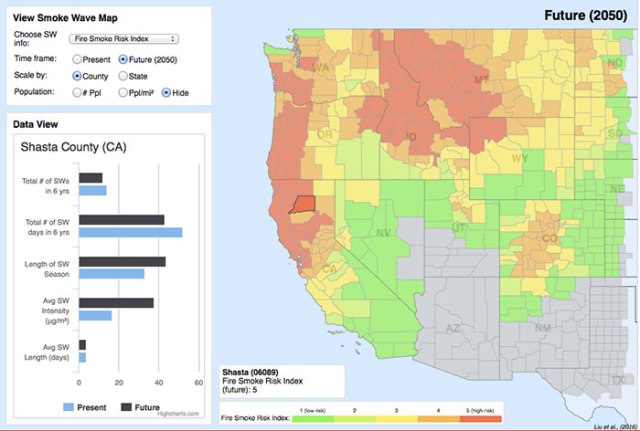
The researchers estimated air pollution from past and projected future wildfires in 561 western counties, and found that by mid-century more than 82 million people will experience “smoke waves,” or consecutive days with high air pollution related to fires.

The regions likely to receive the highest exposure to wildfire smoke in the future include northern California, western Oregon, and the Great Plains.

Their results, published in the journal Climatic Change, point to the need for new or modified wildfire management and evacuation programs in the nation’s high-risk regions, said Jia Coco Liu, a recent Ph.D. graduate at the Yale School of Forestry & Environmental Studies (F&ES) and lead author of the study.

“Our study illustrates that smoke waves are likely to be longer, more intense, and more frequent under climate change,” Liu said. “This raises critical health, ecological, and economic concerns. Identifying communities that will be most affected in the future will inform development of fire management strategies and disaster preparedness programs.”

Other authors include Michelle Bell, the Mary E. Pinchot Professor of Environmental Health at F&ES; Keita Ebisu, a former doctoral student with Dr. Bell; as well as colleagues at Harvard, Colorado State University, and the University of Michigan.

Smoke from wildfires, which are becoming more frequent and intense in the U.S. West as the climate changes, contains large amounts of fine particulate matter, or PM2.5, which can have profound impacts on human health.

Interactive Map

smoke wave map liu etal

But while wildfires are estimated to contribute about 18 percent of the total PM2.5 emissions in the U.S., many questions remain on how these emissions will affect human populations, including how overall air quality will be affected, how these levels will change under climate change, and which regions are to most likely to be impacted.

Using sophisticated atmospheric and climate models, the researchers estimated the levels of PM2.5 directly attributable to wildfires during a recent six-year period, 2004 to 2009, as well as under projected future climate change conditions (2046-2051).

Twenty counties that are currently free from smoke waves are expected to experience at least one in the future six-year period. The length of the smoke wave season, the period between the first and last smoke wave day, is estimated to increase by an average of 15 days in more than 62.5 percent of the counties.

About 56 percent of the counties currently affected by smoke waves — including most located in the forests of the northern Rocky Mountains and coastal counties — will likely face more intense smoke waves in the future. (About 19 percent will have less intense smoke waves.)

The researchers also developed an interactive map to illustrate their findings.

“We hope these results will advance the understanding of the impacts of an increasing threat of wildfire smoke, and aid in the design of early warning systems, fire suppression policies and public health programs,” said Liu.

Source: Health Risks from Wildfires in U.S. West To Increase Under Climate Change

Posted in Air Quality, USA & Canada | Tagged , , , , , | Leave a comment