Coal burning aggravating air pollution: Greenpeace 

Burning of coal is major source of air pollution, and thermal power plants including, those in NCR, are the main culprits for increase in deadly pollutants all over the country during past five years, a new report on Monday claimed.

Greenpeace India in its report ‘Out of Sight – How coal burning advances India’s Air Pollution Crisis’ released on Monday, claimed thermal power generation is causing a “steady” deterioration in the overall air quality in North India.

“The report reveals coal as the largest overlooked source of air pollution and identifies air pollution emission hotspots in India visibly linked to thermal power plants in the area. Satellite based analysis from 2009 to 2015 reveals the thermal power plant clusters in Singrauli, Korba Raigarh, Angul, Chandrapur, Mundra and NCR were the source of SO2 (sulphur dioxide) and NO2 (nitrogen dioxide) emission growth in India over the past five years, showing nationwide increase of 13 per cent and 31 per cent respectively for PM2.5 and SO2,” the NGO said in a statement.

It said using similar data, earlier studies have shown an increase of 20 per cent in the regional trends for NO2 levels over the last decade. Secondary particulate matter formed by SO2 and NO2 is one of the major contributors to PM2.5 levels.

The NGO said that multiple research studies have emphasised 30 per cent to 34 per cent of total PM2.5 concentration in India is contributed by the secondary particulates, most of which come from burning of fossil fuels. Large industrial clusters, hotspots of SO2 and NO2 emissions, are found to be highest coal guzzlers, it said.

“To address the air pollution crisis, we need to accept that coal burning is responsible for increased emissions of SO2 and NO2 contributing to overall particulate matter concentration and identify the correlation between such increases and major coal consuming hot-spots in the country. An estimated 75-90 per cent of sulphates and 50 per cent nitrates are formed from SO2 and NOx emissions primarily originating from the thermal power plants. The satellite images clearly show that the emissions are highest in the regions where a lot of coal is being burnt,” said Sunil Dahiya, a Greenpeace India Campaigner.

Particulate matter, or PM, is the term for particles found in the air, including dust, dirt, soot, smoke, and liquid droplets. Particles less than 2.5 micrometres in diameter (PM2.5) are referred to as “fine” particles and are believed to pose the greatest health risks. Because of their small size (approximately 1/30th the average width of a human hair), they can lodge deeply into the lungs.

Greenpeace India said the current installed capacity of thermal power generation is causing a “steady deterioration” in the overall air quality in North India.

A recent report by IIT Kanpur on Delhi’s air pollution indicated that it would need a comprehensive and systematic plan in place for an area of at least 300 kilometres around Delhi to make a meaningful impact on the air quality. The report said that urgent, coordinated inter-agency efforts is needed to resolve the crisis not just for Delhi but to address the pollution in most north Indian cities.

“Greenpeace is calling for an ambitious and systematic national clean air action plan with focused targets, clear timelines and demonstrable accountability towards public health. Now that we have a clear understanding of the primary and secondary sources causing pollution, it provides us an opportunity to test India’s emergency response plan on air pollution,” added Dahiya.

Source: Coal burning aggravating air pollution: Greenpeace | Latest News & Updates at Daily News & Analysis

Posted in Air Quality, Asia, India | Tagged , , , , , , | Leave a comment

The global air pollution ‘blindspot’ affecting 1 billion people 

More than 100 of the world’s poorest and most poorly governed countries have no or limited monitoring of the polluted air their citizens are breathing

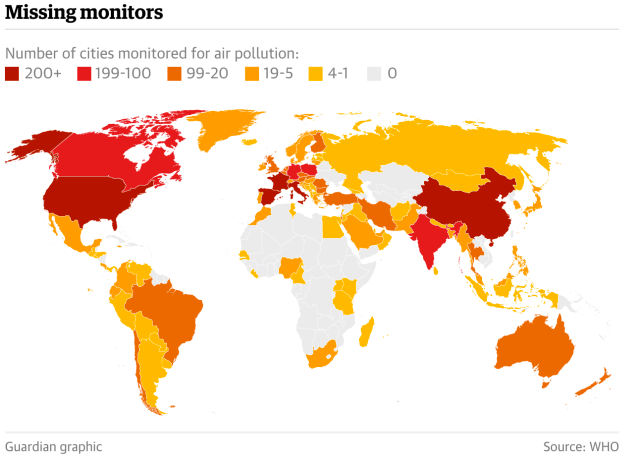
More than 1 billion people live in countries that do not monitor the air they breathe, according to data released by the World Health Organisation (WHO).

Guardian analysis has revealed a great air pollution blindspot stretching the length of Africa, across large parts of the former Soviet Union, south-east Asia and the Caribbean. In 92 countries the monitoring equipment and staff needed to measure one of the world’s most deadly pollutants – particulate matter (PM) – are simply not available.

A further 33 countries, including Indonesia, Egypt and Russia monitor just one or two cities.

Outdoor air pollution kills 3.3 million people each year and it is getting worse. Globally, pollution levels have risen by 8% in five years. But there are signs that it can be brought under control. According to the WHO, pollution is falling in many places where monitoring occurs, including a third of cities in low- and middle-income countries.

Setting up stations to record pollution was the first step, said a WHO spokeswoman: “The cities which have invested in the capacity to regularly monitor and report the local air quality measurements have already demonstrated a commitment to starting to address air quality issues and public health.”

Screen Shot 2016-05-22 at 18.37.17

In those countries with no checks, citizens’ lungs remain the only place where pollution is recorded. People may be acutely aware of the corrupted air, but without the evidence that global or national standards have been breached, there is little imperative for governments to act.

The WHO data, made public last week, showed air pollution was a hallmark of global inequality. Where it is monitored, denizens of poor cities are almost twice as likely as the rich to be breathing bad air.

Poverty is also a common theme. Of the world’s poorest 50 countries by GDP per capita, 35 are not monitoring air in any of their cities. Because they are predominantly poor- to middle-income, unmonitored countries are very likely to have high air pollution in their cities, meaning the majority of city-dwellers in those places will be be unknowingly exposed to pollution that breaches WHO standards.

The cost of setting up a single monitoring station is currently around $150,000-200,000, according to the UN Environment Programme. This does not include the ongoing staffing and maintenance costs. Although new technology may be significantly cheaper.

In Africa, the world’s poorest continent, just 10 out of 54 countries are doing any monitoring at all. Africa has just 1.3% of the cities where the WHO records air quality, despite having 16% of global population and cities set to set to triple in size in the next 50 years.

But it is not only the poor who lack information – the poorly governed also live in the dark. The Economist Intelligence Unit’s (EIU) democracy index labels 51 countries as “authoritarian”. Of these, 36 do not monitor their air. Just five non-monitoring countries appear in the democratic top 50.

In post-Soviet states, most of which rank as middle-income countries, barely any investment has been made in keeping tabs on the air. Across the vast expanse of Russia, with its thousand towns and cities, only Moscow records air quality.

Tiny Latvia boasts more monitoring stations than its former imperial master. Only the three Baltic states – Latvia, Lithuania and Estonia – have managed to implement thorough surveillance. Each of these rates above 7 out of 10 on the EIU index – Russia scores 3.31.

Even in countries where democratic freedom is limited, public information about air pollution can force great change. In China, the public outcry that followed the release of air quality data by the US embassy at Beijing’s forced the Communist party to make air a national priority. The consequent control measures, including a mass shutdown of coal power stations and steelworks, has lead to falling pollution in some of the worst-affected Chinese cities.

The pressure has also encouraged more monitoring. In China, 210 cities are now monitored, compared to 111 just two years before. This fits with an improving trend across the world. In 2014, 1,622 cities were monitored. Now it’s 2,974.

With high costs associated with monitoring, it is necessary to target high-risk areas first. One satellite study found that 96% of west Africans live above the WHO guidelines. However satellite observations are notoriously inexact. Professor Randall Martin is head of the Spartan project, which operates a network of on-ground sites at which satellite measurements can be calibrated.

“Satellite remote sensing offers a global observation source to fill that monitoring gap,” he said.

With these improvements, the blindspot is growing smaller. The number of cities monitored in Africa has doubled, with the notable addition of Nigeria. Africa’s most populous country had no cities being recorded in 2014. Now it has 12, with the city of Onitsha named as the worst city in the world for PM10 (particles under 10 but above 2.5 microns in width) pollution.

Similarly, because of an expansion of monitoring in Iran, the city of Zabol has superseded Delhi as the city with the worst fine particle (PM2.5) pollution.

With hundreds, perhaps thousands, more cities (including Lagos, Nigeria’s largest conurbation) waiting for the fog to be lifted on their own air quality, it is unlikely these two will remain at the top for long.

Source: The global air pollution ‘blindspot’ affecting 1 billion people | Environment | The Guardian

Posted in Africa, Air Quality, Asia, Iran | Tagged , , , , , , , , , , , , , , | Leave a comment

Air pollution ‘kills 600,000′ in Africa every year 

Every year, 600,00 people die prematurely from indoor air pollution in Africa, a report by the United Nations Environment Programme (UNEP) has revealed. 

According to UNEP, the continent’s reliance on the use of biomass for cooking, lighting and heating means that 90 per cent of the region’s population is exposed to health threat.

UNEP also said land degradation, air pollution, and the provision of sanitation and safe drinking water were among the main problems on the continent.

Also, many of the region’s fisheries, both inland and marine, face over-exploitation from illegal, under-reported and unregulated fishing.

It, however, said that the continent had an opportunity to use its large young population to drive its growth.

“Low-carbon, climate-resilient choices can develop the continent’s infrastructure, accelerate industrialization, increase energy and food production, and promote sustainable natural resource governance,” it said.

On water and sanitation, the report said the proportion of the population served with “clean water is increasing and grew from 64 per cent in 2005 to 68 per cent in 2012.”

UNEP said that absolute numbers of people without safe drinking water remain high.

“More than half of the population in sub-Saharan Africa still does not have any access to improved sanitation, compared to 90 per cent coverage in North Africa, with a vast difference between urban and rural areas,” the report said.

It listed African megacities such as Cairo, Kinshasa and Lagos, and emerging mega cities such as Dar es Salaam, Johannesburg and Luanda, as facing challenges from poor management of sanitation services.

The report said those challenges arose from inadequate and deteriorating infrastructure resulting from under-investment.

According to it, land-based activities causing pollution of freshwater bodies ultimately impact coastal and marine resources.

On land and forest, it noted that Africa had the second largest continent in the world, but most prized asset for food production, nutritional health and economic development.

“Worryingly, about 500 000 square meters of land in Africa is being degraded due to soil erosion, pollution and deforestation,” it said.

“This land degradation can damage agricultural productivity, nutrition and human health.

“A growing population and a rise in the demand for firewood will mean that forest cover in Africa is likely to continue shrinking, declining to less than 600 million hectares by 2050.

“Over cultivation, inefficient irrigation practices, overgrazing, the over-exploitation of resources, uncontrolled mining activities and climate change will further degrade land in Africa”.

The report said these challenges lead to reduced agricultural productivity, reduced food security, which could increase migration and spread disease, destroy infrastructure such as roads and bridges, and high rates of poverty.

Source: Air pollution ‘kills 600,000′ in Africa every year | TheCable

Posted in Africa, Air Quality | Tagged , , , , , , , , | Leave a comment

Why air pollution in schools is such a big deal – and what to do about it 

Ian Colbeck: About 3,000 British schools are in areas where air quality is poor, with those in poorer communities suffering more

Former London mayor Boris Johnson has been accused of holding back negative findings from a 2013 report on the city’s air pollution.

The report stated that 433 of London’s 1,777 primary schools were in areas where nitrogen dioxide concentrations breached EU limits. Nitrogen dioxide, or NO2, is an air pollutant that when inhaled can aggravate respiratory diseases such as asthma, emphysema and bronchitis. It has been estimated that in 2010 there were 5,900 deaths in London associated with long term exposure to NO2.

There’s a social element too. Of those 433 polluted schools, 82% were officially considered “deprived” (where more than 40% of pupils eligible for free school meals).

Given that the then-mayor was, for some time, promoting Cleaner Air 4 Schools it is difficult to understand why the report wasn’t released three years ago. After all, the finding that children, especially poorer children, suffer the most from air pollution isn’t particularly surprising.

In November 2015 a study by King’s College London and the thinktank Policy Exchange found that a third of the capital’s primary, secondary and independent schools were situated in areas with NO2concentrations above legal limits. This equates to about one in four school children in London being exposed to poor air quality.

This isn’t just a London thing: the Sunday Times mapped school location against government data of NO2 emissions per square kilometre and found that about 3,000 British schools were sited in areas with potentially dangerous levels of air pollution.

Two schools in South Yorkshire next to the M1, England’s main north-south motorway, are to be relocated as their pupils were exposed to too much air pollution.

However in Croydon, south London, a new school is to be built next to a busy arterial road where NO2 concentrations have been shown to exceeded EU limits. It is proposed that the school will be “internally ventilated” to reduce the pupil’s exposure.

The London report highlights the importance of environmental justice: deprived poorer communities suffer from poor air quality more than wealthy communities and by implication its associated disease burden. This has been known for some time and data from 2001 indicates that of the 2.5 million people in areas of Britain where the NO2 limit value was breached, more than half were among the poorest 20% of the population. A more recent analysis found that air quality improvement has been greatest in the least deprived areas.

There is now a wealth of research papers that have characterised children’s exposure to air pollutants in schools, although many concentrate on indoor air quality. In one of the most comprehensive studies, focused on Barcelona, it was found that schools had high levels of pollutants because the majority of them were very close to high traffic streets. However schools contribute to just over 30% of a child’s total exposure to air pollution.

Why is exposure to air pollution of particular concern for children? Young people are more susceptible to air pollution as their lungs are still growing and developing, and because they tend to spend more time being active outdoors. For example children living in areas with high levels of nitrogen dioxide have up to 10% less lung capacity) than normal.

Both the Royal College of Physicians and parliament’s environment audit committee have noted that little attention has been paid to planning when it comes to air pollution at schools due to their proximity to roads. The committee even recommended that national planning policy “should make it impossible to build new schools, care homes or health clinics near existing air pollution hotspots, and any redevelopment of such existing buildings should only be approved if they reduce pollution exposure for their users. Building regulations should provide for existing schools sited near pollution hotspots to be fitted with air filtration systems.”

Transport to and from school is one option that should be considered. However, parents are often reluctant to allow their child to walk along busy roads and so often drive, making the situation worse. Children these days are walking to school less often. In the 1970s an estimated 64% of all trips to school were made by walking (74% for primary age pupils and 53% for secondary age). By 2014 younger children were being driven as often as they walked in (both 46%) while older children were walking just 38% of the time.

Exploring safer or “well-being” walking routes could be one solution to encourage more walking to school and reduce exposure to air pollution.

Every council has a legal duty to increase opportunities for children to travel to and from school by sustainable modes such as cycling and walking. Most schools have a “travel plan” which identifies healthy and sustainable transport options to help to reduce the numbers of cars on the road at peak times and improve the local environment. More could be done to make parents aware of these.

Source: Why air pollution in schools is such a big deal – and what to do about it | Ian Colbeck | Environment | The Guardian

Posted in Air Quality, London, UK | Tagged , , , , , | Leave a comment

Timaru’s air pollution the worst in Australasia, figures reveal 

Timaru’s air pollution levels are the worst in Australasia, new figures released by the World Health Organisation (WHO) show.Timaru’s annual mean levels of PM10 particles and PM2.5 particles were both above the air pollution level recommended as safe by the WHO.PM10 and PM2.5 particles are used to measure air quality levels. The particles are so small that they can get into the lungs, potentially causing serious health problems.

Timaru’s air pollution levels are the worst in Australasia, new figures released by the World Health Organisation (WHO) show.

Timaru’s annual mean levels of PM10 particles and PM2.5 particles were both above the air pollution level recommended as safe by the WHO.

PM10 and PM2.5 particles are used to measure air quality levels. The particles are so small that they can get into the lungs, potentially causing serious health problems.

As urban air quality declines, the risk of strokes, heart disease, lung cancer, and chronic and acute respiratory diseases including asthma, increases for the people who live in them, the WHO states.

Christchurch was the worst of New Zealand’s major cities, while Wellington and Auckland’s air was found to be much cleaner.

While the level of air pollution in Timaru presented “some risk”, Parliamentary Commissioner for the Environment Dr Jan Wright said there was no reason to panic.

Timaru had a PM2.5 annual mean level of 15 micrograms per cubic metre, and a PM10 level of 28 micrograms per cubic metre.

The WHO guidelines state that levels of 10 and 20 micrograms per cubic metre respectively are considered safe.

Wright released a report into New Zealand’s air quality in 2015. She found that a lot of progress had been made in improving air quality, but there was still real evidence of harm to New Zealanders’ health.

Following the release of the updated WHO air quality database, Wright said an increasing reliance on heat pumps rather than woodburners would improve the country’s air quality in the future.

“Air quality over time has got a whole lot better in New Zealand, and will continue to do so.

“People get the idea that if you’re below the guidelines then everything’s fine, and if you’re about then everything’s terrible. That’s not the case at all.”

Environment Canterbury (ECan) measures dirty air in PM10, particulate matter less than 10 micrometres in diameter. Readings higher than 50 are considered to be high pollution levels.

Timaru has recorded two high pollution nights this year, with levels of 55 and 51 respectively. Washdyke has recorded one high pollution night.

From September this year, Timaru cannot have any more than three high pollution nights a year to meet the national air quality target.

Timaru had 26 high air pollution readings in 2015.

ECan air spokeswoman Katherine Trought said ECan was concerned about the high levels of PM10 in Timaru as there was no safe level for air pollution.

Due to the combined effects of high emissions and South Canterbury’s weather and landscape, during calm winter nights pollution could be trapped in a layer of cold air near the surface, she said.

Winter air pollution was usually worse in the evenings as that was when most people used their log burners, and the rapid cooling of the ground created a layer of cold air that trapped emissions.

“Everyone has a role to play in improving winter air quality, and as well as wood burner users, we are working with industry, land managers, farmers and developers. This winter, we’re asking wood burner users to do their bit too.”

MP for Rangitata, National’s Jo Goodhew, said she was “heartened” by ECan’s educational approach. Goodhew said people sometimes visited her Timaru electorate office about the issue, including some who were  concerned about having to change their fireplaces.

According to the new WHO database, levels of ultra-fine particles of less than 2.5 microns were highest in India, which has 16 of the world’s 30 most polluted cities.

China had improved its air quality since 2011 and now had only five cities in the top 30. Nine other countries, including Pakistan and Iran, had one city each in the worst 30.

The most polluted city in Australia was Geraldton, north of Perth.

New Zealand’s air quality (micrograms per cubic metre)

Christchurch

PM10: 21

PM2.5: 10

Dunedin

PM10: 18

PM2.5: 9

Wellington

PM10: 10

PM2.5: 5

Auckland

PM10: 14

PM2.5: 6

* An earlier version of this city said Timaru’s air quality was the worst in Oceania. This was incorrect, it is the worst in Australasia.

Source: Timaru’s air pollution the worst in Australasia, figures reveal | Stuff.co.nz

Posted in Air Quality, Australia & Oceania | Tagged , , , , , , , , , | Leave a comment

How are cities around the world tackling air pollution? 

More cycling, better public transport and car bans – cities from Delhi to Zurich are using a range of initiatives to lower traffic pollution and improve health

Paris

Paris bans cars in many historic central districts at weekends, imposes odd-even bans on vehicles, makes public transport free during major pollution events and encourages car- and bike-sharing programmes. A long section of the Right Bank of the river Seine is now car-free and and a monthly ban on cars has come into force along the Champs-Elysées.

Delhi

Reports that pollution levels in Delhi matched those in Beijing spurred the city to ban all new large diesel cars and SUVs with engines of more than 2,000CC and to phase out tens of thousands of diesel taxis. The city has experimented with alternately banning cars with odd and even number plates and is now encouraging Uber-style minibuses on demand. Other cities considering diesel bans are Dublin and Brussels.

The Netherlands

Politicians want to ban the sale of all petrol and diesel cars from 2025, allowing only electric or hydrogen vehicles. The proposed new law would allow anyone who already owns a petrol or diesel car to continue using it. Most cities encourage bicycle use.

Freiburg

Freiburg in Germany has 500km of bike routes, tramways, and a cheap and efficient public transport system. One suburb, Vauban, forbids people to park near their homes and makes car-owners pay €18,000 for a space on the edge of town. In return for living without a car, people are offered cheaper housing, free public transport, and plentiful bicycle spaces.

Copenhagen

Copenhagen prioritises bikes over cars and now has more cycles than people. The city calculates that one mile on a bike is worth $0.42 [27p] to society, while one mile in a car is a 15p ($0.20) loss. Large parts of the Danish capital have been closed to vehicles for decades and the city plans to become carbon neutral by 2025.

Oslo

Oslo plans to halve its climate emissions by 2020 and proposes a large no-car zone, the building of 40 miles of new bike lanes, steep congestion charges, a rush-hour fee for motorists, and the removal of many parking spaces.

Helsinki

The Finnish capital plans to drastically reduce the number of cars on its streets by investing heavily in better public transport, imposing higher parking fees, encouraging bikes and walking and converting inner city ring roads into residential and walking areas. The idea is to make the city’s public transport so good that no one will want a car by 2050.

Zurich

Zurich has capped the number of parking spaces in the city, only allows a certain number of cars into the city at any one time, and is building more car-free areas, plazas, tram lines and pedestrianised streets. The result has been a dramatic reduction in traffic jams, and less pollution.

Curitiba

The southern Brazilian city of 2 million people has one of the biggest and lowest cost bus systems in the world. Nearly 70% of the city goes to work by public transport and the result is pollution-free air and traffic-free streets.

Bangalore

The Indian city is converting its 6,000 buses to compressed natural gas and discouraging the car. So far, says the city, it has reduced traffic pollution by about 20% in a few years and one in four people who used to travel by car now use public transport.

Source: How are cities around the world tackling air pollution? | Environment | The Guardian

Posted in Air Quality, Asia, Europe, France, India, Latin America | Tagged , , , , , , , , , , , , , , , , , , | Leave a comment

Polluted dust can impact ocean life thousands of miles away, study says

As climatologists closely monitor the impact of human activity on the world’s oceans, researchers at the Georgia Institute of Technology have found yet another worrying trend impacting the health of the Pacific Ocean.

A new modeling study conducted by researchers in Georgia Tech’s School of Earth and Atmospheric Sciences shows that for decades, air pollution drifting from East Asia out over the world’s largest ocean has kicked off a chain reaction that contributed to oxygen levels falling in tropical waters thousands of miles away.

“There’s a growing awareness that oxygen levels in the ocean may be changing over time,” said Taka Ito, an associate professor at Georgia Tech. “One reason for that is the warming environment – warm water holds less gas. But in the tropical Pacific, the oxygen level has been falling at a much faster rate than the temperature change can explain.”

The study, which was published May 16 in Nature Geoscience, was sponsored by the National Science Foundation, a Georgia Power Faculty Scholar Chair and a Cullen-Peck Faculty Fellowship.

In the report, the researchers describe how air pollution from industrial activities had raised levels of iron and nitrogen – key nutrients for marine life – in the ocean off the coast of East Asia. Ocean currents then carried the nutrients to tropical regions, where they were consumed by photosynthesizing phytoplankton.

But while the tropical phytoplankton may have released more oxygen into the atmosphere, their consumption of the excess nutrients had a negative effect on the dissolved oxygen levels deeper in the ocean.

“If you have more active photosynthesis at the surface, it produces more organic matter, and some of that sinks down,” Ito said. “And as it sinks down, there’s bacteria that consume that organic matter. Like us breathing in oxygen and exhaling CO2, the bacteria consume oxygen in the subsurface ocean, and there is a tendency to deplete more oxygen.”

That process plays out in all across the Pacific, but the effects are most pronounced in tropical areas, where dissolved oxygen is already low.

Athanasios Nenes, a professor in the School of Earth and Atmospheric Sciences and the School of Chemical and Biomolecular Engineering at Georgia Tech who worked with Ito on the study, said the research is the first to describe just how far reaching the impact of human industrial activity can be.

“The scientific community always thought that the impact of air pollution is felt in the vicinity of where it deposits ,” said Nenes, who also serves as Georgia Power Faculty Scholar. “This study shows that the iron can circulate across the ocean and affect ecosystems thousands of kilometers away.”

While evidence had been mounting that global climate change may have an impact on future oxygen levels, Ito and Nenes were spurred to search for an explanation for why oxygen levels in the tropics had been declining since the 1970s.

To understand how the process worked, the researchers developed a model that combines atmospheric chemistry, biogeochemical cycles, and ocean circulation. Their model maps out how polluted, iron-rich dust that settles over the Northern Pacific gets carried by ocean currents east toward North America, down the coast and then back west along the equator.

In their model, the researchers accounted for other factors that can also impact oxygen levels, such as water temperature and ocean current variability.

Whether due to warming sea waters or an increase in iron pollution, the implications of growing oxygen-minimum zones are far reaching for marine life.

“Many living organisms depend on oxygen that is dissolved in seawater,” Ito said. “So if it gets low enough, it can cause problems, and it might change habitats for marine organisms.”

Occasionally, waters from low oxygen areas swell to the coastal waters, killing or displacing populations of fish, crabs and many other organisms. Those “hypoxic events” may become more frequent as the oxygen-minimum zones grow, Ito said.

The increasing phytoplankton activity is a double-edged sword, Ito said.

“Phytoplankton is an essential part of the living ocean,” he said. “It serves as the base of food chain and absorbs atmospheric carbon dioxide. But if the pollution continues to supply excess nutrients, the process of the decomposition depletes oxygen from the deeper waters, and this deep oxygen is not easily replaced.”

The study also expands on the understanding of dust as a transporter of pollution, Nenes said.

“Dust has always attracted of a lot of interest because of its impact on the health of people,” Nenes said. “This is really the first study showing that dust can have a huge impact on the health of the oceans in ways that we’ve never understood before. It just raises the need to understand what we’re doing to marine ecosystems that feed populations worldwide.”

Read more at: http://phys.org/news/2016-05-polluted-impact-ocean-life-thousands.html#jCp

Source: Polluted dust can impact ocean life thousands of miles away, study says

Posted in Air Quality | Tagged , | Leave a comment

Farms a major source of air pollution, study finds

Emissions from farms outweigh all other human sources of fine-particulate air pollution in much of the United States, Europe, Russia and China, according to new research. The culprit: fumes from nitrogen-rich fertilizers and animal waste combine in the air with combustion emissions to form solid particles, which constitute a major source of disease and death, according to the new study.

Emissions from farms outweigh all other human sources of fine-particulate air pollution in much of the United States, Europe, Russia and China, according to new research. The culprit: fumes from nitrogen-rich fertilizers and animal waste combine in the air with combustion emissions to form solid particles, which constitute a major source of disease and death, according to the new study.

The good news is if combustion emissions decline in coming decades, as most projections say, fine-particle pollution will go down even if fertilizer use doubles as expected, according to the new study published in Geophysical Research Letters, a journal of the American Geophysical Union.

Agricultural air pollution comes mainly in the form of ammonia, which enters the air as a gas from heavily fertilized fields and livestock waste. It then combines with pollutants from combustion–mainly nitrogen oxides and sulfates from vehicles, power plants and industrial processes–to create tiny solid particles, or aerosols, no more than 2.5 micrometers across, about 1/30 the width of a human hair.

Aerosols can penetrate deep into lungs, causing heart or pulmonary disease. A 2015 study in the journal Nature estimates they cause at least 3.3 million deaths each year globally, and a recent study in Geophysical Research Letters found they cause over 500,000 annual deaths in India alone.

Many regional studies, especially in the United States, have shown agricultural pollution to be a prime source of fine-particulate precursors, but the new study is one of the first to look at the phenomenon worldwide and to project future trends. The study’s results show more than half the aerosols in much of the eastern and central United States come from farming.

“This is not against fertilizer–there are many places, including Africa, that need more of it,” said Susanne Bauer, an atmospheric scientist at Columbia University’s Center for Climate Systems Research and NASA’s Goddard Institute for Space Studies in New York and lead author of the study. “We expect population to go up, and to produce more food, we will need more fertilizer.”

The fact that agricultural emissions must combine with other pollutants to make aerosols is good news, according to Bauer. Most projections say tighter regulations, cleaner sources of electricity and higher-mileage vehicles will cut industrial emissions enough by the end of this century that farm emissions will be starved of the other ingredients necessary to create aerosols, she said.

“You might expect air quality would decline if ammonia emissions go up, but this shows it won’t happen, provided the emissions from combustion go down,” said Fabien Paulot, an atmospheric chemist with Princeton University and the National Oceanic and Atmospheric Administration who was not involved in the study. That means pollutants other than ammonia should probably be targeted for abatement, he said.

Johannes Lelieveld, lead author of the 2015 Nature study, disagreed. “One should be cautious about suggesting that food production could be increased” without increasing pollution, because that “critically depends” on the assumption that societies will successfully curb industrial emissions, he said. Lelieveld pointed out that even with recent reductions in industrial pollution, most nations, including the United States, still have large areas that exceed the World Meteorological Organization’s recommended maximum of particulate matter.

If future industrial emissions do go down, much farm-produced ammonia will end up in Earth’s troposphere, roughly 2 to 10 kilometers (1 to 6 miles) above the surface, Bauer said. There, lightning and other natural processes may also help create fine particulates, but most of these particles would be trapped by raindrops and harmlessly removed from the atmosphere, she said.

Source: Farms a major source of air pollution, study finds — ScienceDaily

Posted in Air Quality, Asia, Europe, USA & Canada | Tagged , , , , , , | Leave a comment