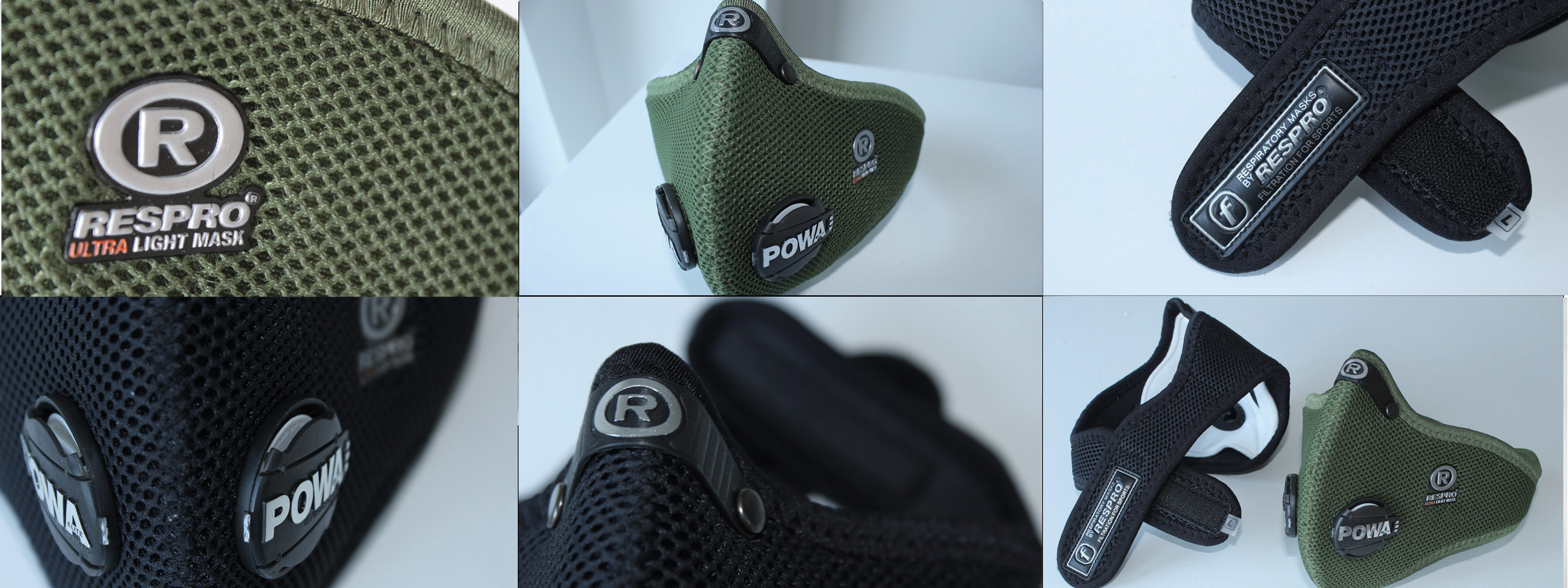
ULTRALIGHT™ MASK

Respro® Ultralight™ Mask

Respro® Ultralight™ Mask

The material used for the Ultralight™ mask is a 4-way stretch, air permeable (allows air to pass) technical fabric that allows the face to breathe in hot and humid conditions.

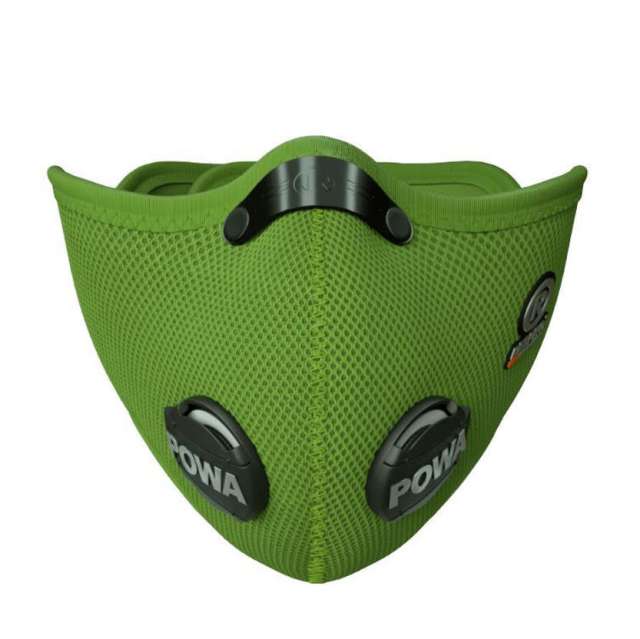
The Ultralight™ comes with black/silver Powa™ Elite valves and a black/silver unbreakable nose clip and carry bag. The Hepa-Type™ sports filter is installed as standard; the perfect 2.5PM filter for urban areas high in diesel particulates or travelling in hot dusty conditions.

For more information or to buy a Respro® Ultralight™ mask, visit our website respro.com.

Posted in Respro® Masks | Tagged | Leave a comment

Vote for Respro®

Pitch to Rich

We need your help…

The dangers of air pollution are everywhere.

By bringing awareness of the dangers of air pollution to all of us, we would like to think that we can change things for the better. We have made a pitch to Richard Branson  and we need your vote to win. #pitchtorich
We can’t thank you enough for voting. Together we can make a first step towards reducing air pollution and with it improvements in air quality.

Please vote* for Respro® at

www.virginmediabusiness.co.uk/pitch-to-rich/grow/respro-uk-ltd

*voting closes 5th May 2015

Don’t wait till it’s too late. #VOOM Together we can make a difference.

Posted in Air Quality | Tagged | Leave a comment

German cities show excessive air pollution levels

In many cities, air pollution from fine dust particles and nitrogen dioxide exceeds the maximum threshold levels, according to a new report from the Environment Ministry. EurActiv Germany reports.

Residents of Stuttgart are currently exposed to the highest pollution levels in the Federal Republic, a report published by the German Environment Ministry showed.

The study was conducted in response to an inquiry from the Green Party faction regarding certain regions that are known to exhibit high levels of pollution.

Air pollutants are harmful to health and can be fatal in the long-term. To reduce these risks, Germany has set threshold values for certain substances. But these levels are being exceeded more and more frequently in many parts of the country.

According to the research, Stuttgart often had an annual nitrogen dioxide level that was more than double the acceptable threshold value. Cities with pollution levels just below Stuttgart’s were Munich, Reutlingen, Düren, Limburg and Freiburg.

Fine dust particles pose another serious problem. Here, the maximum is 40 µg up to a particle size of ten micrometres per cubic metre of air. Stuttgart exceeded this limit on 91 days in 2013. After Stuttgart, Reutlingen follows in second place, followed by Markgröningen, Tübingen, Gelsenkirchen, Hagen and Leipzig.

Fine dust remains a significant threat

Only 35 violations of the fine dust threshold are permitted per year. Particles in fine dust are suspected to contribute to diseases like asthma, cancer and cardiovascular illness.

Not long ago, researchers at the Institute for Diabetes Research at the Helmholtz Centre in Munich were even able to provide evidence that air pollutants can accelerate the development of type 1 diabetes in children.

Residents in Fichtelberg bei Oberwiesenthal are exposed to the highest ozone pollution. There, the threshold was exceeded on 46 days in 2013.

“The environmental and health burden is devastating in many places,” said Bundestag MP Peter Meiwald. Apparently the federal government’s regulations are failing on many points, he argued.

Meanwhile, most authorities and institutes consider it unlikely that the problem can be solved in the near future. The Umweltbundesamt (Federal Environment Agency) recently expressed doubt “over whether the EU threshold value for even smaller particles PM2.5 in urban residential areas, to take effect in 2020, can even be complied with”.

Jürgen Resch, CEO of Deutsche Umwelthilfe (German Environmental Relief) criticised the German government for acting too fast in its attempt to control fine dust and nitrogen dioxide pollution.

“Other countries model how it can be done,” Resch indicated. In Switzerland, all construction vehicles and locomotives are required to be equipped with particle filters, he pointed out. Germany does not have a regulation of that kind, the politician criticised.

The politician also said cities like Madrid or Stockholm also have much higher standards for buses, for example.

“It is shocking, at how many recording points the threshold values are being exceeded,” said Green Party politician Bärbel Höhn. Almost every state of Germany has critical regions, she indicated.

EU law requires states to reduce emissions

At the end of last year, the European Commission cautioned Germany over excessive air pollution due to fine dust – particularly in Stuttgart and Leipzig – and threatened to take legal measures against the country if the German government did not act.

EU law requires member states to contain their emissions. But which individual measures the member state chooses to take, is up to national governments.

Still, if Germany does not comply with threshold values soon, the Commission could be entitled to initiate an infringement procedure before the European Court of Justice.

via German cities show excessive air pollution levels | EurActiv.

Posted in Air Quality, Europe, Germany | Tagged , , , , , , , , , , , , , | Leave a comment

Air Quality Awareness Week

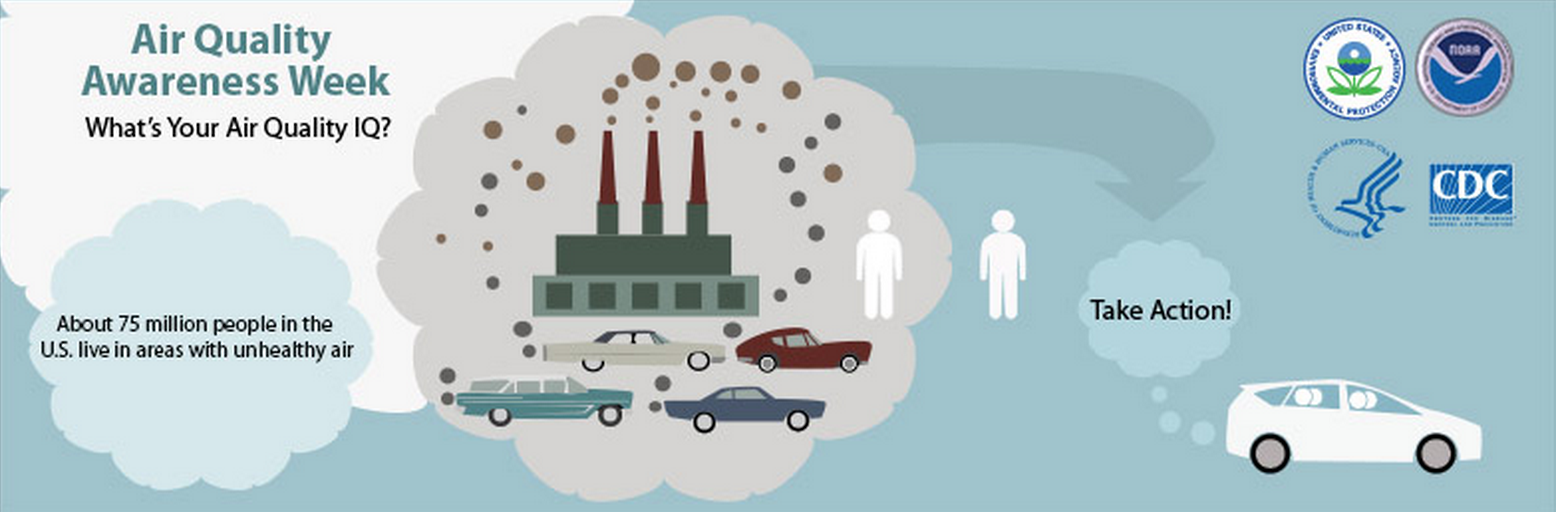
Screen Shot 2015-04-28 at 08.56.04Learn how air quality affects your health during Air Quality Awareness Week, Monday, April 27 – Friday, May 1.

www.epa.gov/airnow/airaware/

Posted in USA & Canada | Tagged , , , | Leave a comment

Key Points to a Mask

 Screen Shot 2015-02-13 at 07.41.06Screen Shot 2015-02-13 at 07.41.50Screen Shot 2015-02-13 at 07.42.30

POINT 1 – Does it seal effectively?

 The single most important point:

For a mask to work properly, it has to seal the area of nose and mouth from the external environment. The inhaled air has to pass through the filter material in order to remove pollution by physically trapping or adsorbing (different from absorption) gas or vapour molecules. A nose clip of some fashion, usually a strip of aluminium to bend between the bridge of the nose and the cheekbone is a vital component required to assist in making an effective seal.

Failure to create an effective seal will allow unfiltered air to pass around the sides of the mask and into the respiratory system. This is known as Inward Leakage.

A ‘one size fits all’ mask will invariably offer a poor fit and an ineffective seal and will place the mask squarely in the useless product bin. Like shoe sizing, one size does not fit all.

POINT 2 – Is the filter material up to spec?

Filter materials come in two categories:

The first is the ability to remove particulate matter. Typically that would be diesel particulates and pollen. The type of filter is usually a non-woven material made from zillions of fibres bonded together. They are electrostatically charged, both positively and negatively (like combing your hair makes a charge), so that particles, which are passing through the filter structure, are attracted and physically held in the matrix of the material. The smaller the particle, the greater the attractive force, which means that materials which are electrostatically charged can readily trap fine respirable dusts that over populate the air in our towns and cities.

Having first been developed by the Defence Establishment in the UK, these types of filter materials are not cheap. So if you are purchasing a product which appears to be ‘cheap’ and it says ‘removes particles down to 0.3 microns’, then the chances are that it might stop one or two particles but not the millions that are actually passing through. Watch out! If the material cannot be backed up by industrial test data then it probably doesn’t do the job effectively.

The second type of filter is Activated Charcoal material. It has the ability to filter (adsorb) gases and vapours. Well, like everything, if it’s cheap, then the chances are that the material is either black cloth appearing to look like Activated Charcoal (Far Eastern copy products are known for this) or a cloth that is impregnated with carbon powder. There is a big difference between the filtering capacity of a carbon powder glued to a carrier material and Activated Charcoal Cloth (D.A.C.C) that is 100% Activated Charcoal.

Carbon powder impregnated cloths are used in the industry for cheap nuisance odour type products, like ‘odour eaters’ ; you know the things you put in your husband/wife or girlfriend/boyfriend’s trainers/shoes because his/her trainers stink after a while. These are good for air that is not moving i.e. static air, but of little use when air is travelling like when you are inhaling air into your lungs. For urban pollution, the best  material  to use would be what’s known as DACC (Dynamic Activated Charcoal Cloth). This material is 100% Activated Charcoal Cloth, which can absorb gases and vapours on a molecular level and very quickly too. It is manufactured under licence and is another decedent of the UK Defence Establishment. It has been tested on a range of gases and vapours that are listed on our website.

POINT 3 – Comfort

The ideal mask would be one that you forget that you have it on:

The comfort goal here is to ensure that you can forget that you are wearing a mask. It is possible like a pair of socks on your feet, you forget that you have the socks on.  The same applies in our demand for comfort.

Exhaled breath contains three components that are not good to re-inhale and only increase discomfort. On exhalation, heat, water vapour and carbon dioxide are all produced and need to be expelled before inhaling again. So rather than these components passing through the filter, it is best to channel them out through exhalation valves. These are valves that open one way only. They close automatically when you inhale and open when you exhale. They are simple but effective parts of a mask and do not need to be replaced. The reason why we want the air to travel out through the valves is so they don’t saturate the filter with water vapour as it makes it harder to breathe in again and the relative back pressure of the speed of exhaled air including heat and water vapour, will hit you back in the nose and mouth area like hot air when getting off a plane at an airport in a really hot climate.

Comfort is important and if the mask is not comfortable for the duration of your journey you probably will give up on it. So choose your mask with the following points in mind:

1.     The correct filtration for the environment you want to use the mask

2.     The right size for your face size and shape

3.     The right valves for the amount of work you are doing, sitting on a couch does not require valves; belting through the City on a bike does!

4.     Correct fitting to ensure you can breathe unimpeded through the nose and or the mouth.

Posted in Air Quality | Tagged | Leave a comment

Stuttgart, München, Hamburg – Die schmutzigste Luft Deutschlands

Zu viel Feinstaub in Stuttgart, zu hohe Stickoxid-Werte in München: In vielen deutschen Städten werden die gesetzlichen Grenzwerte überschritten. Wo ist die Luft besonders dreckig? Der Überblick.

Dreckige Luft schadet der Gesundheit – sie kann auf Dauer sogar tödlich sein, deshalb gibt es gesetzliche Grenzwerte. Beispielsweise darf ein Kubikmeter Luft maximal 40 Mikrogramm Feinstaub bis zu einer Partikelgröße von zehn Mikrometern enthalten.

Doch Grenzwerte für Luftschadstoffe werden vielerorts nicht eingehalten, wie eine Anfrage von Bündnis 90/Die Grünen an die Bundesregierung ergab. “Die Umwelt- und Gesundheitsbelastung ist vielerorts verheerend”, sagte der Bundestagsabgeordnete Peter Meiwald. Offensichtlich versagten die Regelungen des Bundes an zahlreichen Stellen.

Die Abgeordneten wollten von der Bundesregierung die 15 Orte mit den höchsten gemessenen Schadstoffkonzentrationen erfahren. Dabei ging es unter anderem um Feinstaub und Ozon. Die folgende Karte zeigt die Lage der Messstationen mit den deutschlandweit höchsten Schadstoffkonzentrationen. Dabei geht es um PM10 (Feinstaub bis zu zehn Mikrometer Durchmesser), Stickstoffdioxid und Schwefeldioxid. Gemessen wird praktisch immer an Hauptverkehrsstraßen, weil dort die Belastung am höchsten ist.

Screen Shot 2015-04-27 at 09.14.02

Beim Feinstaub gab es sieben Gemeinden, die den Grenzwert für PM10 überschritten. Die PM10-Werte dürfen laut Gesetz nur an maximal 35 Tagen im Jahr über 50 Mikrogramm pro Kubikmeter liegen. Den höchsten Wert hatte die Messstation Am Neckartor in Stuttgart (91 Tage). In Stuttgart werden schon seit Jahren immer wieder die Limits überschritten. Wegen der Kessellage konzentrieren sich dort die Schadstoffe. Dann folgen Reutlingen (79 Tage, Lederstraße), Tübingen (46 Tage, Mühlstraße) und Gelsenkirchen (45, Kurt-Schumacher-Str.). Auch Leipzig (41) hält den Grenzwert für Feinstaub in der Lützner Straße nicht ein. Eine detaillierte Übersicht über die Messstationen mit den höchsten Schadstoffkonzentrationen finden Sie in der 24-seitigen Antwort der Bundesregierung.

Screen Shot 2015-04-27 at 09.15.32

“Erschreckend ist, an wie vielen Messstellen die Grenzwerte überschritten werden”, sagte die Grünen-Politikerin Bärbel Höhn. In fast jedem Bundesland gebe es kritische Regionen. Mitunter ist aber auch nur eine viel befahrene Straße das Problem, wie etwa die Mühlstraße in Tübingen. Dort erreicht der Feinstaub dann bedenkliche Konzentrationen, während die Werte im übrigen Stadtgebiet den gesetzlichen Vorschriften genügen. Doch selbst wenn die Grenzwerte in einer Gemeinde nur punktuell überschritten werden – diese Bereiche sind meist auch jene, die von besonders vielen Menschen frequentiert werden, die damit ungesunder Luft ausgesetzt sind.

Screen Shot 2015-04-27 at 09.16.51

Hauptverursacher der hohen Feinstaubwerte ist der Autoverkehr – dabei insbesondere Dieselmotoren. PM10-Stäube dringen bis in die Nasenhöhle ein und können beispielsweise die Schleimhäute reizen. Noch kleiner Partikel der Größe PM2,5 schaffen es bis in die Lunge und können die Blutgefäße schädigen oder Krebs verursachen. Laut einer Studie der Europäischen Umweltagentur (EUA) verursacht Feinstaub pro Jahr etwa 430.000 vorzeitige Todesfälle in der EU.

Stickstoffdioxid (NO2) entsteht ebenfalls bei Verbrennungsprozessen. Wichtigste Emittenten in deutschen Gemeinden sind Autos mit Dieselmotor. NO2 ist vor allem für Asthmatiker problematisch. Bei zu hohen Konzentrationen steigt das Risiko für Schlaganfälle. Der Jahresgrenzwert liegt bei 40 µg/m3. Da Abgas auch Blätter schädigt, gilt laut Umweltbundesamt bereits ein Wert von 30 µg/m3 als kritisch für Pflanzen.

Die höchsten Werte wurden in Stuttgart und München gemessen – unter den Top 15 sind aber auch Straßen in Berlin, Hamburg und Köln. Überall dort waren die NO2-Werte oberhalb des gesetzlichen Limits von 40.

Screen Shot 2015-04-27 at 09.17.32

Jürgen Resch, Geschäftsführer der Deutschen Umwelthilfe, fordert entschlossene Schritte der Bundesregierung gegen Feinstaub und Stickoxide. “Andere Länder machen vor, wie das geht”, sagt er. In der Schweiz müssten alle Baufahrzeuge und Lokomotiven zwangsweise mit Partikelfiltern ausgerüstet sein – hierzulande bestehe keine solche Pflicht. Auch an Busse stellten Städte wie Madrid oder Stockholm deutlich höhere Forderungen.

Ein großes Problem sind laut Resch auch neue Dieselfahrzeuge. “Die erfüllen nur auf dem Prüfstand die Abgasnorm”, im Alltagsbetrieb sei der Ausstoß an Feinstaub und NO2 um ein Vielfaches höher. Kurzfristig könne man die Situation nur mit Fahrverboten verbessern. Die Luftreinhaltepläne vieler Städte reichten dafür kaum aus.

Grenzwertüberschreitungen gab es auch bei Ozon, das der Lunge schaden kann. Betroffen sind unter anderem Oberwiesenthal, Münster im Schwarzwald und Gersfeld in der Rhön.

Es gibt jedoch auch eine gute Nachricht: Laut Auskunft der Bundesregierung werden die Grenzwerte für Schwefeldioxid (SO2) heute an keiner Messstation in Deutschland mehr überschritten. SO2 wird beim Verbrennen von Kohle und Öl freigesetzt. Es reizt Schleimhäute und Augen. SO2 war in den Achtzigerjahren auch mitverantwortlich für den sauren Regen. Das Abgas war vor allem in der einstigen DDR ein großes Problem, weil vielerorts schwefelhaltige Kohle verbrannt wurde.

Glücklicherweise ist die SO2-Belastung in den vergangenen 20 Jahren aber deutlich gesunken. Die höchsten Werte werden heute im Erzgebirge, Hamburg, Duisburg und Bottrop gemessen. Gesundheitsprobleme sind dadurch nach Auskunft des Umweltbundesamts nicht zu befürchten.

Screen Shot 2015-04-27 at 09.18.20


via Stuttgart, München, Hamburg – Die schmutzigste Luft Deutschlands – SPIEGEL ONLINE.

Posted in Air Quality, Europe, Germany | Tagged , , , , , , , , , , , , , | Leave a comment

National Park Service urges Utah to crack down on pollution

The National Park Service is pressing Utah environmental regulars to crack down on emissions at two coal-fired power plants to improve air quality and views in the state’s five national parks.

Haze mars vistas at the parks about three-fourths of the time in violation of federal regulations mandating upgrades at the nation’s dirtiest power plants to protect their air quality, the park service wrote in April 2 letters to the Utah Department of Environmental Quality and U.S. Environmental Protection Agency.

The park service wants the state to require further reductions in nitrogen-oxide emissions at two coal-fired power plants in central Utah through installation of retrofit technology known as selective catalytic reduction.

But the Utah Division of Air Quality would not take the step under proposed revisions to its plan to combat regional haze, The Salt Lake Tribune reported (http://bit.ly/1E9BEaR ).

“The state clearly values the importance of the five national parks in Utah and actively promotes national tourism, yet at the same time it appears unprepared to fulfill its legal requirements under the Clean Air Act and associated regulations to protect and enhance the very scenic views that attract millions of visitors to the parks every year,” wrote Tammy Whittington, associate regional park service director.

Utah’s air quality division maintains $588 million in past upgrades and the recent shutdown of Rocky Mountain Power’s aging Carbon Power Plant help the state meet regional haze standards.

Rocky Mountain Power contends retrofits to its Hunter and Huntington power stations in Emery County would be cost prohibitive.

“You’re talking in excess of $170 million per unit. They are custom retrofits; the actual cost would vary per unit. You get a better result by the work already done at Hunter and Huntington and the Carbon closure than the regional haze rules requires,” Rocky Mountain Power spokesman Dave Eskelsen told The Tribune.

“If you add” selective catalytic reduction “to those units, you get a substantial expense to consumers with a marginal benefit to the regional haze quality,” he added.

Selective catalytic reduction retrofits would reduce Hunter and Huntington nitrogen-oxide emissions by 14,700 tons, or 86 percent, according to environmental groups.

Last year, the EPA rejected portions of Utah’s regional haze plan, and environmentalists say the state’s revised plan is not much different.

“They keep delaying and delaying and re-proposing the same plan,” Cory MacNulty of the National Parks Conservation Association said. “We have to have reductions that go much deeper than this plan to clean the air over our parks.”

via National Park Service urges Utah to crack down on pollution – San Francisco Chronicle.

Posted in Air Quality, USA & Canada | Tagged , , , | Leave a comment

Smog Alert program changes name to Air Quality Advisory

The Southwest Ohio Air Quality Agency in partnership with OKI Regional Council of Governments changed the name of the Smog Alert program to Air Quality Advisory.

An Air Quality Advisory is a public message that is issued the day before the Southwest Ohio Air Quality Agency expects to see levels of air pollution that are unhealthy for sensitive groups such as children, the elderly and people with asthma, bronchitis and other respiratory problems, according to a press release. When issued, advisories are for Butler, Clermont, Hamilton and Warren counties in Ohio and Boone, Campbell and Kenton counties in Kentucky.

Levels of six main air pollutants are monitored to determine the region’s air quality as it relates to a series of health-based standards. For each of these pollutants, the U.S. EPA has established national air quality standards to protect public health.

Precautions everyone can take to help reduce air pollution:

•Taking the bus, carpooling, biking or walking instead of driving.

•Refueling your vehicle after 8 p.m.; do not top off when refueling and tighten the gas cap.

•Not idling your vehicle.

•Combining trips or eliminating unnecessary vehicle trips.

•Keeping your vehicle maintained with properly inflated tires and timely oil changes.

•Avoiding use of gasoline-powered lawn equipment on Air Quality Advisory days.

•Avoiding use of oil-based paints and stains on Air Quality Advisory days.

•Never burning leaves or other yard trimmings.

•Always burning clean, seasoned wood in outdoor fire pits, fireplaces and wood stoves.

•Not using fire pits or fireplaces for non-essential home heating on Air Quality Advisory days.

•Conserving electricity.

via Smog Alert program changes name to Air Quality Advisory.

Posted in Air Quality, USA & Canada | Tagged , , , , , , , , , | Leave a comment