Toxic air puts six million at risk of lung damage

Around six million people aged over 65 in England are at high risk of lung damage and asthma attacks because of toxic air, according to a new report.

It finds that older people and those with lung disease who are most vulnerable to the effects of pollution are often the most exposed. The new document is from the British Lung Foundation (BLF) and Asthma UK.

It comes as MPs also demand the government sets tougher targets for air pollution.

Improving air quality needs to be “at the core” of the UK’s post-pandemic rebuild, say members of a House of Commons committee that focuses on environmental issues.

The new report by two of the UK’s leading respiratory charities finds that a quarter of all care homes and a third of all GP practices and hospitals in England are in places where particulate pollution exceeds the limits recommended by the World Health Organization (WHO), according to the new report.

The focus is on exposure to fine particulate matter.

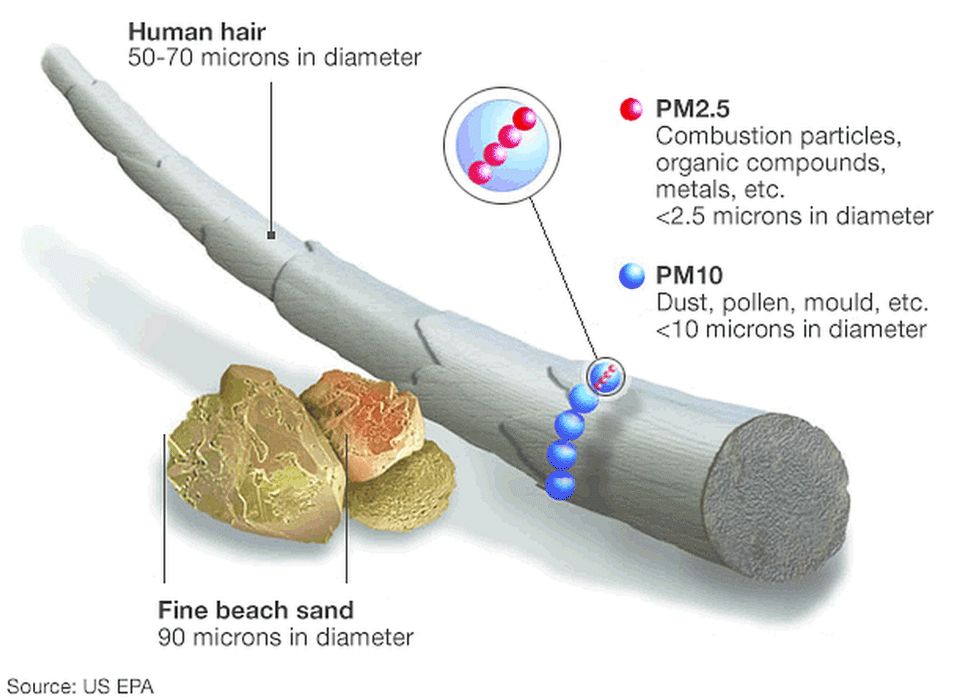
This consists of tiny particles known as PM2.5s which have a diameter of less than 2.5 micrometres across – that is one-four-hundredth of a millimetre, or about 3% of the diameter of a human hair.

PM2.5 particles are so small they can lodge in the lungs and even pass into the bloodstream. There’s evidence they can damage blood vessels and other organs.

Particulate pollution affects us all, but older people are more likely to suffer lung disease or have weakened lungs from ageing.

There are no safe limits for PM2.5s, but the World Health Organization (WHO) recommends that concentrations should not exceed 10 micrograms per cubic metre.

The BLF and Asthma UK report used data on PM2.5s collected in 2019. They found air pollution blackspots across the country that affected care homes.

In 36 local authorities, every single care home is located in areas with PM2.5 levels above the limits recommended by the WHO. These include Epping Forrest, Luton, Thurrock, Reading, Slough, Spelthorne, Broxbourne, Dartford and Watford.

Air pollution is a major health issue in the UK, says Dr Nick Hopkinson, the medical director of the BLF.

He estimates that between 30,000 and 40,000 premature deaths each year are caused by exposure to toxic air.

Air pollution also increases the chances of a person developing lung cancer and cardiovascular disease and may be associated with cognitive decline, including dementia.

“We know that older people are more likely to be exposed to particulates and we know that air quality is worse where poor people live”, Dr Hopkinson told BBC News.

It also found that 3,000 hospitals and GP practices are in areas where particulate pollution exceeds WHO recommended levels.

The current legal limit for PM2.5 in the UK is twice the WHO recommendation, at 20 micrograms per cubic metre.
The BLF and Asthma UK are demanding the government reduce that to the 10 micrograms per cubic metres limit recommended by the WHO.

The advice has been echoed by the Commons environment, food and rural affairs (Efra) select committee.

The charities behind the report are also calling for the government to appoint a minister with specific responsibility for improving air quality in the UK and to publish a national health protection plan to safeguard those most at risk from toxic air.

Kimberlee Cole from Eastbourne is one of those people.

She has a lung condition called bronchiectasis, which is exacerbated by air pollution.

Her lungs are so sensitive she can tell how polluted it is just by breathing in the air when she opens the door in the morning.

When the particulate count is high, it irritates her lungs, making them produce excess mucus which leads to violent coughing fits that can last hours.

“Sometimes my lungs actually bleed”, Kim says. “Sometimes it can be so bad I’m actually sick because of the coughing.”

Responding to the report, Environment Minister Rebecca Pow said: “Air pollution has reduced significantly since 2010 with emissions of fine particulate matter falling by 9% and emissions of nitrogen oxides are at their lowest level since records began. However, we know there is more to do.

“Our landmark Environment Bill will set at least two ambitious legally-binding air quality targets, with a primary focus on reducing exposure to particulate matter pollution. As part of this, we will consider the World Health Organization’s guidelines for PM2.5.

“PHE (Public Health England) also continues to support health professionals improve our understanding of links between air pollution and health, including working with the National Institute for Care Excellence to develop guidelines and standards to better protect vulnerable people from air pollution.”

Alastair Lewis, a professor of atmospheric chemistry at the University of York, welcomed the report’s focus on the impact of air pollution on vulnerable communities.

“The largest inequalities arise based on issues like health and deprivation and deprived communities typically have the worst air quality,” he says.

However, he cautions that the figures for particulate pollution in the report are based on atmospheric models, rather than measurements made on the ground.

He also points out that much of the PM2.5 in the atmosphere is often formed in the atmosphere by chemical reactions of other gases.

These gases move between regions and even between countries so there may not be a local solution to the problem.

Dr Heather Walton, an expert in air pollution from Imperial College London, also welcomed the findings. She told BBC News: “The summary of the health evidence is well balanced and the modelling used is a standard model used by Defra.”

She said the WHO guidelines provided a useful focus, but added: “Nonetheless, it is important to note that health effects continue down to concentrations below the WHO guidelines and so it is always beneficial to reduce PM2.5 concentrations in whatever way possible.”

She said that bringing levels down long-term would take a mixture of international, national and local policies.

via Toxic air puts six million at risk of lung damage – BBC News

Posted in Air Quality | Tagged , , , | Leave a comment

Sahara dust causes air pollution spike in Europe

A plume of Sahara dust that has blanketed parts of southern and central Europe in recent days caused a short, sharp spike in air pollution across the region, researchers said Tuesday.

The European Commission’s Copernicus satellite monitoring program said measured levels of particles smaller than 10 micrometers, so-called PM10s, increased in places such as Barcelona, Spain and in the French cities of Lyon and Marseille on Sunday.

The cloud of fine sand blown northward from Algeria tinted skies red and mixed with fresh snowfall in the Alps and Pyrenees, leaving slopes looking orange.

While PM10 particles can enter the lungs, causing breathing difficulties, asthma attacks and other health problems, the concentration of Sahara dust didn’t reach levels considered harmful.

More than three years ago, Storm Ophelia turned skies a spooky shade of sepia across parts of Britain.

That storm brought dust from the Sahara and smoke from wildfires in southern Europe. Ophelia caused two deaths in Ireland, where it was the worst storm in half a century. Social media users shared photos of ominous clouds blocking out the sun, prompting the Science Museum in London to joke on Twitter: “It’s not the apocalypse!”

Many people expressed concern about this phenomenon, while others have noted that it looks like something from a science fiction movie.

Sahara dust causes air pollution spike in Europe | Daily Sabah

Posted in Air Quality, Europe, France, Germany, Italy, Spain | Tagged , , , , , , , , | Leave a comment

Air pollution from fossil fuels responsible for ‘one in five deaths worldwide’

Number of deaths connected to fine particulate matter from fossil fuel burning could be twice as high as previously thought, research says

Air pollution from fossil fuels could account for nearly one in five deaths globally, a new study suggests.

The research finds air pollution from fossil fuel burning accounted for around 10 million premature deaths in 2012 – with China and India seeing the largest number of lives cut short.

The number of deaths associated with air pollution from fossil fuels fell to 8.7 million in 2018, the study estimates, as a result of significant improvements to air quality in China. This figure represents around 18 per cent of the total number of deaths recorded in 2018, the researchers say.

Published in the journal Environmental Research, the study focuses specifically on deaths attributable to fine particulate matter (PM2.5) pollution. “PM2.5 can penetrate deep into our lungs,” Karn Vohra, study lead author and a PhD student in environmental health sciences at University of Birmingham, told The Independent. 

Evidence suggests exposure to PM2.5 is linked to a range of serious health problems, including respiratory illnesses, strokes and heart attacks.

“We estimate a global mortality burden of 8.7 million premature deaths in 2018 from fossil fuel PM2.5 pollution,” Mr Vohra said.

“The highest mortality burdens are estimated over regions with substantial fossil fuel combustion, notably India, China and parts of eastern US, Europe and Southeast Asia.”

For the research, the scientists used a high-resolution mathematical model to study global concentrations of PM2.5 specifically from fossil fuel burning.

They also made use of a new health risk assessment model to estimate the total number of premature deaths that can be attributed to PM2.5 pollution from fossil fuel burning.

The finding that PM2.5 pollution from fossil fuels could account for 8.7 million – or one in five – premature deaths a year is more than double that of previous estimates. (This estimate is for 2018, before the start of the Covid pandemic.)

The most recent assessment on the global causes of mortality published by The Lancet found that all “outdoor particulate matter” – which includes dust and smoke from fires as well as fossil fuel burning – accounted for 4.2 million deaths globally each year.

In the UK, the number of deaths attributable to air pollution from fossil fuels could also be higher than thought, according to the results.

The new research estimates that, in 2012, around 99,000 people died prematurely as a result of air pollution from fossil fuels in the UK. Previous estimates had suggested that between 28,000 and 36,000 people will die each year as a result of exposure to all types of air pollution in the UK.

Mr Vohra said the uptick in the global number of deaths attributable to fossil fuel pollution was linked to the high-resolution models used in the research.

Dr Thomas Smith, an assistant professor in environmental geography at the London School of Economics who wasn’t involved in the study, said the modelling techniques used by the researchers marked “an important step forward”.

“A key advance is related to the model,” he told The Independent. “This has a fine spatial resolution which allows it to better represent ‘pollution hotspots’, such as cities. Previous studies using lower-resolution models that might have ‘smoothed-out’ these pollution hotspots.”

However, there is still uncertainty around the global number of deaths attributable to air pollution from fossil fuels, Mr Vohra added.

The study provides a central estimate of 8.7 million premature deaths a year, but notes a possible range of between -1.8 million to up to 14 million.

“The uncertainty is due to the relatively limited number of epidemiological studies of the very high PM2.5 concentrations typical of China,” said Mr Vohra.

“The wide range of uncertainty at these higher PM2.5 concentrations should be an incentive for additional studies to improve our estimates at these high concentrations.”

Overall, the findings add to “the urgency to shift to cleaner sources of energy”, he added.

In addition to causing air pollution, fossil fuels also damage human health by driving the climate crisis. A recent report found that the health of millions of people is already being affected by the impacts of the climate crisis, which include worsening extreme weather events and shifts to disease risk.

“The lethal health impacts of climate change and air pollution – two of the most pressing global health issues of our time – have to be arrested,” said Dr Ronald Law, an affiliate professor at the University of Washington and chief of health emergency preparedness in the Philippines.

“Bold actions to shift to clean energy sources is a must if we are to better protect the health of our planet, society and people, now and in the future.”

Air pollution from fossil fuels responsible for ‘one in five deaths worldwide’ | The Independent

Posted in Air Quality, Asia, China, Europe, Health Effects of Air Pollution, India, Medical Studies, UK, USA, USA & Canada, World News | Tagged , , , | Leave a comment

Skies and snow turn orange as massive Saharan Dust load spreads across south-central Europe this weekend

A massive amount of Saharan Dust has advected across the Mediterranean into central Europe this weekend, thanks to the favorable pattern turning the jet stream into southerly directions. High dust concentrations have turned skies and snow to orange across southern and central parts of Europe, creating an apocalyptic scenery.

It has been a dynamic pattern establishing across Europe this week, with a persistent upper-level High over the Arctic region and northern Europe. But to the south, an atmospheric river is dragging storm systems from the Atlantic into the southern parts of Europe.

One of these systems has deepened across southwestern Europe this weekend and turned the jet stream into south-southwesterly directions. This means the flow comes directly from the Saharan desert and it normally raises the potential to receive Saharan Dust particles across the European continent.

This time, the result is the significant advection of Saharan Dust into the Mediterranean region and into central Europe. Including the Alps and areas further north where reports of orange snow and skies are coming from the public.

The NASA MODIS satellite image above indicates an impressive advection of Saharan Dust into the northern Mediterranean, expanding north into the Alpine region and central Europe. The dust has already been detected across central France, Swiss, southern Germany, Austria, and also northern Balkans by Saturday afternoon. It keeps pushing north and east tonight.

The Saharan Dust load will be the most intense into Saturday night, then gradually diminishing while the dust spreads further north and east on Sunday.

The general weather over Europe hints at a developing progressive pattern with a continuous train of frontal systems crossing the Atlantic into the southern portions of Europe.

Thanks to the blocking pattern further north, with a classic locked-in pattern across the Arctic region, delivering much colder air mass into Scandinavia, eastern Europe, and also further west towards the North Sea and the UK.

The first wave has emerged into southwestern Europe with a surface low over France.

The flow ahead of it has turned southerly, from north Africa into central Europe. Further north, a high-pressure system helps the flow then turning northwest and east. The wave is actually quite deep which intensifies the jet stream on its eastern flank. Notice its most intense part is over Algeria, directly over the Saharan desert.

Note: This frontal system will also bring a lot of rain into the northern Mediterranean region, including quite some fresh snow over the Alps until Monday. While at the same time, advection of the very cold continental Polar air mass will continue from northeast Europe towards western Europe this weekend into early next week.

This typically means that strong winds pick up Saharan Dust particles and drag them farther north into the Mediterranean. If the pattern helps further flow north, dust is brought into central Europe.

Such a situation has resulted in this weekend, as Saharan Dust has been observed across the Alps, as well as surrounding countries. Below is one example from the Swiss Alps:

Attached below is a wide-angle satellite view of the Saharan Dust advection this Saturday. Dust is advecting across the west into the northern Mediterranean, expanding across the Alps and central Europe and further north. See the video animation we posted earlier above. Satellite is provided by NASA MODIS.

The highest concentrations of dust particles have been observed east of Baleric Islands, northwestern Italy, Switzerland, southeast France, and western Austria. Skies have turned orange in many areas.

As the winds keep pushing the Saharan Dust north and east tonight, it will likely reach Benelux, central Germany, Czech Republic, and Hungary as well by Sunday morning. Weather models have nicely covered this event with the highest Saharan Dust concentrations over the western Alps, eastern France, and southern Germany this Saturday.

Part of the dust load is also expanding into the Balkan peninsula today, but it less dense as the strongest southerly advection is across the Mediterranean into the Alpine region.

With the progress of the trough/low further northeast on Sunday, the Saharan Dust load advection will spread east, so the highest amounts of dust will spread across Italy into the Balkan peninsula.

Dust particles are likely to be detected as far north and northeast Germany, south-central Poland, and Ukraine on Sunday. It may not be a surprise to see some Saharan Dust particles also in parts of Benelux and England.

Skies and snow turn orange as massive Saharan Dust load spreads across south-central Europe this weekend

Posted in Air Quality, Europe, France, Germany, Italy | Tagged , , , , , , , | Leave a comment

Research shows how air pollution has a detrimental impact on cardiovascular health

Tiny particles of air pollution — called fine particulate matter — can have a range of effects on health, and exposure to high levels is a known risk factor for cardiovascular disease. New research led by investigators at Massachusetts General Hospital (MGH) reveals that fine particulate matter has a detrimental impact on cardiovascular health by activating the production of inflammatory cells in the bone marrow, ultimately leading to inflammation of the arteries. The findings are published in the European Heart Journal.

The retrospective study included 503 patients without cardiovascular disease or cancer who had undergone imaging tests at MGH for various medical reasons. The scientists estimated participants’ annual average fine particulate matter levels using data obtained from the U.S. Environment Protection Agency’s air quality monitors located closest to each participant’s residential address.

Over a median follow-up of 4.1 years, 40 individuals experienced major cardiovascular events, such as heart attacks and strokes, with the highest risk seen in participants with higher levels of fine particulate matter at their home address. Their risk was elevated even after accounting for cardiovascular risk factors, socioeconomic factors, and other key confounders.

Imaging tests assessing the state of internal organs and tissues showed that these participants also had higher bone marrow activity, indicating a heightened production of inflammatory cells (a process called leukopoiesis), and elevated inflammation of the arteries. Additional analyses revealed that leukopoiesis in response to air pollution exposure is a trigger that causes arterial inflammation.

“The pathway linking air pollution exposure to cardiovascular events through higher bone marrow activity and arterial inflammation accounted for 29% of the relationship between air pollution and cardiovascular disease events. These findings implicate air pollution exposure as an underrecognized risk factor for cardiovascular disease and suggest therapeutic targets beyond pollution mitigation to lessen the cardiovascular impact of air pollution exposure.” Shady Abohashem, MD, Co-First Author, Cardiovascular Imaging Fellow, MGH

Co-first author Michael Osborne, MD, a cardiologist at MGH, explains that therapies targeting increased inflammation following exposure to fine particulate matter may benefit patients who cannot avoid air pollution. “Importantly, most of the population studied had air pollution exposures well below the unhealthy thresholds established by the World Health Organization, suggesting that no level of air pollution can truly be considered safe,” he says.

Research shows how air pollution has a detrimental impact on cardiovascular health
Posted in Air Quality, Health Effects of Air Pollution, Medical Studies | Tagged , , | Leave a comment

Hungary ‘systematically’ breached EU air pollution limits, says court

Hungary has “systematically and persistently” breached legal limits on air pollution from particulate matter, in some regions for as long as 12 years, the European Union’s top court said in a ruling on Wednesday.

Air pollution is Europe’s number one environmental health risk, with 379,000 premature deaths in the EU attributed to fine particulate matter pollution in 2018.

EU laws have required countries to limit particulate matter since 2005, and the last few years have seen a series of legal action from the European Commission against countries flouting the rules.

The judgment from the Court of Justice on Wednesday puts Hungary on a list of nine EU countries found guilty of illegal air pollution since 2011. Romania, Bulgaria, Portugal, Italy, Poland, Slovenia and Sweden all breached particulate matter limits, while France had illegal levels of nitrogen dioxide.

In a case brought by the Commission in 2018, the court ruled that Hungary had breached limits on particulate matter pollution from 2005 to 2017 in Budapest and the northeast Sajo river valley region, and in the southwest city of Pecs from 2011 to 2017, with the exception of 2014.

The court also said that, since 2010, Hungary had failed to ensure that breaches were kept as short as possible.

The ruling orders Hungary to comply or face potential further legal action by the Commission to impose financial penalties.

The court acknowledged Hungary did adopt air quality plans – but it said these plans did not require fast action to rein in particulate matter.

Particulate matter is produced by industry and vehicle emissions, as well as some agriculture, and is associated with respiratory and cardiovascular diseases.

In Hungary, 13,100 premature deaths were attributed to fine particulate matter in 2018, according to the European Environment Agency. Per capita, such fatalities in Hungary were the same as the Czech Republic and Greece, and behind only Bulgaria and Poland in the EU.

Hungary ‘systematically’ breached EU air pollution limits, says court | Reuters

Posted in Air Quality, Europe | Tagged , , , | Leave a comment

Children exposed to air pollution suffer reduced thinking skills

Exposure to air pollution in childhood is linked to a decline in thinking skills in later life, Edinburgh University researchers have said.

A greater exposure to air pollution at the very start of life was associated with a detrimental effect on people’s cognitive skills up to 60 years later, the research found.

The team tested the general intelligence of more than 500 people aged approximately 70 years using a test they had all completed at the age of 11 years. The participants then repeated the same test at the ages of 76 and 79 years.

A record of where each person had lived throughout their life was used to estimate the level of air pollution they had experienced in their early years.

The team used statistical models to analyse the relationship between a person’s exposure to air pollution and their thinking skills in later life. They also considered lifestyle factors, such as socio-economic status and smoking.

Findings showed exposure to air pollution in childhood had a small but detectable association, with worse cognitive change between the ages of 11 and 70 years.

This study shows it is possible to estimate historical air pollution and explore how this relates to cognitive ability throughout life, the researchers said.

“For the first time we have shown the effect that exposure to air pollution very early in life could have on the brain many decades later,” said Dr Tom Russ, director of the Alzheimer Scotland Dementia Research Centre.

“This is the first step towards understanding the harmful effects of air pollution on the brain and could help reduce the risk of dementia for future generations.”

Researchers say until now it has not been possible to explore the impact of early exposure to air pollution on thinking skills in later life because of a lack of data on air pollution levels before the 1990s, when routine monitoring began.

For this study, researchers used a model called the EMEP4UK atmospheric chemistry transport model to determine pollution levels – known as historical fine particulate matter (PM2.5) concentrations – for the years 1935, 1950, 1970, 1980 and 1990. They combined these historical findings with contemporary modelled data from 2001 to estimate life-course exposure.

A study released earlier this month found that while urban air pollution levels dropped in major cities during the first Covid-19 lockdowns in March 2020, the changes were smaller than expected.

Children exposed to air pollution suffer reduced thinking skills | E&T Magazine
Posted in Air Quality | Leave a comment

Air pollution in biggest cities four times above safe levels

An investigation by OpenAQ has found that the average level of air pollution in the world’s largest cities is nearly four times higher than the maximum levels recommended by the WHO.

According to estimates, 90 per cent of the world experiences harmful levels of air pollution; the problem is particularly acute in cities in the Global South and disproportionately affects poorer communities in these cities.

OpenAQ’s investigation found that the average annual level of PM2.5 air pollution was 39μg/m3, almost four times higher than the World Health Organisation guidelines (10μg/m3). PM2.5 is fine particulate matter from sources such as car exhausts; it is the type of air pollution that has the most severe impact on human health. It its linked to numerous health conditions ranging from respiratory to psychiatric, and exacerbates Covid-19 fatalities. Air pollution in the US alone is estimated to account for 100,000 deaths a year.

Overall, 33 of the world’s largest cities are exceeding WHO guidance for PM2.5 levels.

The worst affected cities were all in Asia: Lahore in Pakistan, Delhi in India, Dhaka in Bangladesh, Ahmedabad in India, and Xi’an in China had the highest levels measured. The findings illustrate the association between global inequality and air pollution; for instance, PM2.5 levels in Delhi are 102μg/m3 compared with 7.7μg/m3 in New York City, 10.15μg/m3 in Los Angeles, and 11.5μg/m3 in London.

The investigation was carried out by NGO OpenAQ. The organisation has this week announced the launch of a new open-source data platform, which will enable citizens to collect air quality data using low-cost sensors, which can be installed by individuals and communities as well as by governments. According to another study from OpenAQ, 51 per cent of the world’s population has no access to official government data on air quality.

The platform brings together data from the Environmental Defense Fund’s Air Quality Data Commons, Purple Air, HabitatMap, and Carnegie Mellon University, and already has more than 750,000,000 data points from 99 countries.

“We want to encourage new, affordable solutions to monitor air quality, and bring that data to OpenAQ to increase funding and action for those communities who are most affected by air pollution,” said Jeremy Taub, executive director of OpenAQ. “It will fill important data gaps allowing communities to develop solutions to air pollution.”

Professor Albert Presto of Carnegie Mellon University added: “Sensors bring air pollution data to the neighbourhood level, but people need to be able to access the data from trusted sources using reliable tools. OpenAQ is one source that will allow us to further disseminate this valuable data.”

Air pollution in biggest cities four times above safe levels | E&T Magazine
Posted in Air Quality, Asia, China, Health Effects of Air Pollution, India, World News | Tagged , , , , , , , , , , , , | Leave a comment