Unrelenting haze makes 40 spots in Malaysia unhealthy

Hazy conditions in the country worsened today as smoke billowing from Indonesian fires surpassed levels not seen since 2015.

According to the Department of Environment’s Air Pollutant Index (API) this morning, 40 areas across the country were firmly in the “unhealthy” band while Johan Setia in Selangor descended back into “very unhealthy” levels.

In the central region of the peninsula, the Greater Klang Valley continues to be enveloped in a thick haze that left many areas with air quality bordering on “very unhealthy” levels.

Putrajaya recorded an API reading of 175 at 8am today while Kuala Lumpur was at 154.

In Selangor, areas further away from Johan Setia did not have much respite as API readings were 186 in Kuala Selangor, 171 in Shah Alam, and 166 in Petaling Jaya.

Perak also continued to suffer from hazy conditions, with “unhealthy” readings across all areas of the state except Tanjong Malim with an API of 75. The worst in the Silver State was Seri Manjong (172).

Further south, Nilai in Negri Sembilan registered an API of 190 this morning, putting it on the cusp of becoming very unhealthy. However, the air pollution eased towards Melaka where the worst API registered was 138 in Bukit Rambai.

Most areas in Johor were marginally into the “unhealthy” except Segamat (154) and Larkin (125).

In the north of the peninsula, most areas were either “moderate” or just inside the “unhealthy” band.

Over in East Malaysia, air quality improved significantly overnight, leaving just Sri Aman in Sarawak with unhealthy (134) air.

According to reports today, Indonesia’s Riau is now experiencing worse air pollution than experienced in 2015 as fires continued to rage there and in surrounding provinces.

Poor visibility there has also forced airlines to cancel or divert flights to airports in the area.

Indonesia continues to reject neighbouring countries’ offers to help it put out the fires within its borders, ignoring the 2002 Asean Agreement on Transboundary Haze Pollution that created a framework expressly to address what has become an annual crisis.

The republic’s media pleaded with Jakarta yesterday to accept aid from Malaysia and Singapore to fight the fires, stressing that Indonesia needed “all the help we can get. Now.”

via Unrelenting haze makes 40 spots in Malaysia unhealthy | Malaysia | Malay Mail

Posted in Air Quality, Asia, Indonesia, Malaysia, Singapore | Tagged , , , , , , | Leave a comment

Southern Thailand smog well above safe levels

Screen-Shot-2019-09-20-at-09.52.19

Hat Yai, the main city in Songkhla, has been among the worst hit by the smog engulfing parts of southern Thailand, Malaysia, Singapore and the Indonesian islands of Sumatra and Borneo.

The business district of Hat Yai has been hard hit with PM2.5 particles exceeding the safety standards of 50 (set by the World Health Organisation). But some rain yesterday afternoon provided a short respite. This morning it is up to 158 again.

Two other areas facing similarly poor air quality are Yala and Satun provinces, according to Tananchai Wansuk, the chief of the area’s environment office.

“The smog from the Indonesian island of Sumatra is expected to cloud southern Thailand for at least the next three days.”

Meanwhile, measures have been put in place to protect public health in southern Krabi province amid a seasonal recurrence of haze drifting from Indonesia, the chief of the provincial health office said yesterday.

Dr Aphichai Limanont said hospitals of all sizes had been instructed to communicate information about coping with the smog, with those at most risk, such as children, the elderly, and people with chronic respiratory problems are being warned to be especially vigilant.

Aphichai acknowledged that Krabi had witnessed dense smog every year recently, but said the authorities had been able to cope.

The southern Thai provinces struggle perennially with the smoke from forest fires burning on Indonesia’s Sumatra Island and Kalimantan and it reappeared this week in Yala and Songkhla. Malaysia and Singapore have been suffering for several weeks with government environmental officials pointing fingers and trading insults.

Meanwhile, Indonesia’s President Jokowi has acknowledged the problem while 30,000 Indonesian army, firefighters and emergency responders are in the fire zones battling the intentionally-lit plantation fires.

via Southern Thailand smog well above safe levels | The Thaiger

Posted in Air Quality, Asia, Indonesia, Malaysia, Singapore, Thailand | Tagged , , , , , , , | 1 Comment

Singapore cracks world’s top 10 most-polluted cities as haze continues

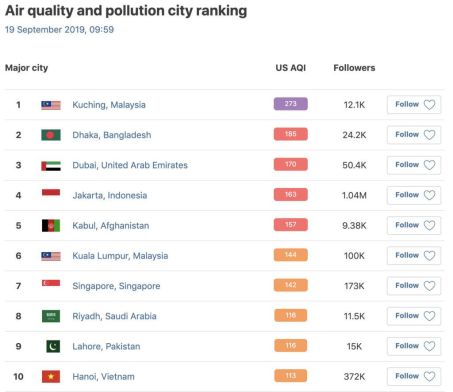
Indonesian fires choking this part of the region have shot Singapore into the top 10 rankings of the world’s most polluted cities, according to live data from global air quality monitoring firm AirVisual this morning.

Our haze situation remains firmly at “unhealthy” levels today, with the National Environment Agency’s (NEA) pollutant standard index (PSI) sitting at 120 as of 9am — good for #7 on the AirVisual ranking — while the air quality in Malaysia and Indonesia continues to worsen, especially in areas near Sumatra and Borneo, where most of the fires are taking place.

In Kalimantan on Borneo and Jambi on Sumatra, the haze is at hazardous levels, with staggering AQIs of 445 and 458, respectively, according to air quality monitoring site aqicn.org.

More than a thousand schools in Malaysia were reportedly forced to close due to the haze, which even led to the death of a 4-month-old baby in Indonesia.

Unsurprisingly, Indonesia and Malaysia’s capital cities, Jakarta and Kuala Lumpur, join Singapore in the top 10 of the IQAir AirVisual live ranking of polluted cities.

As of about 10 am, Singapore was ranked number 7 with a US Air Quality Index (AQI) of 142, just below Kuala Lumpur at number 6, with a US AQI of 144. Jakarta is ranked fourth with an AQI of 163 while Kuching topped the list with an AQI of 273.

Check out the rest of the top 10 rankings below:

c581268f0819ef96294494470200fa5e

Now, you might have noticed some disparity between the US AQI and the PSI readings Singaporeans get updated with each day. For the record, the PSI as of 9am today is at 120.

One reason behind this is that the US AQI is measured differently, as it follows an air quality index reporting system set out by the US Environmental Protection Agency, calculating four of US’ major air pollutants that are regulated under its laws. They are: ground-level ozone, particle pollution, carbon monoxide, and sulfur dioxide.

Singapore’s PSI, however, calculates six pollutants: particulate matter (PM10), fine particulate matter (PM2.5), sulfur dioxide, ozone, carbon monoxide, and nitrogen dioxide.

“The only country that adopts the USEPA AQI is the US. It is therefore incorrect to compare the PSI with other air quality indices which are calculated using different methodologies,” NEA had said on its website.

There are also no international guidelines on how air quality indices should be computed and that each country adopts a different measuring system based on their “local needs and circumstances,” the website added.

So if you’re in doubt about the indices, you might want to refer to more than one index readings for a better gauge of the air quality around you.

via Singapore cracks world’s top 10 most-polluted cities as haze continues

Posted in Air Quality, Asia, Indonesia, Malaysia, Singapore | Tagged , , , , , , , , , , , , , , , , , , , , | Leave a comment

Air pollution particles found on foetal side of placentas – study

Research finds black carbon breathed by mothers can cross into unborn children

Air pollution particles have been found on the foetal side of placentas, indicating that unborn babies are directly exposed to the black carbon produced by motor traffic and fuel burning.

The research is the first study to show the placental barrier can be penetrated by particles breathed in by the mother. It found thousands of the tiny particles per cubic millimetre of tissue in every placenta analysed.

The link between exposure to dirty air and increased miscarriages, premature births and low birth weights is well established. The research suggests the particles themselves may be the cause, not solely the inflammatory response the pollution produces in mothers.

Damage to foetuses has lifelong consequences and Prof Tim Nawrot at Hasselt University in Belgium, who led the study, said: “This is the most vulnerable period of life. All the organ systems are in development. For the protection of future generations, we have to reduce exposure.” He said governments had the responsibility of cutting air pollution but that people should avoid busy roads when possible.

A comprehensive global review concluded that air pollution may be damaging every organ and virtually every cell in the human body. Nanoparticles have also been found to cross the blood-brain barrier and billions have been found in the hearts of young city dwellers.

While air pollution is reducing in some nations, the evidence of harm caused by even low levels is rapidly increasing and 90% of the world’s population live in places where air pollution is above World Health Organization (WHO) guidelines.

The research, published in the journal Nature Communications, examined 25 placentas from non-smoking women in the town of Hasselt. It has particle pollution levels well below the EU limit, although above the WHO limit. Researchers used a laser technique to detect the black carbon particles, which have a unique light fingerprint.

In each case, they found nanoparticles on the foetal side of the placenta and the number correlated with air pollution levels experienced by the mothers. There was an average of 20,000 nanoparticles per cubic millimetre in the placentas of mothers who lived near main roads. For those further away, the average was 10,000 per cubic millimetre.

They also examined placentas from miscarriages and found the particles were present even in 12-week-old foetuses. The first report of possible pollution particles in placentas was presented at a conference in September 2018, though the composition of the particles had not been confirmed.

The detection of the particles on the foetal side of the placental barrier means it was very likely the foetuses were exposed, Nawrot said. Work to analyse foetal blood for particles is now under way, as is research to see if the particles cause DNA damage.

The team also found black carbon particles in the urine of primary school children. The study, published in 2017, found an average of 10 million particles per millilitre in hundreds of nine-to-12-year-olds tested. “It shows there is translocation of particles from the lungs to all organ systems,” said Nawrot.

“It is really difficult to give people practical advice, because everyone has to breathe,” he said. “But what people can do is avoid busy roads as much as possible. There can be very high levels next to busy roads, but just a few metres away can be lower.”

Prof Jonathan Grigg, whose group presented the first report of particles in five placentas in September, welcomed the research and said the group’s work had since been expanded and would be published soon.

“We see evidence of particles in all women – it is not like it is a one-off,” said Grigg at Queen Mary University of London in the UK. “It implies that every day we have these very small particles moving around our bodies.”

“We should be protecting foetuses and this is another reminder that we need to get [air pollution] levels down,” he said. “But people shouldn’t be totally scared.” He said the total weight of the tiny particles was small and more research was needed to determine their impact, but he advised people to use lower pollution transport optionsor public transport, rather than cars.

Grigg said: “This new field of research certainly focuses our attention on the direct role of particles getting to the tissues, rather than particles getting into the lungs and releasing other [inflammatory] substances.”

Air pollution research now shows full scale bodily harm, from heart and lung disease to diabetes and reduced intelligence to brittle bones and damaged skin. The WHO calls air pollution a “public health emergency” and recent analysis indicates 8.8 million early deaths each year, though scientists suspect even this may be “the tip of the iceberg”.

via Air pollution particles found on foetal side of placentas – study | Environment | The Guardian

Posted in Air Quality, Health Effects of Air Pollution, Medical Studies | Tagged , , , , , | Leave a comment

These areas have the worst air pollution in South Africa

While the main culprits may not surprise you, the bronze prize for pollution goes to a newcomer.

The two regions in South Africa with the worst air pollution are repeat offenders and will not cause much surprise, but the area in third spot in this dirty race to the bottom was unspoilt wilderness not too long ago

Figures contained in a detailed air quality report, presented in Parliament by the Department of Environmental Affairs, show the Vaal Triangle’s air to be the most polluted in the country, followed by the coal fields of the Mpumalanga highveld. The third worst air quality can be found in and to the north of (“behind” in local parlance) the Waterberg in Limpopo.

The worst air pollution in South Africa: Cities and suburbs
The worst air pollution in the country is to be found specifically in the suburb of Three Rivers in Vereeniging, and the nearby townships of Sharpeville (at Vanderbijlpark) and Zamdela (at Sasolburg).

On the Mpumalanga highveld, the towns with the most heavily polluted air are Standerton, Delmas, eMalahleni (formerly Witbank), Middelburg, Hendrina and Ermelo.

In the Waterberg region the towns of Lephalale (formerly Ellisras), Thabazimbi and Mokopane (formerly Potgietersrus) were singled out for their dirty air.

Generally, air pollution levels in South Africa have remained largely stable over the last few years. Air quality is measured daily at 136 monitoring stations operated by the state and about 25 operated privately.

On top of the three worst areas already referred to above, there were a number of towns and neighbourhoods where air pollution reached unacceptable levels at least once (and in some cases more often) in the last year

Places where pollution has reached ‘unacceptable levels’
The affected areas were Phalaborwa, George, Bellville South, Cape Town City Bowl, Cape Town Atlantic Seaboard, Goodwood, Khayelitsha, Table View, Bedfordview, Springs-Etwatwa, Springs Central, Vanderbijlpark, Olifantsfontein, Thokoza, Alexandra, Buccleuch, Soweto-Jabavu, Olievenhoutbosch, Rosslyn, Bloemfontein Central, Port Elizabeth-Walmer, Durban Central, Chatsworth, Durban-Wentworth, Marikana and Mahikeng.

Cape Town
In Cape Town, air pollution levels are very low, but the highest levels of air pollution were measured at the Wallacedene informal settlement near Kraaifontein, in Khayelitsha and in the Cape Town city centre.

Johannesburg
The level of air pollution in Johannesburg is generally about six times higher than in Cape Town, with the townships of Alexandra, Diepsloot and Ivory Park the worst affected areas.

Pretoria’s air pollution is about three times worse than in Cape Town. In Pretoria, the situation is worst in Olivenhoutbosch (near Centurion), followed by Pretoria West in second place and the suburb of Booysens coming in third worst.

On the East Rand, pollution levels are lower than in Johannesburg but higher than in Pretoria. Etwatwa township near Springs has the worst air quality on the East Rand, followed by the Wattville area close to Benoni. Germiston has the third worst air quality on the East Rand.

Durban
The three worst affected neighbourhoods in Durban are the city centre, Chatsworth and Wentworth.

Surprisingly the town of Standerton, which is some distance away from the province’s mining and heavy industrial hubs, measured the most polluted air on the Mpumalanga highveld, followed by Delmas second worst, Balfour third and Middelburg fourth.

In addition to the established reasons for and causes of South African air pollution, the air quality report listed power outages as a new contributing factor to a periodical worsening of air quality.

via These areas have the worst air pollution in South Africa

Posted in Africa, Air Quality | Tagged , , , , , , , , , , , | Leave a comment

Kuching declared ‘world’s most air-polluted city’ – and KL is not far behind

Due to the worsening haze in southwestern Sarawak, Kuching has earned the title of the most air-polluted city in the world. This is the second time in a week that a Malaysian city has topped the list of the world’s most polluted cities, according to US-based website World’s Air Pollution: Real-time Air Quality Index.

According to the New Straits Times, Kuala Lumpur took first place on Wednesday (Sept 11) with a 165 reading on the Air Quality Index (AQI), which is the index used by the World’s Air Pollution website.

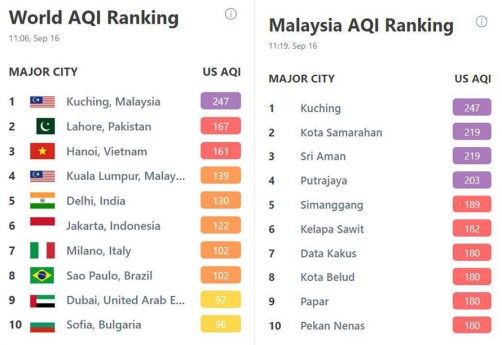
On Monday (Sept 16), Kuala Lumpur was at fourth place in a global air quality ranking by IQAir AirVisual.

20191609-HazeKuching-ranking

Kuala Lumpur was ranked fourth in a global air quality ranking. IQAir AirVisual

Five areas in Malaysia were in the “very unhealthy” air quality category as of 11am on Monday. They are: Johan Setia, Putrajaya, Kuching, Samarahan and Sri Aman.

According to the Department of Environment’s (DoE) monitoring of the Air Pollutant Index (API), Kuching recorded the highest API reading of 245, followed by Sri Aman (220) and Samarahan (216).

In Peninsular Malaysia, Johan Setia and Putrajaya both had a very unhealthy API reading of 202. A further 29 places recorded “unhealthy” readings.

API readings of 0 to 50 represent “good” air quality, while 51 to 100 is considered “moderate”, 101-200 is classified as “unhealthy”, 201-300 is “very unhealthy”, and above 300 is deemed “hazardous”.

20191609-HazeKuching-Info

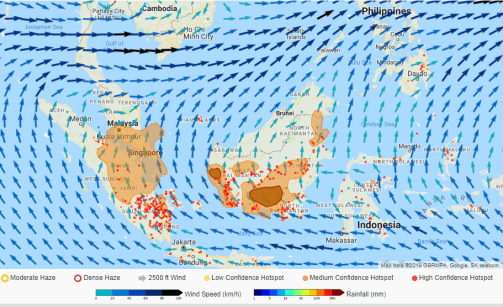
A map showing hotspot activities, wind direction and rainfall across Indonesia and Malaysia as of September 15. ASMC

According to the Asean Specialised Meteorological Centre (ASMC), dry conditions prevailed over the southern ASEAN region on Sunday. Moderate to dense smoke haze continued to emanate from persistent hotspots in the provinces of Riau, Jambi, South Sumatra, Lampung and many areas of Kalimantan, it said. The prevailing winds have blown some of the smoke haze to affect parts of peninsular Malaysia and Singapore.

However, the haze situation in Singapore gradually improved over the weekend, with a 24hr-Pollutant Standards Index (PSI) of 77 to 86 as of 11am on Monday (Sept 16).

The ASMC has forecasted that hazy conditions in the region can be expected to continue with the hotspot activities in Sumatra and Kalimantan persisting under the prevailing dry weather.

via Kuching declared ‘world’s most air-polluted city’ – and KL is not far behind, Business Insider – Business Insider Malaysia

Posted in Air Quality, Asia, Malaysia | Tagged , , , , , , | Leave a comment

Air pollution a growing threat for North Macedonia

The World Health Organisation (WHO) recently ranked Skopje, the capital of North Macedonia, as the third most polluted city in Europe. The organisation’s data shows that Skopje’s annual air pollution stood at 40 µg/m3 in 2018, 60 per cent higher than EU guidelines and four times higher than WHO guidelines.

North Macedonia has an especially poor record when it comes to particulate matter (PM) air pollution, one of the most damaging causes. In 2018, it was the country’s eighth largest mortality risk factor and was linked to 7.3 per cent of deaths, decreasing the average life expectancy in North Macedonia by 0.81 years.

What’s more, the effects of air pollution go beyond health and have a considerable impact on economic growth: it increases medical expenditure, decreases work productivity and contributes to a rise in premature deaths.

Health expenditure in North Macedonia has increased to around 397 million US dollars, which is almost 3.5 per cent of GDP. The country’s job performance has also been affected: the World Bank estimates that the productivity impact of air pollution is around 0.13 per cent of GDP (4.7 million US dollars). Furthermore, the increased death tolls, which result in reduced labour hours and total profits, lead to a decrease in gross domestic product.

Such a major health crisis requires immediate solutions by both public and private actors in the Macedonian economy, with a green economic transformation being vital to resolve the issue.

Air pollution will therefore be one of the key topics of the Macedonia2025 Summit between November 13 and 15 in Skopje, a platform for sharing knowledge, connecting business and inspiring innovation not just in North Macedonia, but all of Southeastern Europe, serving as an opportunity to address the issue by sharing expertise and encouraging a joint dialogue by all stakeholders.

via Air pollution a growing threat for North Macedonia – Emerging Europe | News, Intelligence, Community

Posted in Air Quality, Europe | Tagged , , , , | Leave a comment

The Amazon Has Seen More Than 100,000 Fires This Year, Causing Spike in Air Pollution

enxi8e9gkbhmlf0nohhm-620x349The fires burning throughout the Amazon rainforest and the rest of Brazil are billowing all types of air pollutants into the atmosphere, new satellite images from the European Space Agency (ESA) show.

The agency released the images Monday, reminding the world that the Amazon fires aren’t just an environmental issue — but a public health issue, as well. The images come as the number of Brazil’s forest fires soar past 100,000, a 45 per cent increase from this same time last year, according to Brazil’s National Institute for Space Research.

With the spike in fires, ESA found that the rates of dangerous pollutants like carbon monoxide, formaldehyde, and aerosols have gone up dramatically this year compared to last. The particulate matter from the organic matter going up in flames can cause respiratory or cardiac issues for individuals exposed. Carbon monoxide can make it harder for individuals to breathe by reducing oxygen levels. The World Health Organization issued a warning to vulnerable communities just last week because of all this air pollution.

Aerosols = bad (Illustration: European Space Agency)

There are also environmental impacts as well. The black carbon emissions from the fire are absorbing sunlight and blocking outgoing energy, a process that can worsening warming. The forest is also releasing carbon dioxide from its burning trees, another factor that could speed up global warming.

Many suspect that President Jair Bolsonaro’s new reign in the country has everything to do with this rise in Brazil’s forest fires. He’s been outspoken about handing the Amazon over to private interests, which burn the forest to clear land for crops, cattle, mining, and timber. The indigenous communities that live under the forest canopy have the most to lose as the Amazon continues to burn.

These maps show how much carbon monoxide has increased. (Image: European Space Agency)

Unfortunately, the Amazon forest fires are part of a greater global trend: The number of global fires increased by nearly fourfold last month compared to last year. August 2018 saw 16,632 fires. August 2019? 79,000. The world is on fire.

Featured image: European Space Agency

via The Amazon Has Seen More Than 100,000 Fires This Year, Causing Spike in Air Pollution | Gizmodo UK

Posted in Air Quality, Latin America | Tagged , , , , | Leave a comment