British people unaware of pollution levels in the air they breathe – study 

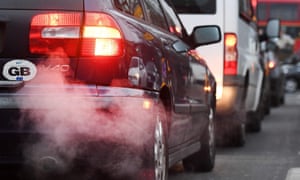
People across the UK are underestimating the impact of the air pollution crisis in their local areas, according to a new survey.

Almost two thirds of respondents said they were concerned about the issue of air pollution, but only one in 10 said they thought the air they breathe is bad.

Last week the Guardian revealed that there are 802 educational institutions in the capital where pupils as young as three are being exposed to illegal levels of air pollution that can cause serious long term health problems.

And government statistics show 38 our of 43 UK “air quality zones” breach legal limits for air pollution.

Friends of the Earth, which carried out the latest survey, said that despite the growing evidence many people – particularly outside London – were still unaware of the dangers of air pollution.

“With only 1 in 10 British adults rating their air quality as poor despite swaths of the country breaking legal limits for air pollution, it seems the message about the scale and danger of air pollution isn’t getting through,” said Oliver Hayes, a Friends of the Earth air pollution campaigner.

“Often you can’t see it or smell it, but it’s there – and air pollution is risking the health of an entire generation of children.”

To coincide with the findings Friends of the Earth has launched what it says will be the “biggest ever citizen science air pollution experiment”. People can apply to the charity for clean air kits, enabling them to test the air quality where they live, and FoE will provide tips on how to avoid air pollution and what people can do to help support the campaign for clean air.

Hayes said: “Our clean air kits help people to find out about the air quality in the places they care about most: on the street where they live, where they work, where their children go to school and at the heart of their communities.

“The results will help us build up a localised picture of the state of our nation’s air to really bring home why everyone, from individuals to businesses and politicians, must do all they can to make the air we breathe safer.”

Air pollution is linked to heart disease, lung cancer, worsening asthma and poor lung development in children and leads to the premature deaths of around 40,000 people every year in the UK.

The Friends of the Earth report coincided with a separate study for the Greater London Authority which found a much higher awareness of air pollution in the capital.

It found that nine out of 10 people in London believe air pollution is at crisis levels and two thirds describe air quality in their local area as bad.

It also found that every London borough has recorded illegally high levels of air pollution in the last two years.

Hayes said: “Whilst Londoners are starting to understand the air pollution crisis, in part due to welcome attention from politicians and the media, outside of the capital it’s a very different story.”

Friends of the Earth said it hoped thousands of people will join in the charity’s experiment so it can create a comprehensive national air pollution picture. It said the data generated will feed into a national map which will help create a “state of the nation” report on air pollution.

Source: British people unaware of pollution levels in the air they breathe – study | Environment | The Guardian

Posted in Air Quality, Europe, UK | Tagged , | Leave a comment

Woodstoves are good for the soul, bad for the heart: Researchers find that air pollution from wood burning linked to increased risk of heart attacks in seniors

The risk of acute myocardial infarction for the elderly living in and around small cities is increased by air pollution caused by biomass burning from woodstoves.

It is well documented that air pollution in big cities causes heart and lung problems. But what are its consequences on people in smaller urban centres?

By comparing pollution data from three cities in British Columbia (Prince George, Kamloops and Courtenay/Comox) with hospital admissions, researchers from McGill and Health Canada found that rising concentrations of fine particulate air pollution caused by wood burning were associated with increased hospitalization for myocardial infarction. During the cold season, when pollution from woodstoves is at its highest, the risk of heart attacks among subjects of 65 years and older increased by 19%.

“We noticed that the association was stronger when more of the air pollution came from wood burning, says McGill University professor Scott Weichenthal, lead author of a new study published in Epidemiology. This suggests that the source of pollution matters and that all particulate air pollution is perhaps not equally harmful when it comes to cardiovascular disease.”

Improving public health

Scott Weichenthal thinks the findings might push cities across Canada to tackle air pollution caused by fireplaces and woodstoves. Increasing winter smog alerts have prompted cities such as Montreal to bring forward bylaws forcing homeowners to register and, eventually, replace their stoves with cleaner sources of heating. The study, says Weichenthal, gives credence to “initiatives aimed at reducing air pollution from residential wood burning in the interest of public health.”

Source: Woodstoves are good for the soul, bad for the heart: Researchers find that air pollution from wood burning linked to increased risk of heart attacks in seniors — ScienceDaily

Posted in Health Effects of Air Pollution | Tagged , , , | Leave a comment

Air pollution exposure may increase risk of dementia

Alzheimer’s disease is a progressive brain disease that eventually strips sufferers of their ability to remember, communicate and live independently. By 2050, it is projected to affect nearly 14 million Americans and their families, with an economic cost of one trillion dollars – more than the estimated combined total for treating heart disease and cancer.

Of the leading causes of death in America, Alzheimer’s disease is the only one that we currently cannot prevent, cure or even stall. Our latest research seeks to change this situation by providing a better understanding of the environmental causes and mechanisms behind the disease.

Our findings lead us to conclude that outdoor air pollution, in the form of tiny particles released from power plants and automobiles that seep into our lungs and blood, could nearly double the dementia risk in older women. If our results are applicable to the general population, fine particulate pollution in the ambient air may be responsible for about one out of every five cases of dementia.

This study, the first to combine human epidemiologic investigation with animal experiments, adds to a growing body of research from around the world that links air pollution to dementia. It also provides the first scientific evidence that a critical Alzheimer’s risk gene, APOE4, interacts with air particles to accelerate brain aging.

Where there’s smoke

Previous research at the University of Southern California has already established that air pollution accelerates the risk of having a heart attack. Based on this work, we established the AirPollBrain Group to examine whether and how exposure to fine particulate matter – known as PM2.5 because the particles measure 2.5 micrometers or less in diameter – impacts the aging brain.

Click to zoom. USEPA

We designed this study to answer three broad questions. First, we wanted to know whether older people living in locations with higher levels of outdoor PM2.5 have an increased risk for cognitive impairment, especially dementia. We also wanted to know whether people who carry the high-risk gene for Alzheimer’s disease, APOE4, are more sensitive to the damage potentially caused by long-term exposure to PM2.5 in the air.

Our third question was whether similar findings could be observed with controlled exposures to particles in mice modified to carry human Alzheimer’s disease genes. If we found similar effects in mice, it could shed light on possible mechanisms underlying what is happening in human brains.

We focused on older women and female mice because APOE4 confers a greater Alzheimer’s disease risk in women than in men.

Human subjects

For the human epidemiologic study component, we collaborated with investigators from the Women’s Health Initiative Memory Study, or WHIMS, which followed a large group of older women nationwide, starting in the late 1990s when these women were 65 to 79 years old but did not have dementia or any significant cognitive impairment.

We combined EPA monitoring data and air quality simulations to build a mathematical model that allowed us to estimate the everyday outdoor PM2.5 level in various locations where these women lived from 1999 through 2010. Because the WHIMS followed its study participants very closely, we were able to gather detailed information on other factors that may affect an individual’s risk for dementia, such as smoking, exercise, body mass index, hormone therapy and other clinical risk factors like diabetes and heart disease. This allowed us to account for these other factors and better isolate the effects of air pollution exposure.

We found that women exposed to higher levels of PM2.5 had faster rates of cognitive decline and a higher risk of developing dementia. Older women living in places where PM2.5 levels exceeded the U.S. Environmental Protection Agency’s standard had an 81 percent greater risk of global cognitive decline and were 92 percent more likely to develop dementia, including Alzheimer’s. This environmental risk raised by long-term PM2.5 exposure was two to three times higher among older women with two copies of the APOE4 gene, compared with women who had only the background genetic risk with no APOE4 gene.

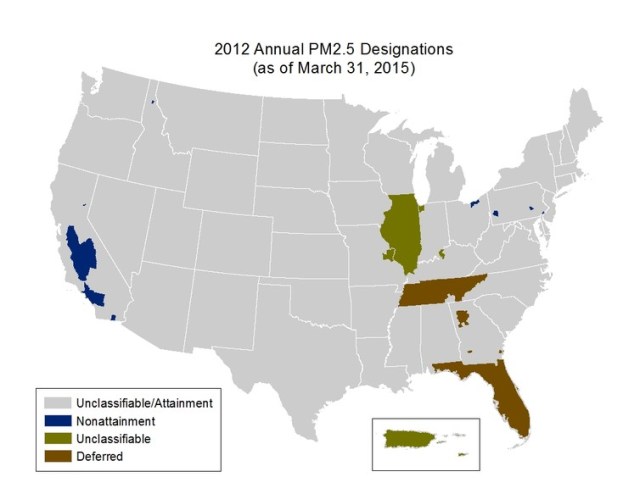
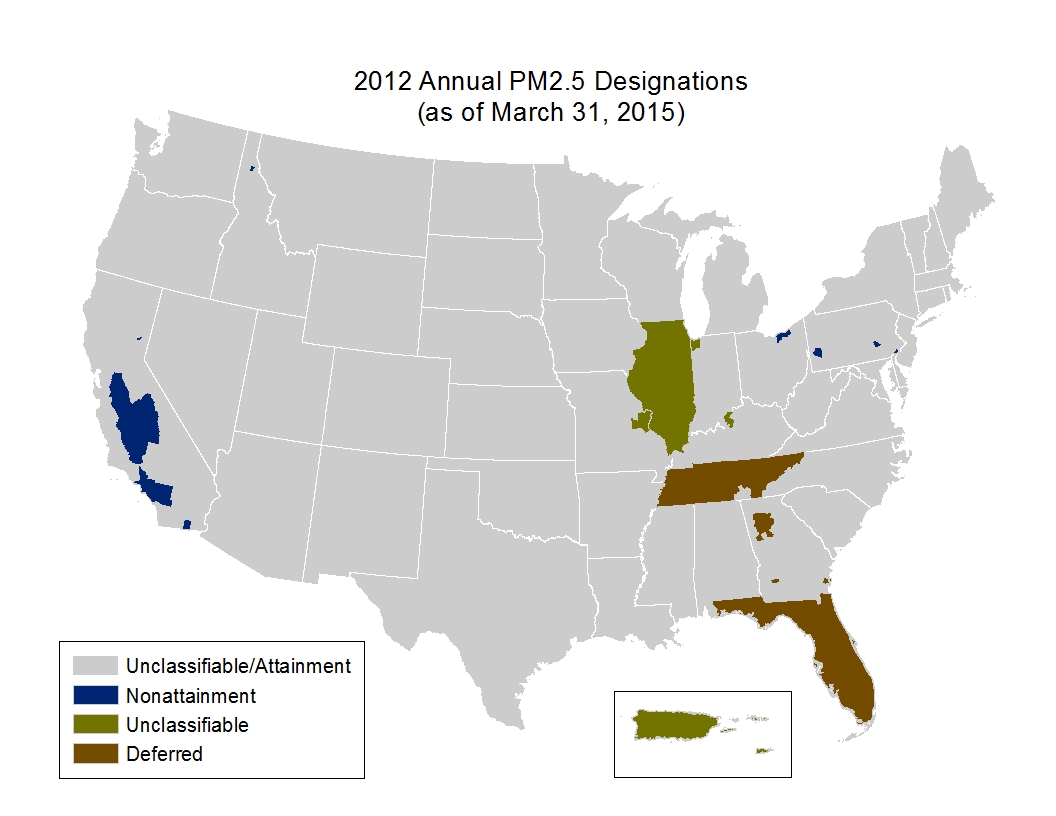
Nonattainment areas are not meeting the EPA standard. Areas designated unclassifiable do not have enough verified monitoring data to show they are meeting the standard, but are working with EPA to improve their data. USEPA

Mouse models

For the laboratory studies, we exposed female mice with Alzheimer genes to nano-sized air pollution for 15 weeks. The air particle collection technology, invented by our colleague Constantinos Sioutas from USC’s Viterbi School of Engineering, collects air particles from the edge of USC’s campus as a representative air sample from urban areas.

The experimental data showed that mice systematically exposed to this particulate matter accumulated larger deposits of proteins called beta-amyloid in their brains. In humans, beta-amyloid is considered as a pathological driver of neurodegeneration and is a major target of therapeutic interventions to prevent the onset of Alzheimer’s or slow its progress. Similar to our epidemiologic observation in older women, these effects were stronger for APOE4 female mice, which are predisposed to Alzheimer’s disease.

Future studies

Our future studies will look at whether these findings also apply to men, and whether any drugs under development may provide protection against air pollution exposure. More work is also needed to confirm a causal relationship and to understand how air pollution enters and harms the brain.

Brain aging from exposure to air pollution may start at development, so we also want to look at early life exposure to air pollution in relation to Alzheimer’s disease. We already know that obesity and diabetes are Alzheimer’s risk factors. We also know that children who live closer to freeways tend to be more obese, an effect that is compounded if adults in the household are smokers.

Based on existing mouse models, one would predict that developmental exposure to air pollution could increase risk for Alzheimer’s disease. This is an important piece of the scientific puzzle that we’d like to better understand.

Air pollution, public health and policies

Air pollution knows no borders. This gives our study global implications that should be taken seriously by policymakers and public health officials.

The Clean Air Act requires the Environmental Protection Agency to develop National Ambient Air Quality Standards that provide an adequate margin of safety to protect sensitive populations, such as children and the elderly. In 2012 the EPA tightened the U.S. standard for PM2.5. Nonetheless, in 2015 nearly 24 million people lived in counties that still had unhealthful year-round levels of particle pollution, and over 41 million lived in counties that experienced short-term pollution spikes.

Recent studies have shown that the prevalence of dementia in the United States declined between 2000 and 2012. However, we don’t know whether this trend is connected to air pollution regulations, or if exposures to lower levels of PM2.5 in recent years still pose some degree of long-term threat to older Americans, especially those at risk for dementia.

If long-term PM2.5 exposure indeed increases the risk for dementia, this would imply that public health organizations are underestimating the already large disease burden and health care costs associated with air pollution. For instance, the World Health Organization’s latest assessment of the global burden of disease caused by PM2.5 does not include dementia. Air pollution levels are much higher in India, China and many other developing nations than U.S. levels.

The World Health Organization recommends reducing PM 2.5 to an annual average of 10 micrograms per cubic meter.Phoenix 7777/Wikipedia, CC BY-SA

Similarly, EPA has estimated that the Clean Air Act will provide almost US$2 trillion in benefits between 1990 and 2020, much of it from reduced deaths and illnesses. If there is a connection between particulate pollution and dementia, the Clean Air Act may be providing even larger benefits than EPA’s estimate.

The U.S. National Plan to Address Alzheimer’s Disease, which was mandated by legislation enacted in 2011, aims to prevent or effectively treat Alzheimer’s disease by 2025. We believe any measures that undermine EPA’s operation or loosen clear air regulations will have unintended consequences that will make it challenging to meet this goal.

Source: Air pollution exposure may increase risk of dementia

Posted in Air Quality, Health Effects of Air Pollution | Tagged , , , , | Leave a comment

Heavy air pollution to hit northern cities until start of National People’s Congress 

Pollution will ease by Wednesday, forecasters say, but return with a vengeance on Friday for the following week

A new bout of air pollution is due to hit Beijing and other parts of north China today.

The Ministry of Environmental Protection on Saturday issued an air quality forecast that more than 18 cities in northern China will suffer heavy pollution until at least Wednesday.

Besides the capital, other cities to be affected include nearby Tianjin, and Shijiazhuang, Langfang and Baoding in neighbouring Hebei province. Shanxi, Shandong and Henan provinces will also be affected.

All the regions will be hit the hardest today when the pollution is most serious.

The latest pollution is caused by “unfavourable meteorological conditions for the dispersion of air pollution”, the ministry said.

Air pollution is usually the most serious during winter in China. Pollution levels can usually build up due to a lack of wind to disperse the pollution.

The pollution is expected to ease by Wednesday when a cold front will help disperse the pollutants, the ministry added.

However, the relief with be short-lived with yet more smog returning on Friday until the end of the week on March 5, when the annual session of the National People’s Congress opens.

To combat air pollution, authorities have ordered factories to cut output and have sent inspectors to heavy manufacturing centres to monitor environmental measures taken by factories.

Such efforts have proven to be challenging. Last week, the ministry of environmental protection criticised several cities in the Beijing-Tianjin-Hebei region and neighbouring areas, including Cangzhou and Baoding, for failing to comply with government regulations in stop production on heavily polluted days.

Chen Jining, the minister of environmental protection, held a meeting on Thursday to discuss measures to be taken in the coming days. He pledged to issue timely pollution alerts and to tighten inspections to find factories that failed to comply with environmental regulations.

China has a four-tier colour-coded air pollution warning system, starting with blue, the least serious, and rising through yellow, orange and red.

Source: Heavy air pollution to hit northern cities until start of National People’s Congress | South China Morning Post

Posted in Air Quality, Asia, China | Tagged , , , , , , , , , , | Leave a comment

Car buyers should have ‘long, hard think’ about diesel 

The transport secretary suggests drivers should try to buy the least polluting vehicles possible.

The transport secretary has said drivers considering buying diesel cars should take a “long, hard think”.

Chris Grayling made the remarks to the Daily Mail, which said the government was considering a scrappage scheme for older diesel cars.

Concerns over nitrogen dioxide (NO2) emissions from diesel vehicles have been raised in recent years.

The Department for Transport said Mr Grayling was not telling people to stop buying diesel vehicles.

It declined to comment on reports of a new scrappage scheme.

‘Buy low-emission’

According to statistics from the Department for Environment, Food and Rural Affairs (Defra), NO2 is responsible for about 23,500 deaths in the UK each year.

Concern over emissions increased when it emerged that 1.2 million Volkswagen diesel vehicles in Britain had been fitted with software to help cheat emissions tests.

Mr Grayling told the Mail: “People should take a long, hard think about what they need, about where they’re going to be driving, and should make best endeavours to buy the least polluting vehicle they can.

“I don’t think diesel is going to disappear but someone who is buying a car to drive around a busy city may think about buying a low-emission vehicle rather than a diesel.”

screen-shot-2017-02-25-at-13-08-51

Greenpeace clean air campaigner Areeba Hamid said: “It’s a bit confusing. He’s saying ‘have a long and hard think about diesel’ but in the same breath he’s saying [diesel cars] won’t disappear.”

She said the government should deliver a strong message to the car industry and consumers by changing the taxation structure on diesel cars in the next Budget.

The Society of Motor Manufacturers and Traders (SMMT) chief executive Mike Hawes said: “The biggest air quality gains will come by encouraging the uptake of the latest low emission vehicles, regardless of fuel type.”

Steve Fowler from Auto Express magazine said the government should not “penalise” those who “really have no alternative” to using diesel.

“As much as battery cars, hybrid cars are improving, they’re never going to be the greatest things for really long journeys and for things like towing, so diesel – for the moment – will always have a place,” he said.

“And people living in rural areas – this is where the one size fits all thing doesn’t work.”

When guest editing BBC Radio 4’s Today programme last December, Britain’s chief medical officer, Professor Dame Sally Davies, said diesel cars should “steadily be phased out” in order to reduce deaths from air pollution.

London is one of the worst affected areas in the UK for air pollution, and the city’s mayor Sadiq Khan has asked the government to adopt a £515m diesel scrappage scheme to help reduce emissions in the capital.

Mr Khan has also said a £10 “toxicity charge” – which will target the most polluting older vehicles in the capital – will come into force on 23 October.

A spokesman for the Department of Transport said the government was helping to tackle air quality by providing a further £290m to support electric vehicles.

The spokesman added: “We will update our air quality plans later this year to further improve the nation’s air quality.”

The Labour government ran a £300m scrappage scheme for both diesel and petrol cars between 2009 and 2010.

Source: Car buyers should have ‘long, hard think’ about diesel – BBC News

Posted in Air Quality, Europe, London, UK | Tagged , , , , , , , , , , | Leave a comment

Revealed: thousands of children at London schools breathe toxic air 

Exclusive: 802 schools, nurseries and colleges are in areas where levels of nitrogen dioxide breach EU legal limits

Tens of thousands of children at more than 800 schools, nurseries and colleges in London are being exposed to illegal levels of air pollution that risk causing lifelong health problems, the Guardian can disclose.

A study identifies 802 educational institutions where pupils as young as three are being exposed to levels of nitrogen dioxide that breach EU legal limits and which the government accepts are harmful to health.

The research, commissioned by the mayor of London, Sadiq Khan, suggests thousands more children and young people are at risk from toxic air than previously thought.

Khan said the results were devastating and warned that it was the capital’s poorest children who were bearing the brunt of the air pollution crisis.

“It is an outrage that more than 800 schools, nurseries and other educational institutions are in areas breaching legal air pollution limits,” he said.

“This is an environmental challenge, a public health challenge but also – and no one talks about this – it is fundamentally an issue of social justice. If you are a poor Londoner you are more likely to suffer from illegal air.”

Khan called for the government to introduce a clean air act and for a diesel scrappage scheme to take polluting cars off the road quickly.

The results show nearly double the number of schools than previously thought are affected by illegal levels of toxic air. A report that was kept secret by former mayor Boris Johnson revealed last year 433 primaries were exposed to dangerous levels of air pollution.

The new data shows 802 out of 3261 nurseries, primary and secondary schools and higher education colleges, are within 150 metres of nitrogen dioxide pollution levels that exceed the EU legal limit of 40µg/m3 (40 micrograms per cubic metre of air).

A third of state nursery schools in the capital (27), nearly 20% of primaries (360) and 18% of secondary schools (79) are in areas where toxic levels of nitrogen dioxide threaten children’s health. Of the further education colleges in the capital, 43% (30) were in areas of illegally toxic levels of NO2.

screen-shot-2017-02-24-at-16-11-31 screen-shot-2017-02-24-at-16-11-50

Traffic is a major contributor to air pollution and there is growing concern about emissions from diesel vehicles, which contribute through the production of particulate matter and nitrogen oxides (NOx).

Dr Francis Gilchrist, consultant respiratory paediatrician at Royal Stoke University hospital, said it was known that children were particularly sensitive to air pollution and that lung damage had lifelong consequences.

“If something is not done about air pollution these issues are going to get worse and worse. There is definitely concern that air pollution is affecting children’s lungs – in particular it exacerbates respiratory illness, like asthma, and it predisposes children who are healthy to having repeated chest infections,” he said.

“If you damage your lungs in childhood you are likely to see these effects right through into adulthood, so there is a lifelong impact.”

Khan hopes the introduction of what he says is the world’s first ultra-low emission zone will cut toxic NO2 emissions from diesel vehicles by 50%. He plans to extend the zone to the north and south circular roads in the capital and has brought its introduction forward a year to 2019.

Last week he announced that drivers of older, more polluting cars will have to pay a £10 charge to drive in central London from October.

But other cities – including Paris, Athens and Madrid – have announced more dramatic measures, introducing car-free days and bans on diesel cars from city boundaries.

Khan said he had not ruled anything out. “We are evaluating the success of other cities. We are looking at their plans and nothing is off the table. But at the moment we think our plans are the most effective.”

London is not alone in the UK in facing an air pollution crisis. Khan and the leaders of four other cities badly affected by poor air quality – Leeds, Birmingham, Derby and Nottingham – had written to the government calling on them to do more to tackle the problem across the UK.

“It must be the case that air quality in other cities is having a similar impact and that it is worse in the most deprived parts of those cities. It must impact on schools in the same way, but they do not have the information that is now available in London. The government must take action,” he said.

The new research on schools, nurseries and colleges was based on modelling of data from 2013 carried out by experts from the environmental research group at King’s College London and Aether, the environmental data analysts.

The modelling is more precise than the government’s measurements, which the high court has condemned as overoptimistic.

screen-shot-2017-02-24-at-16-10-33

Judges told ministers last November they must cut the illegal levels of NO2 in dozens of towns and cities in the shortest possible time after ruling their plans to improve air quality were so poor they were unlawful.

The government has until April to come up with proposals to bring before the court.

The study adds to the pressure on ministers to tackle air pollution amid growing evidence of a toxic air crisis in parts of the UK. London breached its annual air pollution limits just five days into 2017.

Last month Khan issued the first “very high” air pollution alert with warnings displayed at bus stops, train stations and road signs across the capital.

This year Khan gave £250,000 to fund 50 air quality audits at the worst affected primary schools. The money will allow schools to work with local councils to introduce measures to protect pupils from toxic air and could include banning the most polluting cars at drop-off and pick-up time, clean air routes for walking to school, green barriers and moving entrances away from busy roads.

Air pollution causes up to 50,000 early deaths – 9,000 of these in the capital – and costs the country £27.5bn each year, according to a government estimate. MPs have called it a public health emergency.

Khan is calling for ministers to introduce a comprehensive diesel scrappage scheme to compensate drivers who bought diesel cars after being told they were more environmentally friendly than petrol vehicles. He also wants the government to introduce a clean air act “fit for the 21st century”.

“Today people scratch their heads that 30 or 40 years ago we knew smoking was bad for your health but no action was taken,” he said. “I don’t want a situation now where in 20 or 30 years’ time our children or grandchildren say knew about air quality but no action was taken.

“I want London to be the envy of the world in relation to air quality, to be the greenest city in the world.”

‘Some days it makes me consider leaving London’

The playground at Tachbrook nursery school in Pimlico, west London, has lots to keep a three-year-old happy at breaktime.

But, like other schools highlighted in the report, it is very close to a busy main road. HGVs, cars, taxis and buses plough up and down the Embankment nearby, and so the school is subject to NO2 pollution levels above EU legal limits.

Headteacher Elizabeth Hillyard said she had signed a petition along with other headteachers in the capital urging more to be done about toxic air.

“Air pollution has bad effects on health and it needs to be addressed and all the heads in Westminster have signed the petition,” she said.

Like other schools, Tachbrook does what it can to protect children, including having a fence around the playground. Kate Lyons, a parent collecting her three-year-old son, said the issue was a concern.

“We are generally concerned about the air in this area,” Lyons said. “You can feel it and taste it. My little boy loves playing in the playground at school, and it does worry me.

“We live nearby and sleep with our windows closed because of the pollution. We used to live in Edinburgh and you can feel the difference living here in London and some days it is something that makes me consider leaving.”

Source: Revealed: thousands of children at London schools breathe toxic air | UK news | The Guardian

Posted in Air Quality, Europe, London, UK | Tagged , , , , , , , , , , , | Leave a comment

Children at Nearly 8,000 U.S. Public Schools Breathe Highly Polluted Air 

Roughly one in every 11 public schools in the U.S. sits within 500 feet of highways and other heavily trafficked roads, exposing 4.4 million students to high levels of toxic air pollution. The data is the result of a new investigationby the Center for Public Integrity and Reveal from The Center for Investigative Reporting.

Breathing air with high levels of particulate matter has been shown to stunt lung growth, trigger asthma, increase the risk of cancer, and damage learning capability in children. California banned the construction of new schools within 500 feet of busy roads in 2003, and the U.S. Environmental Protection Agency has urged school districts to carefully consider air pollution risks since 2011. But according to reporting by CPI and Reveal, nearly one in five U.S. schools that opened in the 2014-2015 academic year were built in high-traffic areas.

“The expectation of every parent is that they’re sending their child to a safe environment,” George Thurston, a population-health professor at the New York University School of Medicine, told the Center for Public Integrity. “And with this kind of pollution, they’re not.”

Source: Children at Nearly 8,000 U.S. Public Schools Breathe Highly Polluted Air – Yale E360

Posted in Air Quality, USA & Canada | Tagged , , | Leave a comment

Proposed fireplace bylaw prohibits burning wet timber, high sulphur coal

About 75,000 Auckland households will need to be careful about how they use their fireplaces under newly proposed burning restrictions.

On Thursday Auckland councillors discussed a draft air quality bylaw for indoor fires which would ban the burning of wet timber and certain types of coal.

The proposed bylaw comes after another proposed bylaw that would have banned all domestic open fireplaces was canned in 2015.

Auckland Council’s manager of social policy and bylaws Michael Sinclair said the new bylaw would not force people to stop using indoor open fires.

Instead, if the bylaw goes ahead it will prohibit burning high-sulphur coal and damp timber that produces a lot of smoke or causes a nuisance to neighbours.

Auckland has about 58,000 old pre-2005 wood burners in homes and 17,000 open fireplaces.

The proposal for the bylaw comes after a “regulatory gap” appeared with the creation of Auckland’s unitary plan.

In Thursday’s meeting councillors Wayne Walker and Chris Darby raised the issue of premature deaths caused by wood fires and questioned why information about that was not going to be included in the proposal.

“These are health issues and particularly the elderly and young are extremely vulnerable,” Darby said.

A report given to Auckland Council in 2012 said air pollution was responsible for 200 premature deaths a year. Motor vehicles and domestic fires are considered the two largest sources of air pollution in Auckland.

Darby said he didn’t think the bylaw went far enough.

“I don’t think it is good enough to have open fires belching stuff into the neighbourhood and killing people.”

Councillor Christine Fletcher said her problem with the bylaw was that it was 35 pages when she said the information could have been fitted into a single page.

Sinclair said the bylaw was 35 pages because of the complicated nature of redefining urban areas because of unitary plan changes.

Councillor Daniel Newman said regardless of air quality his first priority was that people remained warm.

“The most important need is for people to be warm and dry in winter.”

The proposed bylaw was adopted and will go to public consultation.

Council wants the bylaw to be in action by winter this year.

Source: Proposed fireplace bylaw prohibits burning wet timber, high sulphur coal | Stuff.co.nz

Posted in Air Quality, Australia & Oceania | Tagged , , , | Leave a comment