Indonesia dismisses study showing forest fire haze killed more than 100,000 people 

Authorities from Indonesia, Malaysia and Singapore have rejected recent research on the number of early deaths caused by last year’s fires

Indonesian, Malaysian and Singaporean authorities have dismissed research that suggested smoky haze from catastrophic forest fires in Indonesia last year caused 100,000 deaths. Some even contend the haze caused no serious health problems, but experts say those assertions contradict well-established science.

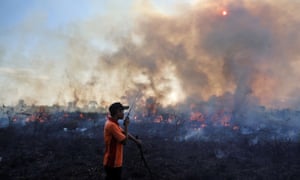
Last year’s fires in Sumatra and the Indonesian part of Borneo were the worst since 1997, burning about 261,000 hectares of forests and peatland and sending haze across the region for weeks. Many were deliberately set by companies to clear land for palm oil and pulpwood plantations.

The study in the journal Environmental Research Letters by Harvard and Columbia researchers estimated the amount of health-threatening fine particles, often referred to as PM2.5, released by the fires that burned from July to October and tracked their spread across south-east Asia using satellite observations.

In Indonesia, a spokesman for the country’s disaster mitigation agency said the research “could be baseless or they have the wrong information”. Indonesia officially counted 24 deaths from the haze including people killed fighting the fires.

Singapore’s Ministry of Health said short-term exposure to haze will generally not cause serious health problems. The study was “not reflective of the actual situation”, it said, and the overall death rate hadn’t changed last year.

In Malaysia, health minister Subramaniam Sathasivam said officials are still studying the research, which is “computer-generated, not based on hard data”. “People have died but to what extent the haze contributed to it, it’s hard to say,” he said. “If an 80-year-old fellow with high blood pressure, diabetes, heart problem and exposure to haze died, what did he die of? This is a hell of a difficult question to answer.”

The dry season fires are an annual irritant in Indonesia’s relations with its neighbours Singapore and Malaysia and the finding of a huge public health burden has the potential to worsen those strains. The 2015 burning season, which was worsened by El Niño’s dry conditions, also tainted Indonesia’s reputation globally by releasing a vast amount of atmosphere-warming carbon.

The Indonesian government has stepped up efforts to prosecute companies and individuals who set fires and also strengthened its fire-fighting response. This year’s fires have affected a smaller area in large part due to unseasonal rains.

Jamal Hisham Hashim, research fellow with the International Institute for Global Health in Kuala Lumpur, Malaysia, said governments should not dismiss the study even if the estimated deaths are arguable.

He said decades of air pollution research that followed London’s killer smog in 1952 has established the relationship between fine particulate matter and premature deaths, particularly in people with existing respiratory and cardiovascular diseases.

“The pollution level that occurred during the haze is severe enough to cause premature deaths. That is indisputable,” he said. “The study is a wake-up call. We need to be shaken; we have become too complacent with the haze.”

Joel Schwartz, an author of the study who is regarded by his peers as one of the world’s top experts on the health effects of air pollution, said authorities in the affected countries have not offered any details of how they reached conclusions critical of the study.

During the haze, Malaysia suffered air pollution at 10 times the level that the World Health Organization says causes premature deaths, he said, while Singapore’s claim that short-term exposure does not have serious effects is factually incorrect.
The Singaporean statement that its death rate was unchanged from 2014 did not demonstrate anything, Schwartz said, due to a worldwide trend for declining mortality. The study’s premise is that deaths are higher than what they would be without the haze rather than a comparison to a particular year, he said.

Separately, Singapore’s health ministry did not respond to a question on why heart disease and pneumonia, both of which can be brought to fatal conclusion by fine particle exposure, had increased as a percentage of deaths in 2015.

Malaysia, meanwhile, does not measure PM2.5 in its air pollution index but has been planning to from next year.

Half a dozen scientists with expertise in air pollution who reviewed the study for the Associated Press said its methodology was sound and its conclusions reasonable. Some cautioned that the estimates of 91,600 deaths in Indonesia, another 6,500 in Malaysia and 2,200 in Singapore are invariably uncertain because aspects of the modelling rely on assumptions and the actual figures could be higher or lower.

The study considered only the health impact on adults and restricts itself to the effects of fine particles rather than all toxins that would be in the smoke.

Philip Hopke, director of the Center for Air Resources Engineering and Science at New York state’s Clarkson University, said air pollution studies have to overcome several challenges because “no one who gets sick or dies comes to the doctor or hospital with a clear label that says airborne particles or ozone did this.” Another problem is the studies typically assume that fine particles are the sole cause of illness or death but smoke from fires contains ozone and a variety of volatile compounds that would also affect health.

“A major event like occurred here is extremely likely to have caused adverse health outcomes in terms of both sickness and deaths,” he said.

Source: Indonesia dismisses study showing forest fire haze killed more than 100,000 people | Environment | The Guardian

Posted in Air Quality, Asia, Singapore | Tagged , , , , , , , , , | Leave a comment

California restricts pollutants from cow flatulence to diesel emissions 

California on Monday moved to restrict air pollutants from sources as diverse as diesel trucks and cow flatulence, the latest of several efforts in the most populous U.S. state to reduce emissions leading to climate change.

Under a bill signed Monday by Democratic Governor Jerry Brown, the state will cut emissions of methane from dairy cows and other animals by 40 percent and black carbon from diesel trucks and other sources by 50 percent. The bill also mandates the state to reduce emissions of fluorinated gases, or hydrofluorocarbons used in refrigeration.

The measure comes on the heels of several climate-change bills signed in recent weeks by Brown, including one that by 2030 will mandate an overall reduction of greenhouse gas emissions to 40 percent below the level released in 1990.

“We’re protecting people’s lungs, their health by cutting out a poisonous chemical that comes out of diesel trucks,” Brown said at a signing ceremony in the Los Angeles suburb of Long Beach, where trucks at the nation’s largest port complex spew particulate matter, including black carbon, along clogged freeways, contributing to high rates of asthma and other conditions in some of the region’s poorest areas.

“It goes from some machine, into the air and into your lungs,” Brown said.

The pollutants targeted in the bill signed Monday differ from carbon dioxide and other pollutants associated with global warming in that they remain in the atmosphere a relatively short time. However, these emissions have heat-trapping effects, so reducing their presence can help fight climate change, Brown said.

In addition to black carbon, which comes from trucks as well as the burning of organic material and other sources, the bill also requires reductions in hydrofluorocarbons, used in refrigeration and to power aerosol products.

It would also require the state’s dairy industry, which produces 20 percent of the country’s milk, to find a way to reduce methane produced by cow flatulence and manure.

One technology for doing that is known as a methane digester, which turns the gas into usable fuel. Such equipment is expensive, however, which worries the state’s dairy farmers.

“This mandated 40 percent reduction in methane and 50 percent reduction in anthropogenic black carbon gas represents a direct assault on California’s dairy industry and will hurt manufacturing,” a small-business group, the National Federation of Independent Businesses, said in a news release.

But Brown said the mandates will lead the state to develop better technology and boost the economy.

Source: California restricts pollutants from cow flatulence to diesel emissions | Reuters

Posted in Air Quality, USA & Canada | Tagged , , | Leave a comment

How plant-covered buildings improve urban life 

Living building facades do more than look good, they make the air good and they make urbanites feelgood. At least, that’s the finding of a new report from global engineering firm Arup.

The company reported a series of studies exploring the impact of plant-covered building elements on air quality, acoustics, temperatures, energy use, and general quality of life.

Poor air quality is a growing concern for city-dwellers, where air pollution accounts for millions of premature deaths every year. Arup created a sophisticated computer model to calculate the flow of air through different types of cityscapes, examining how pollution might be impacted by green facades.

“Green façades can result in local reductions in concentrations of particulate matter, typically between 10 and 20%,” wrote Martin Pauli, a senior architect at Arup. The study found that different plant species also created different affects, with pine and birch plants outperforming other species in combating air pollution during winter months.

Plant-covered buildings also makes streetscapes noticeably quieter, according to the report, as living materials are more sound-absorptive than the hard stone, metal, and glass of many urban structures. Increasing the amount of green roofs and living walls has the potential to cut acoustic noise by 10 decibels—making the street sound roughly half as noisy.

Green plantings on buildings have also been known to regulate internal temperatures, cutting the cost of heating and cooling. But green facades also have a dramatic impact on reducing the temperatures of former heat islands by up to 50 degrees (10°C).

Source: How plant-covered buildings improve urban life – Curbed

Posted in Air Quality, Health Effects of Air Pollution | Tagged , | Leave a comment

Many car brands emit more pollution than Volkswagen, report finds 

Diesel cars by Fiat, Suzuki and Renault among makers emitting up to fifteen times European standard for nitrogen oxide

A year on from the “Dieselgate” scandal that engulfed Volkswagen, damning new research reveals that all major diesel car brands, including Fiat, Vauxhall and Suzuki, are selling models that emit far higher levels of pollution than the shamed German carmaker.

The car industry has faced fierce scrutiny since the US government ordered Volkswagen to recall almost 500,000 cars in 2015 after discovering it had installed illegal software on its diesel vehicles to cheat emissions tests. But a new in-depth study by campaign group Transport & Environment (T&E) found not one brand complies with the latest “Euro 6” air pollution limits when driven on the road and that Volkswagen is far from being the worst offender.

“We’ve had this focus on Volkswagen as a ‘dirty carmaker’ but when you look at the emissions of other manufacturers you find there are no really clean carmakers,” says Greg Archer, clean vehicles director at T&E. “Volkswagen is not the carmaker producing the diesel cars with highest nitrogen oxides emissions and the failure to investigate other companies brings disgrace on the European regulatory system.”

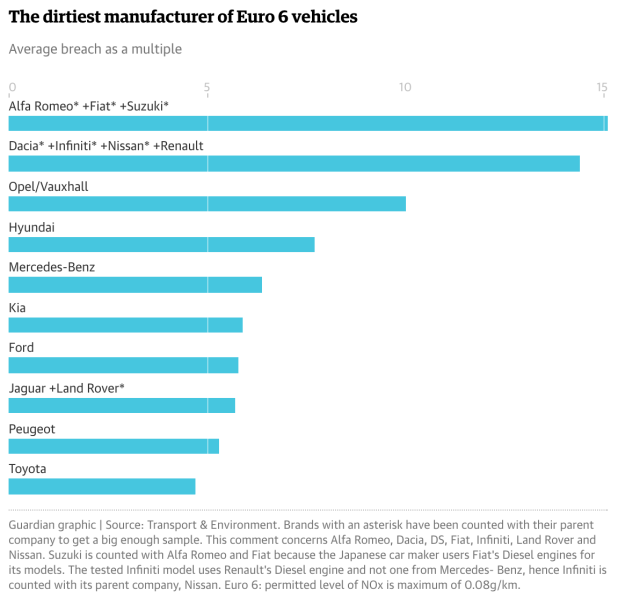
T&E analysed emissions test data from around 230 diesel car models to rank the worst performing car brands based on their emissions in real-world driving conditions. Fiat and Suzuki (which use Fiat engines) top the list with their newest diesels, designed to meet Euro 6 requirements, spewing out 15 times the NOx limit; while Renault-Nissan vehicle emissions were judged to be more than 14 times higher. General Motors’ brands Opel-Vauxhall also fared badly with emissions found to be 10 times higher than permitted levels.

The new models are not breaking the law and the manufacturers say they comply with all current regulations. But cars are are able to be on the road because of the difference between emissions produced in lab tests and real on-road driving situations.

screen-shot-2016-09-19-at-07-50-02

Since September 2015 new diesel cars have had to comply with a new European exhaust emissions standard called Euro 6 which set a limit of 0.08g per km. The new rules heralded a significant reduction from the previous “Euro 5” standard which allowed 0.18g per km. NOx pollution is considered to be a serious public health risk, causing the early deaths of 23,500 people a year in the UK alone.

The report – which also drew on data from investigations conducted by the British, French and German governments, as well as a large public database – surprisingly found Volkswagen to be selling among the cleanest diesel vehicles under the Euro 6 rules. Archer says this was not, however, evidence of the carmaker “learning its lesson” as these models were available before last year’s scandal broke. The Dieselgate engines were mostly of the previous Euro 5 era which were sold between 2011 and 2015.

screen-shot-2016-09-19-at-07-51-17

T&E estimates that there are 29m “dirty” diesel cars and vans on Europe’s roads – a number that is still growing – with 4.3m of them being driven in the UK. The group classify a car as “dirty” if emissions are more than three times over the relevant NOx limit. Archer argues that a mass recall of dirty Euro 5 and 6 vehicles is required given the average lifetime of a car is 17 years. “Software upgrades could easily be implemented to ensure the exhaust systems operate in normal driving conditions as the law clearly states,” heargues.

For Euro 5 vehicles, the five worst performing companies were, in order of the highest emissions: Renault (including Dacia), Land Rover, Hyundai, Opel/Vauxhall (including Chevrolet) and Nissan. For current Euro 6 cars a different pattern emerges. The worst performers are: Fiat (including Alfa Romeo) and Suzuki (to whom Fiat supply engines), Renault (including Nissan, Dacia and Infiniti), Opel/Vauxhall, Hyundai and Mercedes-Benz.

Last month French investigators said they had found that a large number of diesel cars emitted much higher levels of pollution than their European manufacturers claim. According to the independent committee’s report, around a third of the 86 diesel vehicles tested produced levels of NOx well above European limits. The results echo similar findings in tests by the UK’s Department for Transport.

In a statement Fiat Chrysler Automobiles (FCA) said an internal review had confirmed that its diesel engine applications complied with emissions regulation. It added: “The EU is working towards the adoption of a new testing procedure to bring it closer to what one would expect under real driving conditions. FCA supports these efforts and welcomes the introduction of new regulations which should provide clarity for customers and the industry.”

Mike Hawes, chief executive of the UK trade body the Society of Motor Manufacturers and Traders (SMMT) said the tests conducted by various governments had consistently shown the tested vehicles to be legal. “The differences between official laboratory tests and those performed in the ‘real world’ are well known, and industry acknowledges the need for fundamental reform,” he added.

A spokesperson for Hyndai said the company meets all current regulatory standards: “New Euro 6 cars are built using the best available technology to comply with these regulations and they produce less NOx emissions than their predecessors. Hyundai Motor takes environmental compliance extremely seriously and is committed to meeting forthcoming
new targets and to significantly improving the environmental performance of its vehicles.”

Renault, Opel/Vauxhall, Mercedes-Benz, Land Rover and Nissan did not respond to requests for comment on the report.

The EU has tightened emissions regulations and from September 2017 diesels that emit more than double the lab limit for NOx on the road will be banned from sale. Hawes added that next year’s introduction of an on-road Real Driving Emissions (RDE) test, as well as tougher lab tests, would help to provide consumers with the “reassurance that manufacturers are delivering on air quality”.

Source: Many car brands emit more pollution than Volkswagen, report finds | Business | The Guardian

Posted in Air Quality, Europe | Tagged , , , , , | Leave a comment

Study estimates 100,000 deaths from Indonesia haze

Indonesian forest fires that choked a swath of Southeast Asia with a smoky haze for weeks last year may have caused more than 100,000 deaths, according to new research that will add to pressure on Indonesia’s government to tackle the annual crisis.

The study by scientists from Harvard University and Columbia University to be published in the journal Environmental Research Letters is being welcomed by other researchers and Indonesia’s medical profession as an advance in quantifying the suspected serious public health effects of the fires, which are set to clear land for agriculture and forestry. The number of deaths is an estimate derived from a complex analysis that has not yet been validated by analysis of official data on mortality.

The research has implications for land-use practices and Indonesia’s vast pulp and paper industry. The researchers showed that peatlands within timber concessions, and peatlands overall, were a much bigger proportion of the fires observed by satellite than in 2006, which was another particularly bad year for haze. The researchers surmise that draining of the peatlands to prepare them for pulpwood plantations and other uses made them more vulnerable to fires.

The estimate of early deaths linked to respiratory illness and other causes covers Indonesia and its neighbors Singapore and Malaysia. It dwarfs Indonesia’s official toll of 19 that included deaths from illness and the deaths of firefighters. However, the possible scale of serious health consequences was indicated by a statement from the country’s disaster management agency in October that said more than 43 million Indonesians were exposed to smoke from the fires and half a million suffered acute respiratory infections.

The study considered only the health impact on adults and restricts itself to the effects of health-threatening fine particulate matter, often referred to as PM2.5, rather than all toxins that would be in the smoke from burning peatlands and forests. The bulk of the estimated deaths are in Indonesia, by far the most populous of the three countries and the country with the biggest land area affected by haze.

The fires from July to October last year in southern Sumatra and the Indonesian part of Borneo were the worst since 1997 and exacerbated by El Nino dry conditions. About 261,000 hectares of land burned. Some of the fires started accidently, but many were deliberately set by companies and villagers to clear land for plantations and agriculture.

Rajasekhar Bala, an environmental engineering expert at the National University of Singapore, one of five experts who reviewed the paper for The Associated Press and were not involved in the research, said the study is preliminary and involved a “very challenging” task of analyzing the sources and spread of fine particulate matter over several countries and a lengthy time frame.

Even with caveats, it should serve as a “wake-up call” for firm action in Indonesia to curb peatland and forest fires and for regional cooperation to deal with the fallout on public health, he said.

“Air pollution, especially that caused by atmospheric fine particles, has grave implications for human health,” he said.

Frank Murray, an associate professor of environment science at Australia’s Murdoch University, said the death estimates are not “precise health outcomes” but their overall scale should trigger intensified efforts to deal with the crisis. The study is a major contribution to addressing an international problem, he said.

The study finds there is a high statistical probability that early deaths ranged between 26,300 and 174,300. Its main estimate of 100,300 deaths is the average of those two figures. It predicts 91,600 deaths in Indonesia, another 6,500 in Malaysia and 2,200 in Singapore.

The researchers involved in the study say the model they developed can be combined with satellite and ground station observations to analyze the haze in close to real time. That gives it the potential to be used to direct firefighting efforts in a way that reduces the amount of illness caused, they say.

The annual fires have strained relations between Indonesia and its wealthier neighbors Singapore and Malaysia, who are at the mercy of winds that carry the haze into their territory from Sumatra.

But the brunt of the crisis is faced by millions of Indonesians in Sumatra and Kalimantan, many of them poor and with little or no means to protect themselves from the blanket of smoke.

“Particles penetrate indoors, and housing in Indonesia is very well ventilated, so I don’t think there is any avertive behavior that people there could have taken that would have been effective,” said Joel Schwartz, an air pollution epidemiologist at Harvard who co-authored the study. “In Singapore, if you close all the windows and turn on the air conditioning you get some protection, which may have happened.”

The Indonesian Medical Association’s West Kalimantan chapter said Indonesia faces an overall decline in the health of future generations with social and economic consequences if the situation is not tackled.

“We are the doctors who care for the vulnerable groups exposed to toxic smoke,” said Nursyam Ibrahim, deputy head of the West Kalimantan chapter of the association. “And we know how awful it is to see the disease symptoms experienced by babies and children in our care.”

Howard Frumpkin, dean of the School of Public Health at the University of Washington, said it is possible the health consequences are greater than indicated by the study because higher incidence of certain health problems in developing countries could make populations more susceptible to the effects of fine particulate matter.

Source: Study estimates 100,000 deaths from Indonesia haze

Posted in Air Quality, Asia | Tagged , , , , , , , | Leave a comment

Kolkata air quality now toxic all year

In the past two-and-ahalf years, Kolkata’s air qualified as ‘good’ only once for a fortnight in August 2015. In the 31 months between January 2014 and July 2016, there wasn’t a single instance when the average monthly SPM count was below the permissible limit. Worse, it turned absolutely toxic for a fortnight this January.

This year, the city’s air quality has been particularly bad with the PM2.5 count hovering over the Indian threshold of 60 microgramcubic metre. The WHO threshold is even more stringent at 25 microgramcubic metre. “People complain about the air quality of Delhi. But on several days, the air in Kolkata is worse than Delhi,” US consul general in Kolkata Craig Hall said at a workshop on the city’s air quality at the American Centre on Thursday . Later, a brainstorming session was held in association with Jadavpur University’s Global Change Programme and social enterprise Banglanatak.com to chalk out probable strategies to improve the city’s foul air.

According to data recorded by equipment installed at the consul general’s residence at Ho Chi Minh Sarani off Chowringhee since August 2013, fine suspended particulate matter of 2.5 micron dimension that enters the respiratory system unhindered and has severe health impact, varies from high to very high to terrible between October and March every year. The worst month is January when the air is laden with PM2.5 that hangs low over the surface and rushes into our respiratory tract with every breath. The best month is August when rains cleanse the air and wash away the deadly particles.

“It is time Kolkata took notice of the foul air and acted with urgency to improve it, particularly between September and January when the SPM2.5 count breaches that of Delhi. Alarm bells have started to ring in Delhi. It needs to happen in Kolkata as well,” said Rajeev M Sharma from the resource conservation unit at the US embassy .

Vid Nukala, a biomedical science-and-technology advisor who is in the US department of health and human services at the US embassy in Delhi, said pollution in South Asia, including India, had gone up 8% in the past two years. He also pointed out Kolkata’s high pollution level was despite more than half the population walking to work or taking a bus. While those who walk contribute least to the city’s pollution, they are among the most vulnerable to lung cancer, stroke and heart disease.

Source: Kolkata air quality now toxic all year – Times of India

Posted in Air Quality, Asia, India | Tagged , , , , | Leave a comment

Grimsby has the worst air pollution in Britain today

Grimsby has officially among the worst air pollution possible today.

A combination of yesterday’s sweltering heat and easterly winds have produced the worst air quality in the country, as shown on this map.

According to the Department for Environment, Food and Rural Affairs (DEFRA), Grimsby’s air pollution index is ten out of ten – meaning the air quality is the lowest it can be.

Today’s reading comes after residents reported a “smelly pong” stench across the area over the last two days following temperatures that reached 29C yesterday. The smell was believed to have been caused by “muck spreading” with the heat sending the pong across a wide area.

But, although the rest of the country enjoyed the hottest day of the year, Grimsby and the Humber seems to have borne the brunt of the air pollution with the rest of the UK enjoying relatively low air pollution.

A spokesman for DEFRA said: “It is easterly winds that are the reasons that your bit of the country is experiencing the particularly high levels of the air pollution.

“It is a result of the continued, light easterly winds.”

Despite today’s high levels, though, the outlook for the rest of the week makes better reading, with air pollution expected to be “low” over the next few days.

“A return to westerly air flow and fresher conditions means that air pollution levels will be low in this period,” the spokesman said.

Source: Grimsby has the worst air pollution in Britain today | Grimsby Telegraph

Posted in Air Quality, Europe, UK | Tagged , , , , | 1 Comment

Londoners overwhelmingly back Sadiq Khan’s air pollution crackdown

Londoners are backing Sadiq Khan’s plans to crack down on air pollution in the capital, with more than 70 per cent of residents supporting plans to bring forward measures to restrict polluting vehicles in the city, according to the results of the Mayor’s air quality consultation.

Some 15,000 people responded to the Mayor’s office air quality consultation this summer – the highest number of responses to a City Hall consultation ever. Nearly 80 per cent of respondents said they supported Khan’s plans to bring forward the introduction of the Ultra Low Emission Zone – currently due to enter force in 2020 – to 2019, while 71 per cent said the zone should be expanded to encompass the north and south circular.

Londoners also strongly backed an early £10 Emissions Surcharge, dubbed the “T-charge”, on high polluting vehicles entering the capital’s centre from 2017. More than 80 per cent of people backed this measure, which would apply to most cars registered before 2005. City Hall said it will now start to consider the practicalities of implementing the T-charge in more detail, ready for introduction next year.

Evidence suggests almost 9,500 Londoners die every year from long-term exposure to air pollution, while 443 schools in the capital are located in areas with poor air quality.

“A record number of Londoners responded to our consultation, which demonstrates they feel just as strongly as I do that cleaning up the capital’s killer air has to be a major priority,” Khan said in a statement. “Both the previous Mayor and the government failed to get their act together to meet legal pollution limits and that’s why I have put forward some bold, hard-hitting measures to tackle this issue head on. I will consider the consultation findings in more detail before deciding on the next steps.”

Earlier this week Khan set out a new action plan for London’s taxis, including the introduction of a new scrappage scheme for the oldest taxis from next year. Up to £5,000 will be available to drivers who retire their vehicles, Khan pledged, with £3,000 available towards the purchase of a new zero emission capable (ZEC) cab. Meanwhile, drivers of ZEC taxis will receive exclusive access to facilities such as green cab ranks.

Khan called on the government to introduce a nationwide diesel scrappage scheme for all vehicles, which proved popular with consultation respondents. “Londoners were clear that government needs to do its bit to help meet the new ULEZ standards and that it should fund a scrappage scheme. government now needs to listen to Londoners and work with me to deliver a national diesel scrappage scheme,” he added.

It echoes calls made in April by MPs who warned that air quality in Britain is a “public health emergency” and urged the government to take urgent action to crack down on pollution by introducing more clean air zones and a diesel scrappage scheme.

However, in the government’s official response to the MPs’ report, published yesterday, it rejected calls for a national scrappage scheme. “We have considered the use of scrappage schemes both linked to the purchase of ultra low emission vehicles and more generally and have concluded that this may not be an appropriate and proportionate response to the challenges we face, as air quality exceedances are often localised and can be managed in other ways,” the response said.

Instead, the government insists its plan of introducing Clean Air Zones in cities across the UK, as well as investment in low-emission vehicles, the introduction of charging networks and measures to cut pollution from industry and agriculture, is adequate.

The response sparked anger from air quality campaigners. “Despite the mounting evidence of the dangers people face having to breathe our illegally dirty air, the government is refusing to take the bold action needed to cut the 40,000 early deaths from air pollution each year in the UK,” Friends of the Earth air quality campaigner Jenny Bates said in a statement.

“Road traffic is the biggest problem for air pollution and diesel is the worst of all. We urgently need the government to put in place a plan to phase out diesel from our roads. A carefully-designed scrappage scheme would be an important step to help people switch away from dirty diesel vehicles – but the government has today rejected this vital recommendation.”

Source: Londoners overwhelmingly back Sadiq Khan’s air pollution crackdown | Environment | The Guardian

Posted in Air Quality, Europe, London, UK | Tagged , , , , , | Leave a comment