What you need to know about air pollution: Its importance and effective solutions

 Air pollution is now one of the most pressing environmental concerns. While nine out of the ten most polluted cities in the world lie in India and Pakistan that leaves no room for complacency amongst other countries; partly because they too have their own issues and also because we live in a connected ecosystem.

What Is Air Pollution?

Air pollution is a complex topic as so many factors are responsible for the poor quality of our air. However, simply put, air pollution is any chemical, physical or biological change which causes the atmosphere to become dirty and thus risks not only our own potential for survival but also that of other animals and plants.

Air pollution can also be further divided into two distinct categories; visible and invisible. Both can lead to an alteration of the delicate balance of our atmosphere and cause problems to health on a local scale and also damage to the ecosystem globally in terms of depletion of the ozone layer leading to climate change.

Air pollution can arise in two main ways. First, pollutants can be released directly into the atmosphere and are known as primary pollutants. Second, primary pollutants can combine to form secondary pollutants and this can be seen in the formation of issues such as smog.

What Causes Air Pollution?

Fossil Fuels: A main cause of air pollution is the one you might expect, namely the sulphur released from the burning of fossil fuels, such as coal and petroleum. We rely on petrol, diesel and jet fuel to transport not only us but our goods around the world as we live in an increasingly globalised economy.  In 2015 alone nearly 3.6 billion passengers, almost half the world’s population, were transported by the world’s airlines.

Vehicle Emissions: As our reliance on cars, trucks, shipping freighters and aeroplanes increases so do the levels of carbon monoxide and nitrogen oxides released into the atmosphere. 13% of global CO2 emissions, a major factor in global warming, come from transport.

Agriculture: We may not always immediately think of agricultural activities being connected to air pollution but methane and ammonia are both by-products of farming and are highly hazardous to our environment. This is compounded by the use of pesticides, insecticides and fertilizers, a heady cocktail of chemicals, some parts of which make it into the air.

Manufacturing: Heavy industry leads to the release of carbon monoxide, hydrocarbons and a soup of other chemicals, all of which can lead to a decline in air quality. Oil refineries also release hydrocarbons which pollute the atmosphere.

Deforestation: Deforestation is caused by clearing land for agriculture, manufacturing and ever growing urban areas. This lowers air quality because the fewer trees there are the less carbon dioxide they can absorb.

Mining: The result of mining on the health of workers and nearby residents has been clearly demonstrated over the years and in developing countries the quest to extract as many tons of natural resources as possible is having a devastating impact on the health of those working in the mines.

Indoor Pollution: What we use in our own homes is also leading to air pollution. Household cleaning products, paints and varnishes release chemicals into the air which contribute to poor air quality and many of us add to this chemical mix by smoking.

What Damage Does Air Pollution Do?

Air pollution damages our environment, and it also leads to a variety of health issues and even death.

Circulatory and Respiratory Issues: The particulates in the atmosphere have been linked to heart problems, respiratory issues and even cancer. Current estimates are that polluted air causes 5.5 million premature deaths per year.

Climate Change: The rise of levels of carbon dioxide, alongside other greenhouses gases, has led to global warming which has caused increasingly unpredictable weather systems and the melting of the ice caps.

Thinning of the Ozone Layer: As the levels of hydro chlorofluorocarbons and chlorofluorocarbons in the atmosphere rise this leads to a depletion of the ozone layer which protects the planet. As it does we are exposed to higher levels of ultraviolet light which can cause skin and eye problems.

Acid Rain: As sulphur and nitrogen oxides are released into the atmosphere they can combine with water droplets and fall as acid rain. The results can be devastating to fish, wildlife, trees and even the crops we rely on for our food production.

What Can Be Done About Air Pollution?

Air pollution needs to be tackled at a global level through legislation and international agreements which aim to reduce pollution levels, such as the Paris Agreement which was agreed in December 2015.

However, there are also steps we as individuals can take to lower our own environmental impact, particularly when it comes to air pollution.

Reduce Your Use of Private Vehicles: Where possible travel to your destination on foot, by bicycle, on public transport or car pool with others in your area. By lowering vehicle emissions you can reduce your carbon footprint.

Conserve Energy In the Home: Reduce your use of electricity by purchasing eco-friendly goods, keeping your thermostat turned down and insulating your property. Switch to sources of renewable energy where possible.

Recycle: Try to buy less from new and recycle household items as well as everything you are throwing out, even food scraps can go on a compost heap.

Reduce Food Miles: By purchasing more local food from farmers’ markets and growing your own fresh produce you can drastically reduce the distance your food travels to reach your plate.

Improve Your Indoor Air Quality: As well as the steps above you can also improve the air quality in your own home by asking smokers to light up elsewhere; avoiding harsh cleaning agents; minimising your use of synthetic air fresheners; opening the windows regularly; and including plants in your interior design.

While it is sometimes easy to dismiss poor air quality as something which doesn’t concern us, we only have to take a look at the statistics to understand the negative impact pollution is having on us and on our world. It is also important to remember that it is vital for us all to act today if we don’t want to leave a legacy it will be impossible for future generations to reverse.

by Joe Thomas

 (BIO: Joe is a writer from the UK, who creates articles on a range of subjects, including health and nutrition, sustainability and environmental issues. He believes living a healthy lifestyle will ensure a good platform for a happier life. This will help provide a better environment for us all, and help keep us more free of disease. Raising awareness on such issues is important for progression – education is key. joe@allgreenpr.com)

Posted in Air Quality | Leave a comment

Which cities have the worst air pollution levels in the world?

Air pollution hit the headlines earlier this week after it was reported that levels in London were worse than those in Beijing for a brief period on Monday.

However, according to the World Health Organisation (WHO), London is just a mid-table city when it comes to the international league table of polluted places.

screen-shot-2017-01-27-at-11-06-07

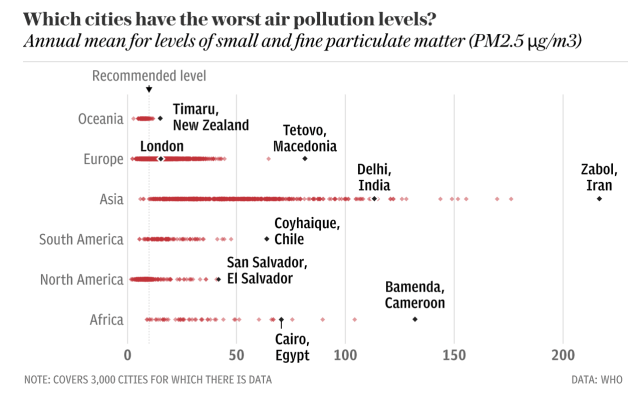
London only ranked 1,389th out of the nearly  3,000 cities and towns around the world monitored in the WHO’s database of annual air pollution readings.

WHO guidelines state that cities should aim to have an annual average of no more than 10 micrograms of PM2.5 (very fine particulate matter) for every cubic metre of air. London had an annual PM2.5 average of 15 μg/min 2013, far lower than Beijing’s average of 85.2 μg/m3.

These particles are very small in diameter and are classed as carcinogenic by leading health organisations. Thousands of deaths a year are attributable to air pollution in the UK.

Which cities have the highest air pollution levels worldwide?

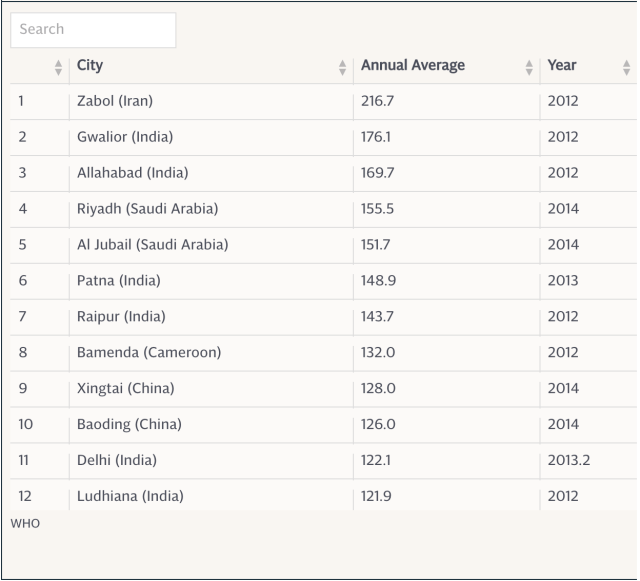
According to the WHO, the most polluted city in the world is  Zabol in Iran where PM2.5 measurements were found to average a massive 217 μg/m3 for the latest available year. This is more than 20 times higher than the WHO’s guidelines suggest it should be.

The next two entries on the list are both located in India (Gwalior and Allahabad) while the first non-Asian city on the list is Bamenda in Cameroon which came in eighth place.

Tetovo in Macedonia was the most polluted European city in the database, followed by Tuzla in  Bosnia and Herzegovina.

The most polluted city in the UK isn’t actually London. Glasgow topped that list, followed by Scunthorpe and Leeds with London in sixth place.

However, given that these rankings are based on figures taken in 2013, the situation may have changed since. London may also experience greater peaks in air pollution but these figures are all annual averages.

screen-shot-2017-01-27-at-11-07-10

Asian cities tend to be more polluted

The WHO’s database is by no means a comprehensive list of every city in the world – many places will simply not be able to provide air pollution figures of sufficient quality to be included.

However, from the figures available, Asian cities were the likeliest to exceed the 10 μg/m3 guideline for PM2.5.

Just four of the 632 Asian locations included in the data were found to be below this level, meaning that the equivalent of 99.4 per cent of Asian cities exceeded it.

African cities were the next most likely to annually exceed their recommended levels of air pollution while towns and cities in Oceania were the least likely.

screen-shot-2017-01-27-at-11-07-47

Source: Which cities have the worst air pollution levels in the world?

Posted in Africa, Air Quality, Asia, China, Europe, India, Iran, London, Middle East, UK, World News | Tagged , , , , , , , , , , , , , , , , , , , , , | Leave a comment

Pollution in London from wood burning on the rise 

If there was one surprise from the recent very high pollution levels, it was the fact that according to King’s College some of the pollution was due to “unusually high levels of domestic wood burning”.

This is not to underestimate the contribution of traffic emissions but wood burning, according to the experts, was making up half of the pollution readings at some monitors at some sites – all exacerbated by low winds not blowing away pollutants.

So isn’t London a clean air zone which is meant to prevent their use? Well, yes.

‘Exempt appliances’

The Clean Air Act means local councils can set up Smoke Control Areas where only smokeless fuels should be burnt, or wood is burnt only in “exempt appliances”.

Homeowners can be fined £1,000, although I haven’t found any records of people being fined in London.

Enforcement may be an issue, as it is not usually a priority for London’s councils.

But wood stoves are becoming more popular and it seems the emissions from wood burning have increased.

The air quality campaigners Clean Air in London say: “Solid fuels are considerably more polluting that natural gas (the main heating fuel used in London).

“In 2009 coal and wood burning in the home was thought to be responsible for 12% of UK PM10 emissions , whilst research by King’s College London suggests around 12% of the PM10 in London’s air during winter 2010 arose from wood burning.”

That is quite a leap from 12% to 50% in the levels of wood burning on Monday.

Also it is worth noting that even the exempt appliances are not completely clean.

In fact, according to a presentation by The Danish Ecological Council which has looked into the use of wooden stoves: “Just 16,000 wood stoves in Copenhagen (600,000 inhabitants) emit as much fine-particles pollution in one winter, as all traffic emit within one year.”

It also says: “New low-emission stoves cause much higher emissions (above 500.000 part/cm3) than new trucks with particulate filters (below 1.000 part/cm3).”

So far mayoral policies have been aimed at cleaning up traffic in particular NO2, but perhaps some attention should focus on the burning of wood in homes.

Simon Birkett from Clean Air In London says: “We need the mayor to educate people and local authorities to enforce the existing Clean Air Act while it’s updated.”

ClientEarth’s air quality lawyer Anna Heslop said: “When pollution is this high then we need to tackle all major sources of it. The biggest cause of chronic and dangerous air pollution all year round comes from diesel vehicles.

“Wood burners can contribute to the most serious smog episodes which we see in winter, like those which Londoners are experiencing at the moment.

“During the worst episodes of very high pollution, people need to be advised not just on the levels but on how they can avoid adding to the pollution, and that means everything from using cleaner transport options and leaving their cars at home to avoiding using wood burners.”

Source: Pollution in London from wood burning on the rise – BBC News

Posted in Air Quality, Europe, London, UK | Tagged , , , , , | Leave a comment

Agricultural fires in Brazil harm infant health, a warning for the developing world

Pollution from the controlled fires that burn across Brazil’s São Paulo state during the sugarcane-harvesting season has a negative impact on infant health nearby. But the health of those same infants likely benefits from the economic opportunities the fires bring to their parents.

Researchers at Princeton and Duke universities gathered information from satellites, pollution monitors and birth records to untangle those competing influences and accurately measure the impact of pollution from the fires.

They found that exposure to pollution from the fires in the last few months of gestation leads to earlier birth and smaller babies, and they found some evidence of increased fetal mortality. Conditions in early life, including in utero, have been shown to affect children’s longterm outcomes, not only in terms of health but also their educational and economic success.

The findings suggest that policymakers in Brazil and across the developing world should pay more attention to the negative health impact of pollution from fires that are often part of traditional farming techniques, even though the pollution doesn’t usually reach levels considered dangerous by industrial standards.

“Policymakers often think about heavily polluted cities like Beijing or New Delhi, but our results show that these agricultural fires are consequential,” said Tom Vogl, an assistant professor of economics and international affairs at Princeton.

Vogl and co-author Marcos Rangel, assistant professor at Duke University’s Sanford School of Public Policy, detailed their findings in a working paper titled “Agricultural Fires and Infant Health” released online in December by the National Bureau of Economic Research.

Brazil is the world’s leading producer of sugarcane, and São Paulo state accounts for more than two-thirds of the nation’s production. The traditional approach to harvesting begins with burning the fields to remove straw and other materials, leaving the cane to be cut by hand. Although mechanized harvesting, which doesn’t use fires, is becoming more common in Brazil, traditional techniques are still widely used there and across the developing world.

The researchers used remote-sensing data from satellites to track fires, which burn throughout the six-month harvesting season. That data was combined with pollution and weather information collected by 13 air-quality monitoring stations.

“We find that fires that are upwind from population centers increase pollution levels in those areas and other fires don’t increase pollution nearly as much,” Vogl said.

The researchers then linked the fire and pollution information to vital records and hospitalization records from the Brazilian government. Altogether the information allowed the researchers to compare how the health of infants responded to fires that had different effects on pollution in their communities.

The key to the research design, Vogl said, was incorporating information on wind direction, which allowed the researchers to parse out the consequences of pollution from the fires from the beneficial things that are correlated with the fires.

“We would get the answer completely wrong if we just looked at the relationship between fires and infant health in general,” Vogl said. “The reason is that these agricultural fires are necessarily connected with economic activity. When there’s more sugarcane harvesting, there are more fires. And when there is more sugarcane harvesting, people have higher incomes, which can be good for kids and kids’ health.”

Rangel added that sustainable development policies need to take into account trade-offs between economic and environmental goals.

“Our results point to a dirty side of clean fuel policies in Brazil,” Rangel said. “To some extent, the incentives for ethanol production for cleaner fuel in urban areas have considerable side effects on the population and future generations in the production areas.

“By appropriately measuring how much ill comes with the blessings of a strong agricultural cycle, our work highlights the need for evidence-based policies across the globe,” Rangel said.

Prashant Bharadwaj, an assistant professor of economics at the University of California-San Diego who studies development and labor economics, said the research helps fill an important gap by looking at persistent, moderate pollution like that from agricultural fires.

“Controlled burns for the purposes of agriculture are very popular in developing countries where the density of population near agricultural areas is also large; hence, their study has important implications for not only large parts of the world, but also for the significant portion of the world’s population that resides in poorer agricultural settings,” Bharadwaj said. Vogl said the researchers, who began their collaboration when Rangel was a visiting professor at Princeton, are working to apply the same technique to examining agricultural fires in Africa.

Read more at: https://phys.org/news/2017-01-agricultural-brazil-infant-health-world.html#jCp

Source: Agricultural fires in Brazil harm infant health, a warning for the developing world

Posted in Air Quality, Latin America | Tagged , , , , , | Leave a comment

The UK’s deadly air pollution can be cured: here’s how 

Pollution levels in the UK are soaring. Last year, a committee of MPs in the UK described the state of the air that we breathe as a public health emergency.

London mayor Sadiq Khan has a budget of £875m to try to tackle air pollution – small, compared to the capital’s annual £3.6bn bill arising from its impact.

And while there may be recognition of the problem, there are fewer examples of successful solutions. How can we travel without harming other people’s health? How can businesses deliver paper clips, coffee and food without polluting the air we breathe?

An estimated 40,000 people across the UK (9,500 in London) die early each year from particle pollution and nitrogen dioxide. Three roads in London have already breached UK and EU limits for nitrogen dioxide for 2017. We have a lot to do and simply cleaning exhausts is not enough.

Diesel traffic is a main source of urban exposure and over half the world’s diesel vehicles are sold in Europe. The low emission zone is the weapon of choice. Over 200 cities now ban the most polluting vehicles. German cities with such zones have made faster progress on particle pollution than those without.

Particle pollution on some main roads in London has improved when lorries were upgraded ahead of the low emission zone. France has just launched a national framework for low emission zones, and following the government’s court defeat, new zones look set for many UK cities.

Low emission zones exclude older vehicles, assuming they emit more pollution than the newer ones. But, for many years, new diesels passed ever-tighter exhaust tests in the laboratory only to emit much more nitrogen oxides on roads. This goes beyond the VW scandal. Other vehicle manufacturers might not have a legal case to answer but they certainly have a moral one.

Promisingly, it looks like the newest buses and lorries produce just a few per cent of the nitrogen oxides when compared to pre-2014 vehicles and, astonishingly, less than half that emitted from the average new diesel car. Fitting better exhaust controls to older buses works too; on one London street nitrogen dioxide fell by around 20% when half the buses were upgraded. Petrol exhaust technologies have worked well for more than 10 years. Greater priority also needs to be given to freight in transport planning to reduce lorry and van movements.

Each year’s delay means more health harm. One answer would be a switch to only the very newest buses and lorries, and petrol cars instead of diesel, while alternative fuelled vehicles and their fuel infrastructure are developed longer-term. This requires scrappage and investment schemes. A large cost but the cost of not doing it is massive.

However, simply cleaning exhausts would be a missed opportunity to build better cities. Reducing traffic would reduce air pollution, reduce climate change emissions, tackle the increasing particle pollution from brakes, tyre and road wear and, with more active travel, it would have huge health benefits.

An annual benefit of €1,300 (£1,126) could come from each person who swaps a five km daily car commute to a cycle journey. Above all, we need to monitor to check that policies work and to ensure that all communities benefit from investment to clean our air.

Source: The UK’s deadly air pollution can be cured: here’s how | Public Leaders Network | The Guardian

Posted in Air Quality, Europe, London, UK | Tagged , , , , | Leave a comment

Rain hope after fog sends pollution soaring 

As fog engulfed the city on Wednesday, air pollution shot up to ‘unhealthy level’ — making it the most polluted day of the week so far. Met office has predicted light showers on Thursday, which could make the situation a little better.

The data available with the Central Pollution Control Board suggested the concentration of particulate matter (PM) 2.5 on Wednesday was at a level that was five times higher than what is prescribed as safe by World Health Organisation (WHO).

While the highest 24-hour average concentration of PM2.5 was 206.27 micrograms per cubic meter and 193.02 micrograms per cubic metre on Tuesday and Monday, respectively, it was 303.45 on Wednesday. The WHO’s prescribed limit is 60 micrograms per cubic metre.
Air quality index (AQI) on Wednesday also touched the 300-mark (considered ‘severe’ and may cause ‘respiratory illness on prolonged exposure’).

Met department expects the situation to get better on Republic Day. “While the maximum temperature has gone up, most parts of Delhi and NCR saw a foggy day on Wednesday. There is a forecast of light showers and thunderstorms on Thursday morning due to the formation of induced cyclonic circulation. The maximum temperature is also expected to come down slightly on Thursday,” said an official from the Met department.

Officials of Haryana State Pollution Control Board (HSPCB) said they expect Thursday’s rain to bring down the level of air pollution. “Low wind speed in winters is primarily responsible for the increase in the air pollution level. Even light showers can clear the concentration of particulate matter in the lower atmosphere. However, the situation in Gurgaon as far better than its neighbouring cities such as Delhi and Faridabad,” said an HSPCB official.

As per the recently notified and enforced graded response system by the Environment Pollution Control Authority, appointed by the Supreme Court, when the level of PM2.5 touches the 300-mark and PM10 touches the 500-mark, emergency measures need to be enforced immediately. Some of the emergency measures include a strict ban on waste burning, closing brick kilns and stone crushers, mechanised sweeping of roads and banning the use of diesel gensets.

Source: Rain hope after fog sends pollution soaring | Gurgaon News – Times of India

Posted in Air Quality, Asia, India | Tagged , , , | Leave a comment

More than half Chinese cities plagued by air pollution 

Beijing: More than 330 Chinese cities monitored by the government, especially capital Beijing and in northern China, reported air pollution despite claims by officials to cut down use of coal and regulating polluting factories.

Nearly 58 per cent of Chinese cities monitored, including Beijing, reported varying degrees of air pollution, this morning, China’s Ministry of Environmental Protection said.

Of the 338 cities monitored by the ministry, 7.1 per cent, including Shijiazhuang the capital city of Hebei Province, which neighbours Beijing, reported serious air pollution, with air quality index (AQI) readings exceeding 300 as of Wednesday.

Beijing itself had lengthy bouts of smog for several weeks recently.

Another 12.8 per cent of these cities, including the northern metropolitan Tianjin, were experiencing heavily polluted air, with AQI readings between 201 and 300, said the ministry.

Moreover, the air in 9.8 per cent of cities, including Beijing, was moderately polluted, with AQI readings between 151 and 200.

The data also revealed 28.1 per cent of the cities, including Changchun in northeastern Jilin Province, had slightly polluted air, with AQI readings between 101 and 150, state-run Xinhua news agency reported.

PM 2.5, particulate matters with a diametre smaller than 2.5 micrometres, was the primary pollutant in most of the cities, the data showed.

Due to unfavourable pollutant dispersing conditions, the ministry said air pollution in most regions was not expected to improve until tomorrow night.

Many Chinese cities suffer from winter smog, triggering public concern.

The authorities have stepped up efforts to cut outdated production capacity and have dispatched inspection teams to provincial areas to supervise environmental measures taken by industrial firms.

Source: More than half Chinese cities plagued by air pollution | Zee News

Posted in Air Quality, Asia, China | Tagged , , , , , , | Leave a comment

Luxembourg and much of Europe choke under freezing smog

Heavy pollution enveloping much of Europe prompted emergency measures across the continent on Tuesday. A toxic cocktail of extreme cold, no wind and heavy burning of coal and wood for heating has left many regions shrouded in smog.

In many countries, including Britain, France and Brussels, officials have cautioned against physical exertion for children and the elderly, and for people with respiratory problems. Luxembourg authorities have issued information and recommendations in this regard as well on January 24.

In a statement, the government indicates that Luxembourg has been hit by several peaks of pollution since Sunday. “The situation will remain complicated for the next few days,” said the environment administration. On Sunday and Monday, the pollution threshold (50μg/m3) was exceeded five times, with a record peak of 63μg/m3 measured in Luxembourg-Bonnevoie.

The Government also indicates that an expected inversion of temperatures between Wednesday and Friday will affect air quality for the worse, making further peaks of pollution possible.

Precautionary measures

Luxembourg’s government recommends using public transport, car pooling and meeting regulatory requirements for heating control in order to reduce pollution. Fires in open fireplaces should be avoided as well.

Especially vulnerable parts of the population, such as people suffering from cardiovascular diseases, respiratory problems, asthma and immunodeficiencies should be careful and avoid long walks or physical activities outside.

Much of Europe affected

Officials in Paris have ordered older, more polluting vehicles off the road since Monday, and cut the price of public transport. Speed limits have also been reduced in many parts of France.

In London, a cloud of freezing smog forced the cancellation of around 100 out of 1,300 flights at Heathrow airport for the second day in a row, while Met Office forecasters had a “severe” warning in place for all of England.

Madrid has not issued an alert since a seven-day stretch of high pollution that ended January 1, which saw the city impose the first driving restrictions based on licence plates in Spain.

Eastern Europe has also been hit by blanket of smog, exacerbated by the heavy use of wood and coal during the cold snap.

Hungarian officials have issued pollution alerts for about 20 cities, including Budapest, where cars without catalytic converters have been forbidden from roads from Monday to Wednesday.

In Bulgaria, pollution has smothered the capital, Sofia, already considered one of the most polluted European capitals. But so far, officials have not imposed any specific restrictions.

Lawmakers in the Krakow region of Poland, considered the area with the dirtiest air in the country, approved Monday an anti-smog plan that calls for replacing the most polluting heating stoves by 2023.

Poland also plans to ban the use of low-quality coal — an important but costly measure in a country where coal is used to heat 72 percent of homes.

Source: Luxemburger Wort – Luxembourg and much of Europe choke under freezing smog

Posted in Air Quality, Europe, France, London, Spain, UK | Tagged , , , , , , , , , , , , , , , | Leave a comment