Danish pressure leads to less shipping pollution in Baltic and North Seas

From 2021, ships sailing the North Sea and the Baltic Sea must significantly reduce their nitrogen oxide (NOx) emissions.

Following Danish pressure, the UN’s International Maritime Organisation (IMO) approved the more stringent legislation this week.

“Denmark has worked for several years to toughen the NOx demands for ships sailing in the North and Baltic seas,” said the environment and food minister, Esben Lunde Larsen.

“So it gives me great pleasure that the Danish pressure has paid off and that the consensus among the nations in the region to do something about the issue has led to the IMO approving the more rigorous demands. The reduction of the ships’ NOx emissions will have a positive effect on health and the environment.”

14 nations agree
Ship smoke is a considerable source of air pollution in the countries around the two bodies of water. In 2015, the IMO toughened its demands for ships to cut sulphur emissions by 90 percent.

IMO’s new decision means that any ships built after 1 January 2021 must reduce NOx pollution by 75 percent compared to ships built today. The new legislation is expected to be finally approved during the next IMO meeting in the spring of 2017.

A total of 14 nations agreed to curb ship pollution in June: Denmark, Norway, Sweden, the UK, France, Belgium, the Netherlands and Germany in the North Sea and Denmark, Sweden, Germany, Finland, Poland, Russia, Estonia, Lithuania and Latvia in the Baltic Sea.

Source: Danish pressure leads to less shipping pollution in Baltic and North Seas | Hellenic Shipping News Worldwide

Posted in Air Quality, France | Tagged , , | Leave a comment

Growth of city trees can cut air pollution, says report 

Planting trees is a cost-effective way to tackle urban air pollution, which is a growing problem for many cities.

A study by US-based The Nature Conservancy (TNC) reported than the average reduction of particulate matter near a tree was between 7% and 24%.

Particulate matter (PM) is microscopic particles that become trapped in the lungs of people breathing polluted air.

PM pollution could claim an estimated 6.2 million lives each year by 2050, the study suggests.

Lead author Rob McDonald said that city trees were already providing a lot of benefits to people living in urban areas.

“The average reduction of particulate matter near a tree is between 7-24%, while the cooling effect is up to 2C (3.6F). There are already tens of millions of people getting those kinds of benefits,” he said.

Dr McDonald said the study of the use of trees in 245 cities around the world compared the cost-effectiveness of trees with other methods of cooling and cleaning air.

“On that front, trees are cost competitive with other options,” he told BBC News.

“When you change a bus from diesel to gasoline, for example, you reduce particulate matter pollution, and trees are certainly in the same ball park.”

However, the TNC report highlighted that most of the cities featured in the study were losing more trees than they were gaining.

How trees cut cities' air pollution

Image: TNS

According to the UN World Health Organization (WHO), about 90% of the global population living in cities in 2014 was exposed to particulate matter that exceeded the WHO air quality guidelines.

The UN agency estimates that outdoor air pollution caused three million premature deaths in 2012, with the vast majority occurring in low- to middle-income nations.

The WHO Health Statistics 2016 says air pollution is “caused by inefficient energy production, distribution and use, especially in the industrial, transportation and building sectors, and by poor waste management”.

It adds that transport systems based primarily on individual motorised transport can lead to further deterioration in air quality.

As everyone within an urban area breathes the same air, the pollution does not discriminate – both rich and poor are exposed to the dangers. But, it adds, people living near the source or busy roads are more exposed and more affected.

The WHO says that the air quality in many cities is not monitored, making it difficult to get an accurate understanding of the global impact of air pollution.

Heat island effect (Image courtesy of TNS)

Image: TNS

Dr McDonald observed: “Trees are by no means a replacement for all the other things cities need to do in order to clean their air but they are part of the suite of tools that cities can draw on.

“We also looked at how much more trees could help if we planted more trees. We found that there was a lot more scope there. All of the cities we looked at, if all the people in them spent an extra US $4 a year on planting trees, you could save between 11,000 and 36,000 lives each year. This is mostly as a result of having cleaner air.

“As well as the avoided mortality, there is even more avoided hospitalisation, and it will benefit tens of millions of folks.

“In this urban century when there are going to be an extra two billion people in cities, smart cities should be thinking about how nature and trees can be part of the solution to keep air healthy.”

However, planting trees in an urban setting is not without potential pitfalls. One is regarding the flow of air in heavily polluted streets, particularly ones with large volumes of traffic. Thick canopies can limit the circulation of air, trapping the poor quality air at low levels, where people breath.

Dr McDonald said this was an issue that the report considered.

“Air flow certainly matters,” he said. “What we talk about in the report is a planting strategy. For example, on streets where there is a lot of traffic and particulate matter, the advice is to ensure there is enough space between your trees to ensure that you are still getting enough air flow in order to prevent that negative outcome.

“However, on most residential streets, where there is relatively less traffic, we found that the issue of air flow blockage is much less of an issue.”

Forgotten landscape

Although trees have long been part of urban life, either by design or consumed by expanding urban areas, they had been sidelined in the second half of the 20th Century.

In a 2014 report, following what was described as the “largest city tree survey of its kind”, it was calculated that London’s trees provided “at least £133 million of benefits every year in terms of air pollution removal, carbon sequestration and reducing the amount of water going into drains”.

One charity that aims to promote the arboriculture additions to urban environments is UK-based Trees for Cities.

Describing its missions, the charity says: “We focus on planting trees where the social and environmental impact on local people is greatest.

“In London this might mean planting trees to clean the air and making our communities healthier places to live, whilst in Addis Ababa it’s planting fruit trees for food and sustainable livelihoods.”

By raising awareness of the ecosystem services they can play, the TNC report’s authors hope that urban trees can become an integral part of cityscapes once again.

“One of our goals outlined in the report is to remind cities that you have the parks or urban forestry department on one side and the health department on the other side. On this issue at least, they need to be talking to each other,” Dr McDonald suggested.

“I am really hopeful that if more cities start thinking that way then we will see a rebirth in urban tree planting.”

Source: Growth of city trees can cut air pollution, says report – BBC News

Posted in Air Quality, Health Effects of Air Pollution | Tagged , , , , , , | Leave a comment

Toxic smog covers Delhi after Diwali

Fireworks associated with the Hindu festival add to pollution in Indian capital as particulates in the air soar above safe levels

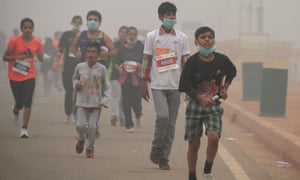
Delhi has been blanketed in a toxic fog the morning after the Hindu festival of Diwali, when hundreds of thousands of people in the Indian capital celebrate by setting off crackers and fireworks.

Air quality in the Indian capital, one of the world’s most polluted cities, is usually very poor due to road dust, open fires, vehicle exhaust fumes, industrial emissions and the burning of crop residues in neighbouring states.

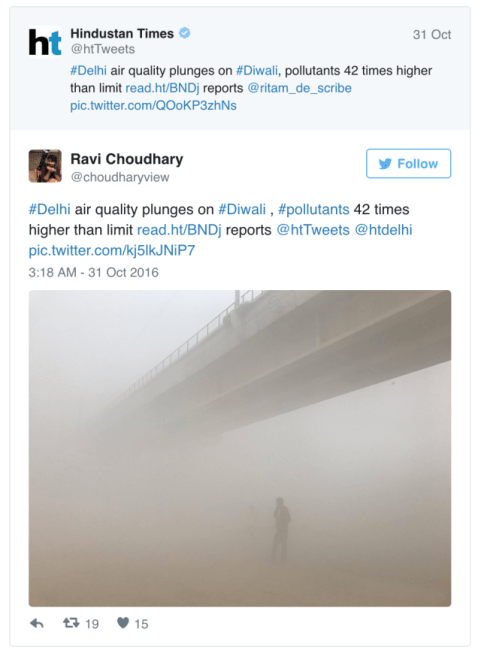
But the density of some harmful particles and droplets in the air spikes for days after Diwali and can reach up to 42 times the safe limit.

screen-shot-2016-11-01-at-06-21-20

An air quality station at the US embassy in Chanakyapuri, one of the city’s greener districts, recorded a PM2.5 level of 999 on Monday morning. India’s pollution control board sets the safe limit for PM2.5 – which measures particulate matter smaller than 2.5 micrometres – at 60.

By contrast, the highest PM2.5 level recorded in London on Monday morning was 139, at a measuring station in Farringdon. Averages tend to be far lower across the year, at about 16, according to a 2010 study.

PM2.5 particles and droplets are considered to be the most harmful kind of air pollution because they are fine enough to evade the body’s natural filters, penetrate the lungs and enter the bloodstream.

Short-term exposure can trigger coughing and eye and throat irritation, while longer term exposure is strongly associated with reduced lung function, heart disease and lung cancer.

A 2015 study found about half of Delhi’s 4.4 million schoolchildren had compromised lung capacity and would never completely recover.

India also has the world’s highest rate of death from respiratory disease, according to the World Health Organisation, with 159 deaths per 100,000 people in 2012, about five times that of the UK and twice that of China.

“The levels we’re seeing are really alarming. They are clearly in the severe category,” said Anumita Roychowdhury, the executive director of the Centre for Science and Environment, a Delhi-based thinktank.

“Delhi’s air remains so polluted throughout the year that it doesn’t really have room for additional pollution during Diwali.”

She said the smog released by the fireworks was worsened by the seasonally cooler temperature and slowing winds, which meant “the air doesn’t blow away, and all the pollution that happens inside the city gets trapped at the ground level, very close to our noses”.

The city authorities have piloted a scheme allowing vehicles to only drive on alternate days, depending on whether their last registration number was odd or even.

The odd-even scheme has been trialled twice and its impact on air quality is being investigated.

Unlike in China, where a PM2.5 reading greater than 300 for more than three days triggers a “red alert” that closes schools, there are no official government warnings over high levels of air pollution.

The capital region’s high court last year criticised the inaction of successive Delhi and national governments in dealing with the problem and compared the megacity of more than 25 million people to “a gas chamber”.

Roychowdhury said awareness of the problem was slowly growing among Delhi’s residents. “Newspapers are writing about it every day, it’s part of the dinner table conversation,” she said.

“Where we still have a lot more to do is to sensitise people about the solutions to the problem. We need to understand that controlling it needs hard decisions, and to build public support for these hard decisions.”

Source: Toxic smog covers Delhi after Diwali | World news | The Guardian

Posted in Air Quality, Asia, India | Tagged , , , | Leave a comment

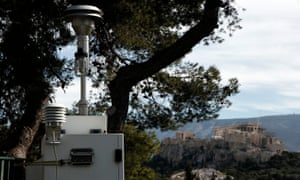
Air quality worsens in Greece as recession bites

World pollutionwatch The ban on diesel cars in Athens and Thessaloniki has been lifted and the price of heating oil has tripled. Hard-pressed Greeks have turned to burning logs – and other things

Greece’s financial recession is leaving its footprint on the environment. This follows twenty years of huge improvements in Greece’s air pollution. While most European countries struggle with the consequences of failure to control exhaust pollution from diesel vehicles, Greece benefitted from long-standing bans on diesel cars in the two biggest cities, Athens and Thessaloniki.

This allowed the country to reap the full benefits of technologies to control petrol exhaust, without these being offset by the poor performance of diesel cars. As a consequence nitrogen dioxide from traffic approximately halved alongside Greek roads between 1996 and 2006, in contrast to the lack of improvement elsewhere in Europe.

Lifting the diesel car ban in 2012 and lower taxes on diesel fuel acted as a huge incentive for those struggling with travel costs. Amongst new car sales diesels leapt from less than 20% (around zero in Thessaloniki) to over 60%, but, so far, economic pressures have reduced traffic volumes averting a possible deterioration in air pollution.

However, a tripling in the cost of heating oil brought about larger changes as hard-pressed Greeks have switched to burning wood. Wintertime particle pollution increased by around 30% in Thessaloniki in 2013 and air toxicity worsened on evenings when fires were lit. Analysis of wintertime air in Athens shows that it is not just logs that are being burnt. Along with chemicals from wood burning, scientists found lead, arsenic and cadmium particles, showing that people are burning painted and treated wood, and also their rubbish, to keep warm.

Source: Air quality worsens in Greece as recession bites | Environment | The Guardian

Posted in Air Quality, Europe | Tagged , , , , , | Leave a comment

One in seven children suffer high air pollution: UNICEF

Almost one in seven children worldwide live in areas with high levels of outdoor air pollution, mostly in South Asia, and their growing bodies are most vulnerable to damage, the U.N. children’s agency UNICEF said on Monday.

UNICEF called on almost 200 governments, which will meet in Morocco from Nov. 7-18 for talks on global warming, to restrict use of fossil fuels to give twin benefits of improved health and slower climate change.

About 300 million children, or almost one in seven worldwide, lived in areas where outdoor pollution was highest, defined by UNICEF as at least six times international guidelines set by the World Health Organization (WHO), it said.

Of the total, 220 million lived in South Asia. It identified the regions with satellite imagery developed by NASA.

UNICEF executive director Anthony Lake said air pollution was a “major contributing factor in the deaths of around 600,000 children under five every year”, causing illnesses such as pneumonia.

“Pollutants don’t only harm children’s developing lungs – they can actually cross the blood-brain barrier and permanently damage their developing brains – and, thus, their futures,” he said in a statement.

“Air pollution affects poor children the most,” Nicholas Rees, a UNICEF specialist on climate and economic analysis who wrote the report, told Reuters.

Worldwide, the WHO estimates that outdoor air pollution killed 3.7 million people in 2012, including 127,000 children aged under five. Factories, power plants and vehicles using fossil fuels, dust and burning of waste were among sources.

Indoor air pollution, often caused by coal- or wood-burning cooking stoves used in homes in developing nations, killed even more people, 4.3 million, of whom 531,000 were aged under five, it said.

UNICEF called on the U.N.-led meeting in Morocco to hasten a shift from fossil fuels to cleaner energies such as wind or solar power, to improve children’s access to health care, limit children’s exposure to pollution and to step up monitoring of the air.

Source: One in seven children suffer high air pollution: UNICEF | Reuters

Posted in Air Quality, Health Effects of Air Pollution | Tagged , , , , | Leave a comment

Delhi Chokes On Air 14 Times More Polluted As Diwali Smog Clouds India

There is thick smog hanging over Delhi and parts of Uttar Pradesh on the morning after Diwali, with pollution at a dangerous “severe” at 7 am on Monday. Smoke from firecrackers has choked the air and also affected visibility.

Data from the central pollution monitoring agency showed that concentrations of Particulate Matter or PM 10 (coarser pollutants) was over 1,600 micrograms per cubic metre compared to a safe level of 100 at around 2 am in Delhi’s Anand Vihar. PM 2.5, a standard measure of air quality, was as much as 14 times the safe limit.

These particles can cause respiratory diseases if one is subjected to prolonged exposure to unsafe levels. Seven areas in the national capital region featured among the 10 most polluted places in the country, while Kanpur and Lucknow in Uttar Pradesh also recorded severe pollution.

Pollution in Delhi peaks during Diwali as a hazardous mix of noxious gases and pollutants hang very close to the surface. The Delhi High Court had described the capital as “gas chamber” last year.

As people celebrated Diwali by bursting firecrackers on Sunday, a NASA photo at about 8 pm showed the top half of India hazy with smoke.

Experts had warned that pollution during this year’s Diwali was expected to be worse than the last two years because of a combination of adverse factors like slow wind speed and moisture in the air, a major hindrance in the dispersion of suspended pollutants.

The pollution monitoring agency has advised people to avoid all outdoor physical activity when air quality is rated “severe” like this morning. People with heart or lung diseases, older adults, and children are advised to remain indoors and keep activity levels low.

A report released by UNICEF on Monday said almost one in seven children worldwide live in areas with high levels of outdoor air pollution, mostly in South Asia, and their growing bodies are most vulnerable to damage.

Around 6 lakh children under age 5 die every year – more than malaria and HIV/AIDS combined – from diseases caused by or exacerbated by outdoor and indoor air pollution, UNICEF said.

Source: Delhi Chokes On Air 14 Times More Polluted As Diwali Smog Clouds India

Posted in Air Quality, Asia, India | Tagged , , , , , , , , | 1 Comment

Southern Taiwan engulfed by air pollution 

Air quality in southern Taiwan reached hazardous levels on Saturday, with the key indicator of fine particulate matter smaller than 2.5 micrometers (PM 2.5) hitting the highest level of 10 in Kaohsiung, Pingtung and Tainan, the Environmental Protection Administration (EPA) said.

The poor air quality was caused by a lack of wind to disperse atmospheric pollutants, the EPA said, urging residents in southern Taiwan who are sensitive to bad air to avoid outdoor activities.

As of 1 p.m., concentrations of PM2.5 reached level 10 in Pingtung City, Pingtung County’s Chaozhou Township, Kaohsiung’s Fengshan and Renwu Districts and Tainan’s Shanhua and Xinying Districts, according to readings from EPA stations in those areas.

The 1-10 PM2.5 index also hit level 9 in Kaohsiung’s Daliao District, and level 8 in Tainan City, Chiayi City and Chiayi County’s Puzi, according to the readings.

According to the EPA, level-10 PM2.5 concentrations exceed 71 micrograms per cubic meter and are considered extremely high, but measurements above level 7 are deemed severe enough to cause tangible discomfort and health problems.

Given the air quality, the elderly and those with chronic lung or heart diseases should avoid prolonged or strenuous outdoor physical activities. People with asthma may also need to use their inhalers more often, the EPA said.

Source: Southern Taiwan engulfed by air pollution – The China Post

Posted in Air Quality, Asia, Taiwan | Tagged , , , , , , , | Leave a comment

Satellite images reveal toxic clouds enveloping northern Iraq

As Iraqi forces fight to retake Mosul from the so-called Islamic State (ISIS), clouds of toxic fumes are spreading across northern Iraq.

The acrid smoke, which is so significant it is visible from space, is threatening to harm Iraqis’ health just as hundreds of thousands of people are fleeing Mosul for their lives.

Militants from the Islamic State blew up the Al-Mishraq sulfur processing plant over the weekend and set fire to 19 oil wells in an effort to hamper the advance of Iraqi and U.S. forces.

NASA released new images on Thursday showing sulfur dioxide plumes dispersing across northern and central Iraq as early as Oct. 20.

Large concentrations of sulfur dioxide can permanently damage the respiratory system and make breathing difficult. Depending where it is located in the atmosphere, sulfur dioxide can also contribute to acid rain and act as a temporary cooling influence on the climate.

Ozone monitoring equipment detected plumes from burning oil wells and sulfur plants near Mosul, Iraq, Oct. 24, 2016. Credit: NASA Earth Observatory

According to Al-Jazeera, at least two Iraqi civilians have died from toxic fumes, and nearly 1,000 people were being treated for breathing problems as of Oct. 22.

NASA said the sulfur dioxide was initially in lower parts of the atmosphere, but shifting winds pushed it higher, enabling the particles to travel longer distances.

The agency’s ozone monitoring equipment detected two streaks of plumes. The white-gray streak, from the sulfur plant, is rich with sulfate aerosols and droplets of light-reflecting sulfuric acid. Black plumes from the Qayyarah oil field are rich with black carbon and other light-absorbing aerosols.

ISIS has ruled Mosul, Iraq’s second-largest city, for more than two years. The push to retake Mosul from the militants is the largest operation launched by Iraq since the U.S.-led invasion in 2003.

The Al-Mishraq sulfur facility was also set ablaze that year. The fire, which burned for nearly a month, release some 21 kilotons of sulfur dioxide per day, according to NASA satellite data gathered in 2003.

U.S. soldiers exposed to the fire suffered serious lung damage. Nineteen personnel had open lung biopsies and were diagnosed with constrictive bronchiolitis, a disease similar to asthma that restricts the airway, the Department of Veterans Affairs said in 2010.

NASA has not yet calculated the total output of this month’s toxic fires near Mosul, a city of more than a million. But the agency said the sulfur dioxide emissions have already been significant.

Simon Carn, an atmospheric scientist at Michigan Technological University, said that if the sulfur dioxide was coming from a volcano rather than a fire, it would already be among the largest volcanic eruptions of 2016, he noted in an Oct. 25 tweet.

@simoncarn

The World Health Organization said Wednesday that 700,000 people were expected to flee Mosul as Iraqi forces continued their advance, a battle that is expected to take weeks, if not months.

Source: Satellite images reveal toxic clouds enveloping northern Iraq

Posted in Air Quality, Iraq | Tagged , , , , | Leave a comment