From London to Delhi, air pollution kills. Why do we do nothing? 

Pollution in some world cities is more than 12 times higher than safe levels. Maybe it explains why residents aren’t taking to the streets to complain

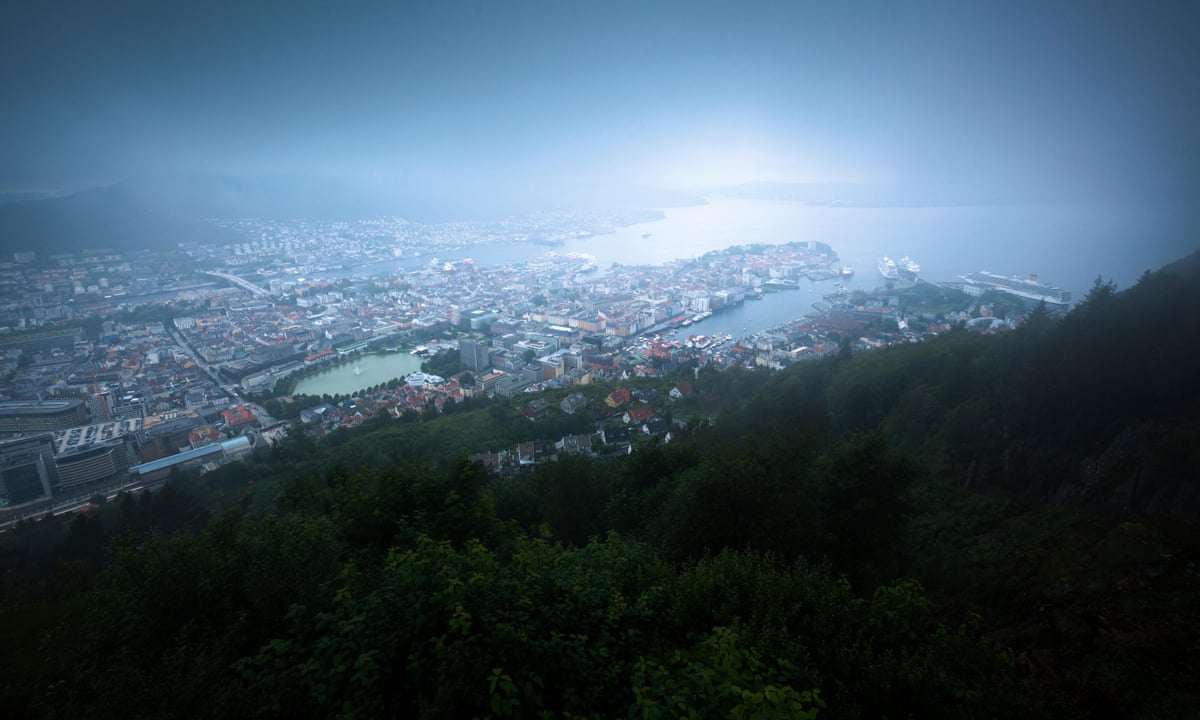
After a week in Kolkata, blessed with mellow sunsets created by the yellowy haze that hung over the city, I flew back to Britain via Delhi on Friday. Our descent into Delhi was delayed because of fog, we were told, but the nicotine-coloured blanket smothering this dynamic Indian city was a malignant smog.

Delhi, a city of 25 million people and nine million vehicles, routinely experiences fine particulate pollution above 300 micrograms per cubic metre; the EU’s legal limit is 25. These figures are not abstract even for visitors. After just a few days in Kolkata and minutes in Delhi, I developed the dry hack known as “the Delhi cough”. Exert yourself outdoors and soon your eyes are streaming and your lungs aching.

Fifteen of the 20 most polluted places identified by the World Health Organisation are in India and China but winter smogs have hung over Barcelona, Milan and Naples, and this month some London streets breached annual EU limits for nitrogen dioxide in just a week. A recent study in Nature found that more people – 1.4 million people a year in China and 650,000 in India – die from air pollution than malaria and HIV combined.

Clean air should be a global priority, and it is puzzling that it is not. Unlike, say, climate change, toxic air is identifiable by the layperson, indisputably of the here-and-now, and kills rich as well as poor, which should make it a seductive subject for problem-solving by politicians.

But Britain is avoiding decisive action to scrap diesel vehicles, and India keeps the home fires burning because it is growing at 7.4%, faster than any major economy. Kolkata is plastered with government adverts urging investors to “ride the growth”. Presumably they mean in an SUV. We should be so much smarter.

Perhaps air pollution hasn’t been solved because no one makes a fuss: scarier than the smog in Delhi, Kolkata and London is the stoicism of residents for whom bad air has become part of daily life. I suppose it’s understandable why they’re not taking to the streets.

Where Seagulls dare

I visited Kolkata as part of an exchange organised by Writers’ Centre Norwich, in which writers from East Anglia and Kolkata swap cities and stories. Both places possess a rich intellectual past – but my most inspiring encounter was with the future, found on a dusty side-street.

Seagull Books, a highbrow publishing house, is a book-lovers’ fantasy. It translates into English exciting new writers from around the world as well as previously untranslated works by the likes of Roland Barthes, and sells these beautifully designed books globally. It makes London’s publishing scene look narrow-minded and blandly commercial. But Seagull is commercial too, tapping into its global audience. Kolkata, where students buy books by the kilo from hundreds of street bookstalls, sparks an uplifting thought: the future of English-language publishing, and literature, lies in India.

Feel my pane

After five years avoiding long-haul flights, I was amazed by the transformation of the aeroplane in my absence. I flew to India in a Boeing 787 Dreamliner whose high internal ceilings reduce claustrophobia and large windows offer panoramic views – of the smog stretching to the Himalayas.

These windows no longer have blinds, and I pressed a little button to turn the pane from opaque to clear to admire the snow-capped peaks of Afghanistan. Suddenly, a central switch was flicked and all windows were forcibly darkened. Airline passengers are already denied almost any autonomy and the possibility of gazing at our planet is the most joyful freedom in flying. It also calms my nerves. How sad that technological advances are so often accompanied by an intensification of control.


Source: From London to Delhi, air pollution kills. Why do we do nothing? | Patrick Barkham | Opinion | The Guardian

Posted in Air Quality, Asia, Europe, India, London, UK | Tagged , , , , , | Leave a comment

Tehran air pollution at alarming levels

Air pollution in the Iranian capital, Tehran, has reached an alarming level once again, prompting authorities to shut down kindergartens and primary schools.

َAccording to secretary of Tehran’s Air Pollution Emergency Committee, Mohammad Hadi Heidarzadeh, kindergartens and primary schools in the capital city will remain closed on Monday and Tuesday.

Traffic will be also limited according to the last two digits on the license plate of automobiles, and smoke-belching cars will be fined or towed away as well on Monday.

Meteorological Department of Tehran Province announced on Sunday that severe stagnant weather will lead to soaring air pollution in the upcoming days.

Tehran, with an estimated population of 14 million people, faced severe air pollution for 18 consecutive days in December.

On December 28, 107 Iranian lawmakers gave a written notice to President Hassan Rouhani, calling for the adoption of necessary measures to tackle the deteriorating air pollution.

They said the president and his Cabinet should implement measures to improve health conditions for Iranians, particularly children and the elderly.

The lawmakers’ notice came two days after the vice president and head of Iran’s Department of Environment, Massoumeh Ebtekar, said the government has made great efforts to tackle air pollution but it is impossible to overcome all previous shortcomings in a short time.

Eighty percent of Tehran’s pollution is blamed on exhaust fumes emitted from five million cars.

Source: PressTV-Tehran air pollution at alarming levels

Posted in Air Quality, Iran, Middle East | Tagged , , | Leave a comment

Air pollution: a dark cloud of filth poisons the world’s cities 

The number of annual deaths caused by pollution around the world is now greater than malaria and HIV combined, according to a recent study, with scientists warning that fatalities could reach 6 million a year by 2050

During these cold winter days, Anumita Choudhury dare not leave her small second-floor apartment in Delhi’s northern suburbs. Elderly now, she has developed asthma. The last time she ventured into the streets of the world’s second most populous city she began gasping for breath and had to be helped home by her neighbours.

The story is the same in many of the world’s great cities. From Kabul in Afghanistan to Hong Kong and Shijiazhuang in China, and from Lima to São Paulo in Latin America, people are increasingly suffering in severe toxic smogs – leaving hospitals and health clinics flooded with people with respiratory and heart problems.

Foul air has blanketed much of urban Asia for many weeks already this winter. In Delhi, where there are nearly nine million vehicles, the high court has compared conditions to “living in a gas chamber”; Beijing and 10 other Chinese cities have issued red alert warnings; in Tehran, where the mayor, Mehdi Chamran, says air pollution kills up to 180 people a day, the smog has been so bad that schools have been closed and sports banned.

According to the World Health Organisation, the toxic fumes of growing numbers of diesel cars are combining with ammonia emissions from farming, wood and coal fires, tyre burning, open rubbish dumps, and dust from construction sites and brick kilns. The consequence is a global crisis that threatens to overwhelm countries’ economies as people succumb to heart and respiratory diseases, blood vessel conditions, strokes, lung cancers and other long-term illnesses.

The toxic haze blanketing cities was observed last week from the international space station.

“It’s bad now, but we just don’t know what will happen in future,” says María Neira, WHO public health chief. “This is the first generation in human experience exposed to such high levels of pollution. In the 19th century pollution was bad, but it was concentrated in just a few places. Now there are huge numbers of people living with high levels of pollution. Nearly 70% of people in cities are exposed to pollution above recommended levels.”

The problem is most acute in Asia, but many industrialised countries have been hit by smog this winter. Milan, Naples, Barcelona and some other cities in Spain declared an emergency and banned traffic for several days over Christmas; Poland’s most popular mountain resort, Zakopane, was choked in fumes; and several London streets breached their annual limits for nitrogen dioxide just days into 2016.

According to a recent study in Nature, led by Johannes Lelieveld, director of the Max Planck Institute for chemistry in Germany, more people now die from air pollution than malaria and HIV combined. They include 1.4 million people a year in China and 650,000 in India. This compares with about 180,000 a year in Europe.

New WHO figures on 2,000 cities, to be released next month, will show pollution worsening in many countries. At the last count in 2014, 15 out of the 20 most polluted places were in India and China. The others were in Pakistan, Iran and Bangladesh. Of the worst 100, nearly 70 were in Asia and only a handful in Europe or the US.

But the WHO figures include only those cities that measure air pollution, and many of the worst offenders do not. “As the world urbanises, the pollution grows,” says Frank Kelly, director of environmental health research at King’s College London. “We suspect that many African cities have terrible pollution problems, but there is very little data. We know that places like Tehran are very polluted. In Europe the pollution is relatively clear in places like Germany, France and Britain, except for the diesel, but in eastern Europe, where they still have old industries, it is still very bad.”

After years of being discounted as an unavoidable cost of economic progress, air pollution is rising up the political and economic agendas, as developing countries grasp that the crisis threatens to cripple their economies and lead to simmering dissent.
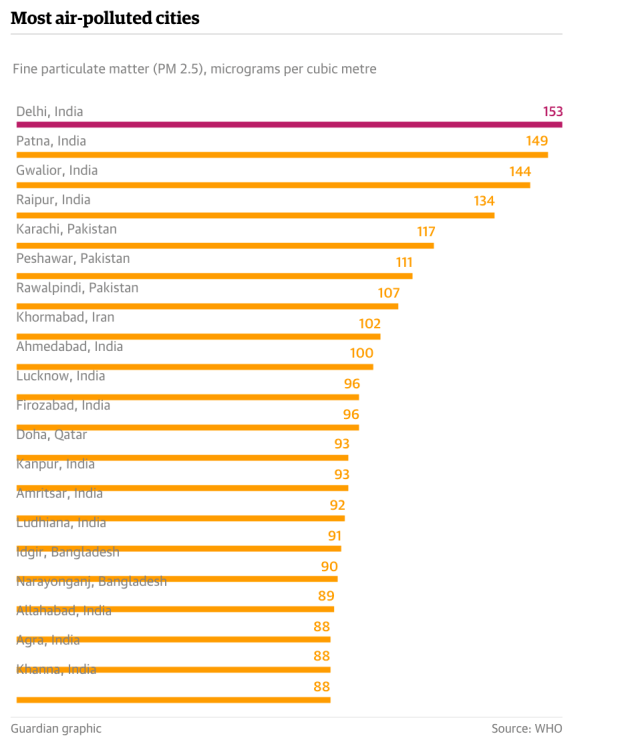
Screen Shot 2016-01-18 at 08.11.37

According to a recent WHO study, the cost of disease and the premature deaths caused in Europe every year by air pollution was more than $1.6trillion in 2010, nearly 10% of the gross domestic product of the EU in 2013. The UK was estimated to have suffered $83bn (£54bn) in costs associated with air pollution. Elsewhere in Europe, the figures were Germany $145bn, and France $53bn. The highest was in Bulgaria, which spent an estimated 29.5% of its GDP on the costs of air pollution fatalities.

More than 90% of citizens in the European region are exposed to annual levels of outdoor fine particulate matter above WHO’s air quality guidelines. This accounted for 482,000 premature deaths in 2012, from heart and respiratory diseases, blood vessel conditions and strokes, and lung cancer.

As concern over pollution grows, cities have begun to take action. On Friday, Delhi ended a two-week trial that took a third of the city’s three million private cars off the road by alternating entry to an odd and even number plates scheme and a ban on large diesel SUVs. City authorities said the trial resulted in a 50% drop in air pollution “primarily caused by vehicular traffic”, but this is disputed.

China has recognised the problem and copied western countries by moving power stations out of cities. This, along with years of heavy investment in renewable energy and increased fines for polluting industries, has improved air quality in some areas. However, away from big cities such as Beijing and Shanghai pollution is still bad.

“It was inevitable in places like London in the 19th century, when health was not considered so important,” says Neira. “But today it is irresponsible to allow it, and the argument of economic development is not valid. We need to develop a different culture in our cities. We need much better public policies.

“It needs social pressure and more awareness. There is no going back. People will not accept pollution. But not cities are aware how serious it is.”

If emissions continue to rise at current rates, the number of smog-induced deaths could double to more than six million a year by 2050, says Lelieveld.

“It is a grim scenario, but I doubt people will accept a doubling of pollution. It is a warning. Pollution is still getting worse, but the awareness is changing and there is a willingness to deal with the problem.”

Global picture

BEIJING

The Chinese capital has long suffered from serious air pollution from coal burning and industry, but embarrassment at the Olympic Games, the closure of many factories and the removal of power plants from the centre have drastically cut pollution levels. There is a new willingness to deal with it, but pollution remains a big public health threat and Beijing was one of 10 Chinese cities that declared an emergency red alert last month.

KABUL

The fast-growing Afghan capital city is one of the unhealthiest in the world, surrounded by hills that trap pollution for days on end and full of cars and buses burning low-quality fuel and millions of houses being warmed with wood and paraffin. According to doctors in the main hospital, air pollution is now the greatest cause of death, killing more than 3,000 people a year – more than from war, terrorism, road accidents or HIV and Aids. Air pollution is also bad in other Afghan cities such as Herat, Kandahar, Jalalabad and Mazar.

TEHRAN

Iranian cities are among the most polluted. Last month the air in Tehran was so bad the city shut all schools, put emergency services on full alert and advised people with cardiac and respiratory problems, as well as pregnant women, to remain indoors. Some of the pollution in the city of five million cars has been blamed on sanctions on imports of refined petrol. This, it is said, has led to the use of low-quality alternatives.

DHAKA

Bangladeshi cities such as Dhaka, Narayanganj and Gazipur are some of the most polluted and fastest growing in the world. Brick kilns, tyre burning, old cars and heavy traffic combine to make them dangerous to live in. “What good is a growth rate of 6% if the air is unbreathable and puts people at high risks of respiratory diseases and other health problems?” a recent editorial in the New Age newspaper asked.

LAGOS

Air pollution in the fast-growing Nigerian city, the largest in Africa, is reaching dangerous levels. But, as in many cities on the continent, there’s little monitoring of pollution and no accurate information on fuel consumption. Pollution is likely to be as bad as the worst of Indian and Chinese cities.

BAKERSFIELD

Los Angeles used to be notorious for its smogs but cleaner cars and better regulation has improved air quality. Some of the worst air in the US is now found in nearby Bakersfield in the San Joaquin Valley, a farming area surrounded by mountains that trap pollution from traffic and agricultural emissions. Warm weather often leads to dangerous photo-chemical smogs.

LIMA

Peru’s capital has the worst pollution in Latin America, according to a 2014 study by the World Health Organisation. Poor fuel, old buses and cars and the city’s geography between the Andes to the east and the Pacific Ocean to the west, all make the air foul at times. Nearly 80% of the estimated 5,000 deaths a year from pollution may be caused by the city’s fleet of old minivans and buses. The many poor areas are the most polluted and are often sited close to open waste dumps and other sources of pollution.

CAIRO

Air quality in the Egyptian capital city of more than seven million people is often 100 times above World Health Organisation safe limits. The toxic fumes of a million mostly old cars mixes with smoke from farmers burning rice straw, industrial pollutants and desert and construction work dust. Heart disease, stroke and respiratory infections are now among the top four causes of premature death in the capital. In August of last year, the Egyptian environment ministry declared a state of emergency to deal with a thick layer of pollution that hung over the city for days.

DELHI

With 9 million vehicles and 25 million people, Delhi is possibly the most polluted mega-city in the world, often covered in a foul-smelling toxic haze. The pollution was so bad last month that the city authorities imposed an on- and off-traffic system to try to reduce the number of cars of the choked roads. It also banned large diesel SUVs for two weeks but the full effects have not been analysed.

LONDON

Once known for its smogs because of massive coal burning, it is now plagued with noxious NO2 gas from hundreds of thousands of diesel engines and the particulates emitted by taxis, central heating systems and construction sites. The government does not expect the city to meet legal pollution levels until 2025. Last week London breached its own legal limit on air pollution for the whole of 2016 in just over seven days.

Source: Air pollution: a dark cloud of filth poisons the world’s cities | Global development | The Guardian

Posted in Africa, Air Quality, Asia, China, Europe, France, Germany, Health Effects of Air Pollution, India, Iran, Italy, Latin America, London, Middle East, Spain, UK, USA & Canada | Tagged , , , , , , , , , , , , , , , , , , , , , , , , , , , , , , , , , , , , , , , , | Leave a comment

Scotland’s most-polluted streets revealed amid call for cleaner air 

A list of Scotland’s most-polluted streets shows more must be done to improve air quality, campaigners say.

Friends of the Earth Scotland said the list showed many streets are still failing to meet safety standards, meaning the Scottish Government could face legal action.

The environmental group analysed official data for two harmful pollutants, nitrogen dioxide (NO2) and coarse particles (PM10) which are known to be linked with serious health problems including heart attacks, strokes, respiratory illness and early death.

Campaigner Emilia Hanna said: “Streets are breaking legal limits in each major city in Scotland, demonstrating just how serious and widespread Scotland’s air pollution health crisis is.

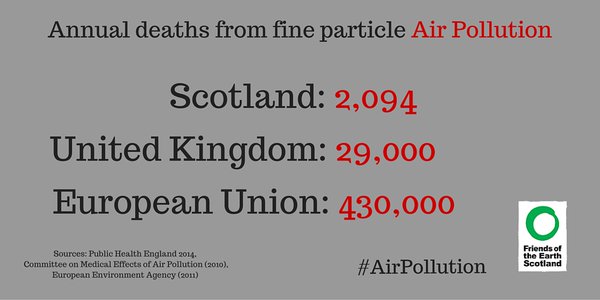
“Air pollution causes over 2000 early deaths in Scotland each year at a cost of over £1.1bn to the economy. Air pollution increases the risk of heart attacks, strokes and asthma attacks and the main culprit is traffic.”

The eight most polluted streets for nitrogen dioxide in 2015 were:

Edinburgh St John’s Road – 65

Glasgow Hope Street – 60

Dundee Seagate – 50

Perth Atholl Street – 48

Dundee Lochee Road – 48

Aberdeen Union Street – 46

Edinburgh Queensferry Road – 41

Aberdeen Wellington Road – 41


Figures are in micro grammes per cubic metre(μg/m3), with the Scottish Air Quality Objective being 18, meaning these locations all fail the objective.

display

Ms Hanna said: “St John’s Road in Edinburgh now has the unfortunate title of being the most polluted street in Scotland with nitrogen dioxide levels well above Scottish safety standards. Edinburgh Council needs to take much more drastic action, including looking at restricting the most polluting vehicles with a Low Emission Zone.

“Four years after we first started publishing the list of the most polluted streets, we still find illegal levels, often in the same locations year after year. These are streets where people live, work and relax. The repeat offenders show us that local councils and the Scottish Government are not treating this public health crisis seriously enough.

“Glasgow Council is no longer measuring harmful particle pollution (PM10) in Anderston near a primary school, and on Hope Street in the city centre. Both these streets last year broke the safety standards so it is very hard to understand why the monitors have been switched off in these key known problem areas. You can’t make a pollution problem go away just by ignoring it.”

Edinburgh resident Irene Orr, recently retired, is a long-term asthma sufferer. She relies on an extensive range of medication each day to manage the condition.

She said: “There is no doubt that the traffic in Edinburgh has an impact on my asthma. The very calm days are the worst as traffic fumes don’t disperse as well.

“One of the reasons I come to Corstorphine so rarely is because there is always traffic congestion on St John’s Road and it’s so polluted.”

Friends of the Earth Scotland is now calling on more support for clean-air initiatives across the country.

Ms Hanna said: “The government must support local authorities with funding to implement low emission zones in all major cities. It must also increase its investment in walking and cycling paths so that it becomes safer and more convenient for people to leave their cars at home.

“It is unacceptable that the Government is throwing £3bn at dualling the A9 while funding for walking, cycling and public transport and measures to improve air quality remains very low. That is why we are calling on the Scottish Government to reallocate a portion of its motorways budget to active travel in the next budget.”

Source: Scotland’s most-polluted streets revealed amid call for cleaner air | Scotland | News

Posted in Air Quality, Europe, UK | Tagged , , , , , , , , , , | Leave a comment

Shock figures to reveal deadly toll of global air pollution 

World Health Organisation describes new data as ‘health emergency’, with rising concern likely to influence decision over Heathrow expansion

The World Health Organisation has issued a stark new warning about deadly levels of pollution in many of the world’s biggest cities, claiming poor air quality is killing millions and threatening to overwhelm health services across the globe.

Before the release next month of figures that will show air pollution has worsened since 2014 in hundreds of already blighted urban areas, the WHO says there is now a global “public health emergency” that will have untold financial implications for governments.

The latest data, taken from 2,000 cities, will show further deterioration in many places as populations have grown, leaving large areas under clouds of smog created by a mix of transport fumes, construction dust, toxic gases from power generation and wood burning in homes.

The toxic haze blanketing cities could be clearly seen last week from the international space station. Last week it was also revealed that several streets in London had exceeded their annual limits for nitrogen dioxide emissions just a few days into 2016.

“We have a public health emergency in many countries from pollution. It’s dramatic, one of the biggest problems we are facing globally, with horrible future costs to society,” said Maria Neira, head of public health at the WHO, which is a specialist agency of the United Nations. “Air pollution leads to chronic diseases which require hospital space. Before, we knew that pollution was responsible for diseases like pneumonia and asthma. Now we know that it leads to bloodstream, heart and cardiovascular diseases, too – even dementia. We are storing up problems. These are chronic diseases that require hospital beds. The cost will be enormous,” said Neira.

Last week David Cameron, whose government has been accused of dragging its feet over air pollution and is facing legal challenges over alleged inaction, conceded in the Commons that the growing problem of air pollution in urban areas of the UK has implications for major policy decisions such as whether to expand Heathrow airport.

Asked by Tory MP Tania Mathias to pledge that he would never allow Heathrow to expand while nitrogen dioxide levels are risking the health of millions, Cameron said she was right to raise the matter, which was now “directly being taken on by the government”. Last December, after warnings from the Commons environmental audit committee and others, Cameron put off a decision on Heathrow expansion for at least another six months.

Government sources say Cameron and other ministers are now taking the air pollution issue far more seriously. In 2014 the prime minister was widely criticised for describing it as “a naturally occurring weather phenomenon”.

According to the UN, there are now 3.3 million premature deaths every year from air pollution, about three-quarters of which are from strokes and heart attacks. With nearly 1.4 million deaths a year, China has the most air pollution fatalities, followed by India with 645,000 and Pakistan with 110,000.

In Britain, where latest figures suggest that around 29,000 people a year die prematurely from particulate pollution and thousands more from long-term exposure to nitrogen dioxide gas, emitted largely by diesel engines, the government is being taken to court over its intention to delay addressing pollution for at least 10 years.

The NGO ClientEarth, which last year forced ministers to come up with fresh plans to tackle illegal nitrogen dioxide levels in British cities, said that it would seek urgent court action because the proposed solutions would take so long to implement and produce cleaner environments. Under the latest government plan, announced before Christmas, the Department for Environment, Food and Rural Affairs (Defra) promised clean air zones for five cities by 2020 in addition to one already planned for London. But this will mean it will years before cities such as Manchester, Cardiff and Edinburgh feel the benefits.

Frank Kelly, director of the environmental health research group at King’s College London, and an adviser to several governments on the health risks of pollution, told the Observer that air pollution had become a “global plague”. “It affects everyone, above all people in cities. As the world becomes more urbanised, it is becoming worse.”

Sotiris Vardoulakis, head of Public Health England’s environmental change department, said: “It’s the leading environmental health risk factor in the UK, responsible for 5% of all adult mortality. If we take action to reduce it, it will have multiple health co-benefits like lower greenhouse gas emissions and healthier cities. Air pollution has an impact on NHS spending, but we have not quantified it.”

A new report from the EU’s European Environment Agency (EEA) says pollution is now also the single largest environmental health risk in Europe, responsible for more than 430,000 premature deaths. “It shortens people’s lifespan and contributes to serious illnesses such as heart disease, respiratory problems and cancer. It also has considerable economic impacts, increasing medical costs and reducing productivity,” said the EEA director Hans Bruyninckx.

Leading economist Lord Stern said air pollution was an important factor in climate change. “Air pollution is of fundamental importance. We are only just learning about the scale of the toxicity of coal and diesel. We know that in China, 4,000 people a day die of air pollution. In India it is far worse. This is a deep, deep problem,” he said.

The latest scientific research, published in the journal Nature, suggests that air pollution now kills more people a year than malaria and HIV combined, and in many countries accounts for roughly 10 times more deaths than road accidents.

According to the WHO, air quality is deteriorating around the world to the point where only one in eight people live in cities that meet recommended air pollution levels.

On Monday the shadow chancellor, John McDonnell, will give evidence in a trial of 13 climate change activists who occupied a Heathrow runway in July, delaying or cancelling flights. The Labour MP, whose Hayes and Harlington constituency includes Heathrow airport, has been a prominent opponent of the airport’s expansion and has strongly backed local residents who are resisting a third runway. At a rally in October he said: “In my constituency at the moment, people are literally dying. They’re dying because the air has already been poisoned by the aviation industry.”


Source: Shock figures to reveal deadly toll of global air pollution | Environment | The Guardian

Posted in Air Quality, Europe, London, UK | Tagged , , , , , , , , , , , | Leave a comment

Air pollution and traffic fumes tied to infertility risk

Women who live close to major highways where the air is polluted by traffic exhaust fumes may be slightly more likely to have fertility problems than women who live further away where the air is cleaner, a U.S. study suggests.

Researchers followed more than 36,000 women from 1993 until 2003 and analyzed air pollution and traffic exhaust near their homes to see if what they breathed might be connected to their ability to conceive.

Over the study period, there were about 2,500 reported cases of infertility. Women who lived close to a major roadway – within 199 meters, or about a tenth of a mile – were 11 percent more likely to experience this problem than women who lived farther from a highway, the study found.

“The risks are slight,” said study leader Dr. Shruthi Mahalingaiah, a researcher at Boston University School of Medicine, in an email.

But even the slight increased risk can present a big global public health problem, said Mark Nieuwenhuijsen, a researcher at the Center for Research in Environmental Epidemiology and the Barcelona Institute for Global Health.

“For an individual woman the results may not be that important because the risk of infertility only increases slightly, but for society as a whole it is important because so many women are exposed to air pollution,” Nieuwenhuijsen added by email.

To look at the link between infertility and air pollution, Mahalingaiah and colleagues examined data on what’s known as particulate matter – a mixture of solid particles and liquid droplets that can include dust, dirt, soot and smoke – near women’s homes and also assessed how close their residences were to major roads.

They focused on what’s known as primary infertility, when women try to conceive for at least a year without success, as well as secondary infertility, which refers to couples who struggle with conception after having at least one prior pregnancy.

When women lived close to major roads, they were 5 percent more likely to report primary infertility, an increase in risk that wasn’t statistically significant, meaning it might have been due to chance.

But these women were 21 percent more likely to report secondary infertility than women who lived farther away, and that increase was statistically significant, researchers report in the journal Human Reproduction.

This association was found even at relatively low concentrations of particulate matter, or less polluted air, although the connection became stronger as the pollution levels increased.

One limitation of the study, however, is that researchers didn’t know the exact dates when conception efforts started or infertility was diagnosed, making it difficult to closely examine how the timing of pollution exposure might influence the odds of pregnancy.

While the study is one of the first of its kind to follow so many women over such a long period of time, more research is needed before making medical recommendations based on the results, Mahalingaiah said.

Even so, the findings add to a growing body of evidence suggesting that pollution can negatively impact conception efforts, said Dr. Sajal Gupta, a researcher at Cleveland Clinic in Ohio who wasn’t involved in the study.

“Couples suffering from infertility need to exercise caution especially if they are residing in areas with high ambient particulate matter,” Gupta said by email. “Relocating to areas with low contamination of particulate matter is an alternative to prevent adverse impact on fertility.”

Infertility is just one of many health problems tied to air pollution, noted Christopher Somers, a biology researcher at the University of Regina in Canada who wasn’t involved in the study.

“Air pollution is worse near major roads with high traffic volumes, so avoid living in these areas if you can,” Somers said by email. “If this is not an option, pay attention to air quality advisories and adjust outdoor activities accordingly.”

Source: Air pollution and traffic fumes tied to infertility risk | Reuters

Posted in Air Quality, Health Effects of Air Pollution, Medical Studies | Tagged , , | Leave a comment

London breaches air pollution limit for the whole of 2016 in just over seven days 

Motorists are responsible for deadly air pollution in the capital

Motorists are responsible for deadly air pollution in the capital

London breached its own legal limit on air pollution for the whole of 2016 in just over seven days, according to worrying new figures.

Under EU rules the capital is allowed to exceed the maximum safe levels of nitrous oxide for 18 hours a year – an allocation it had burned through by the peak of the morning rush hour on Friday 8 January.

Putney High Street and Knightsbridge were the first two areas to report breaches. Last year Oxford Street reported a breach within two days of the new year beginning.

Last year the Committee on the Medical Effects of Air Pollutants warned the Government that as many as 60,000 early deaths a year are caused by air pollution across the UK.

The number, higher than previously thought, was calculated by including the effects of Nitrous Oxide in the death toll for the first time.

Despite mounting evidence of their dangers, motor vehicles are still permitted in city centres – including in central London.

Boris Johnson has plans to bring in an “ultra low emission zone” in central London but the plan will not be rolled out until 2020.

Additionally, that rule will not completely ban motor traffic – instead charging the most polluting vehicles £100 a day if they drive in central London.

Both Labour and Conservative 2016 London mayoral candidates Sadiq Khan and Zac Goldsmith have said they would like to pedestrianise Oxford Street – Britain’s most polluted street.

Cities around the world have taken more dramatic action to save lives, however. An emergency scheme was rolled out in Paris last year to ban half of cars from the road on alternating days until pollution subsided.

Simon Birkett, founder and director of campaign group Clean Air in London, said: “It is breathtaking that toxic air pollution has breached the legal limit for a whole calendar year within a few days.

“Worse, several air pollution monitors have been vying for the dubious honour of recording the first officially monitored breach of the nitrogen dioxide legal limit in the world in 2016.

“Oxford Street would have been first again if it hadn’t been ‘offline’ since last Sunday afternoon – possibly due to vandalism of the scientific equipment.”

Dr Penny Woods, chief executive of the British Lung Foundation,  said: “We’ve seen pollution limits broken repeatedly in areas such as Oxford Street and Putney High Street over recent years. Given that so little has been done to address the crisis, it is no surprise that London has already reached its air pollution limits.

“Unless we clean up public transport by speeding up the introduction of cleaner buses and taxis, and invest in infrastructure for cyclists, we will be in this same position next year, and the year after.

“Air pollution causes tens of thousands of early deaths every year, increases the risk of lung cancer and impairs child lung development. Given the severity of the problem, immediate action must be taken by the government.”

Mr Johnson has cited air pollution from Heathrow airport as one reason for not expanding the airport.

His administration has also increased the number of hybrid buses serving Transport for London routes, improved alternative routes for bicycles, and is mandating new taxis to go zero-emission from 2018.

Source: London breaches air pollution limit for the whole of 2016 in just over seven days | UK Politics | News | The Independent

Posted in Air Quality, London, UK | Tagged , , , , , , , , , | Leave a comment

Air pollution: UK environment ministers face court action within weeks 

Law firm ClientEarth says it will seek urgent court action because of the risk to people’s lives from dangerous emissions

UK environment ministers will be taken to court within weeks to make them speed up plans to reduce dangerous urban air pollution.

Law firm ClientEarth, which last year forced the Department for the Environment, Food and Rural Affairs (Defra) to come up with fresh plans to tackle illegal NO2 levels in British cities, warned that it would seek urgent court action because thousands of people’s lives were at risk if present government plans were not strengthened.

Under new plans revealed before Christmas, Defra promised clean air zones for five cities by 2020 in addition to one already planned for London. But it will still take at least five years to clean up pollution in many cities, including Manchester, Cardiff and Edinburgh.

“The government seem to think that the health of people in cities like Glasgow, Manchester and Bristol is less important than that of people in London. While London gets a clean air zone covering all vehicles, Birmingham gets a second-class zone and Derby and Southampton third-class, while other areas including Manchester and Liverpool are left out. We all have the same right to breathe clean air,” said Alan Andrews of ClientEarth.

Andrews said that ClientEarth would go to the high court by 17 March and would ask for the case to be fast-tracked because people’s lives were at risk. Nearly 6,000 people die prematurely each year in London alone because of NO2,according to one study.

“They [the government] have had since 2011. We are looking for a hearing this year, hopefully before the summer. This is such an urgent issue.

“The supreme court ordered government to take immediate action. These plans are an outrageous statement … that the government doesn’t intend to comply as soon as possible. It is an arrogant response that is simply not good enough,” he said.

In an article for the Guardian on Wednesday, barrister Justine Thornton, the wife of former Labour party leader Ed Miliband, says air pollution is a political scandal which the courts should resolve.

“The government is still putting short-term political priorities ahead of public health and people’s lives. The revised air pollution plan soft pedals on pollution by private motorists while the government appears intent on watering down European legal limits for vehicle emissions.

“The stage is set for a fascinating tussle between law and politics. The UK court will have to roll up its sleeves and decide whether this government is doing what it can to make our air as safe as possible,” wrote Thornton, who will next month formally become a QC.

“Ten more years of dangerous air pollution in London puts a whole generation of children at risk. The quality of the air that our children breathe is too important to be decided behind closed doors by government and vehicle manufacturers,” she wrote.

NO2 pollution limits for the whole year were breached in Putney high street and Knightsbridge last week. These state that maximum hourly nitrogen dioxide concentrations are not exceeded for more than 18 hours a year.

Source: Air pollution: UK environment ministers face court action within weeks | Environment | The Guardian

Posted in Air Quality, Europe, London, UK | Tagged , , , , , , , | Leave a comment